BYD Seal, the Chinese saloon taking on the Tesla Model 3
 Rafa Guitart @GuitartRafa
4 September 2023
9 min.
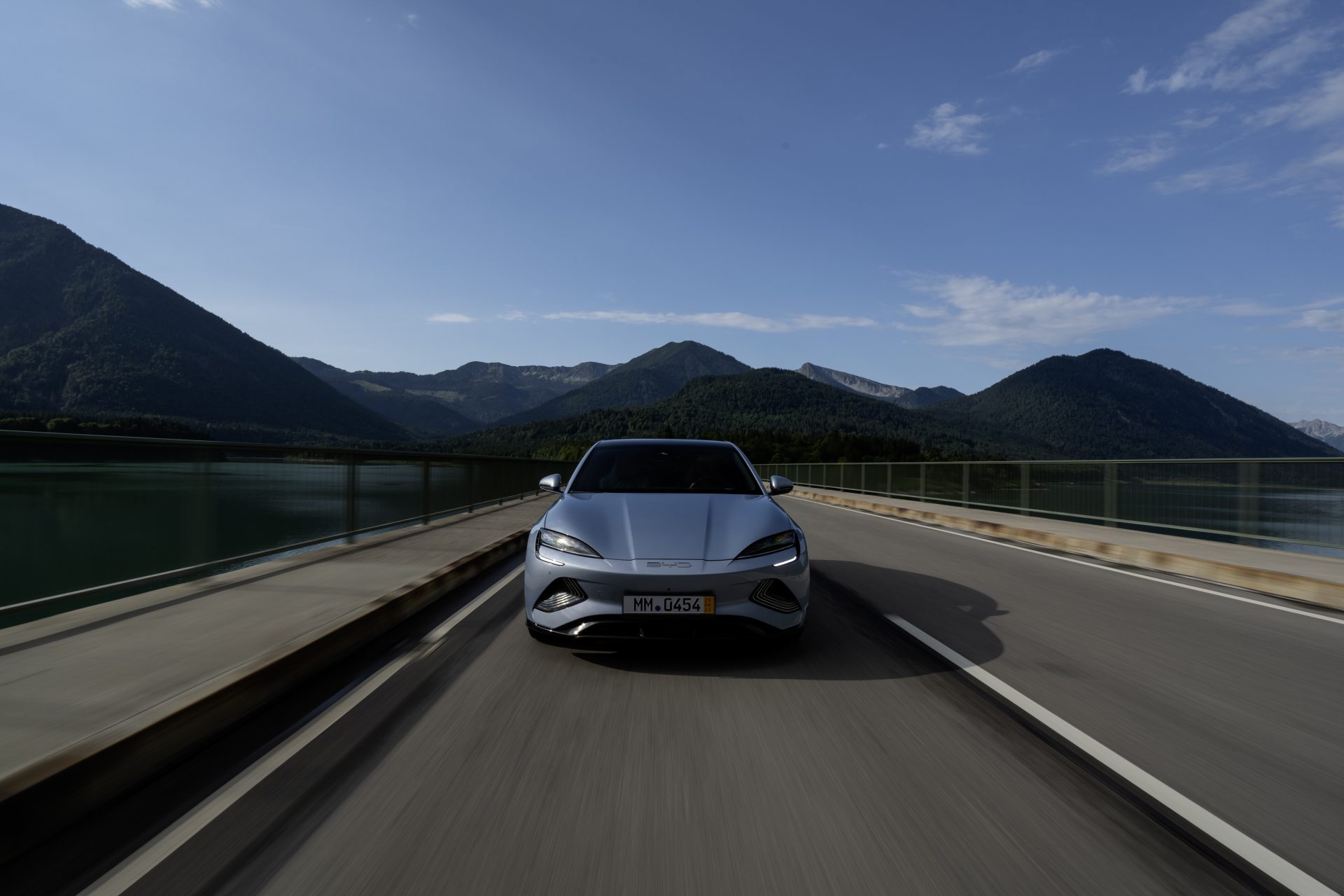
Initially it will offer rear-wheel drive versions with 230 kW and all-wheel drive versions with 390 kW, both powered by an 82.5 kWh battery, allowing ranges of up to 570 km (RWD)
The new Seal, the most complete, refined and interesting model from the Chinese BYD, a specialist in electric cars, sits in the D-segment, positioned very close to a successful model such as the Tesla Model 3, which was recently updated. It measures 4.80 metres long, 1.87 m wide and 1.46 m high, that is, 8 cm longer, 2 cm wider and 2 cm taller than the American brand’s model, while its boot capacity is 400 litres, to which an additional 35 litres at the front of the vehicle are added.
Its configuration is very similar, that is, a four-door saloon; a body style that has fallen out of favour in Europe, but which Tesla has managed to revive with its successful electric model. It is the second model in the Ocean series from BYD to use the brand’s new “Ocean Aesthetics” design language, with an elegant look and a high standard of equipment as standard.
It will initially be available in two versions with an identical 82.5 kWh battery, Design and Excellence, and two drive systems: rear-wheel drive for the Design and all-wheel drive for the Excellence. The first has a 230 kW electric motor (313 CV), promises a 0 to 100 km/h acceleration in 5.9 seconds and a combined-cycle range of 570 km (WLTP). The all-wheel drive Excellence-AWD variant has an electric motor on the front axle and another on the rear (160 kW + 230 kW), with a total power of 390 kW (530 CV), a 0 to 100 km/h acceleration in 3.8 seconds and a combined-cycle range of 520 km. Later on, in mid-2024, a more affordable Confort version with a 61 kWh battery will go on sale.
Like the earlier Atto 3 and Dolphin, the Seal uses the 3.0 e-Platform from BYD, designed for 100% electric vehicles with Cell-to-Body technology, in which the battery forms part of the structure. It integrates the top cover of the battery pack into the chassis structure, forming an assembly that incorporates the top cover, the Blade Battery and the bottom cover, also acting as part of the vehicle’s structure. The battery acts as a body element, which allows the vehicle’s height to be reduced by about 15 mm.
The Seal is the second European model in the BYD Ocean series to adopt the Ocean Aesthetics design language, led by Wolfgang Egger, designed to improve efficiency. Proof of this is that it claims an aerodynamic drag coefficient of 0.219 Cx, thanks to the body shape, the faired underbody and the flush-fitting door handles, and very low consumption figures, which in the case of the less powerful version are 14.4 kWh/100 km, rising to 15.8 kWh/100 km for the all-wheel drive version.
Refined interior
Thanks to its wheelbase of 2,920 mm, the Seal offers rear legroom similar to that of an E-segment saloon. Its boot is not especially large, as it offers 400 litres of capacity, and has a low loading lip as it is a four-door saloon. However, it has a small additional front boot under the bonnet, a “frunk” with a lid, of 53 litres. It has numerous storage spaces in the cabin, a wireless charging system for two mobile phones and a compartment under the central armrest.
It features leather-upholstered seats, with the front ones ventilated and heated and a sporty look, and the driver’s seat offers electric adjustment in eight positions, plus electrically adjustable lumbar support.
As standard, both versions include a large panoramic sunroof, double-layer laminated glass for the front door windows and tinted rear windows. In addition, it has a infotainment system with 4G connectivity for over-the-air (OTA) wireless updates, a 15.6″ screen with electric rotation, voice control and smartphone integration for Android or Apple, and a 12-speaker Dynaudio Performance audio system.
In terms of safety and driver assistance systems, it comes as standard with a forward collision warning system, autonomous emergency braking, rear collision warning, rear cross-traffic alert and automatic rear cross-traffic braking, a lane keeping assistant, lane change assist and preventive lane keeping, automatic high beam control and adaptive headlights.
Also standard are adaptive cruise control and intelligent cruise control, a 360-degree camera, a blind-spot detection system, ESP, traction control, hill descent control, automatic hill hold, speed limit warning and intelligent speed limit control.
High-capacity blade battery
Developed by BYD, the LFP cell Blade Battery promises a longer service life, superior performance and better use of space. It consists of 172 elongated cells arranged like blades. It has greater thermal stability, offers greater resistance to extreme temperatures, is less sensitive to temperature fluctuations and withstands more charge and discharge cycles than conventional lithium-ion batteries.
In addition, it comes as standard with a very efficient heat pump system that allows the battery to be cooled and heated directly from the coolant, as well as cabin climate control with low energy consumption. It can absorb residual heat from the engine and operates at temperatures between -30 °C and 60 °C. Among other functions, it features a V2L system that can act as a portable power source for electrical devices drawing up to 3 kW.
As in other models from the brand, it has an 8-in-1 electric drive system, which integrates eight of the components for propulsion, charging, control and energy management. It comes as standard with an onboard charger of up to 11 kW for three-phase alternating current, although it can also be charged with direct current at a maximum power of 150 kW.
Good handling
To cope with the enormous power delivered by its drive system (313 or 530 CV), it has an independent double-wishbone front suspension and a five-link multi-link rear suspension, which in the case of the most powerful variant is complemented by adaptive hydraulic dampers with variable stiffness, higher-performance 19-inch tyres and an intelligent torque distribution system iTAC (Intelligent Torque Adaption Control), which can reduce torque delivery or brake a wheel if necessary to improve stability.
It has four driving modes to adapt the car to usage preferences and driving conditions: Eco, which prioritises efficiency and extends range; Normal, which provides balanced operation; Sport, which improves performance with a more responsive accelerator and a sportier steering feel; and Snow, which improves traction on slippery surfaces.
During the first contact we only had the opportunity to drive the most powerful variant, with 530 CV and all-wheel drive, a version that we found thoroughly satisfying in terms of finish, refinement, driving pleasure and dynamic behaviour. It is true that, on paper, 530 CV may seem an outrageous and uncontrollable figure, but the truth is that at no point does one feel any loss of control. Firstly, because the power delivery is very linear; although the acceleration is spectacular, reaching 100 km/h in just 3.8 seconds, the traction it provides is really excellent, even on slightly wet roads, as we had the chance to test in the Bavarian region of Germany.
Add to this a very direct and precise steering, with two modes: normal and sport, reasonably firm suspension to control body movements when cornering with some agility, and brakes with astonishing stopping power. Overall, the Seal conveys solidity, precision and a very high level of performance, especially in terms of acceleration, although its top speed is limited to 180 km/h, though it allows some margin in reserve.
We did not have the opportunity to measure consumption accurately, but based on the on-board computer readings, the total average recorded was 20.5 kWh/100 km, which is not bad at all considering we were driving briskly throughout on motorway and inter-urban sections. Following this pattern of driving, we would be in the region of 400 km of real-world range, which is not bad at all for a model of this type and such a high power level.
BYD is already present in 21 countries with electric models and announces spectacular network growth, with more than 250 dealerships by the end of this year and a forecast of exceeding 500 by the end of 2024. The Seal comes with a 6-year full warranty and 8 years for the battery and electric motors.
In Spain it will reach dealerships during the fourth quarter, with deliveries starting in November in its two engine types and two trim levels (Design and Excellence-AWD), with six different body colours (four of them standard) and two interior finishes in light or dark tones. For the Design version, rear-wheel drive with 313 CV, the price, excluding aid, is 46,990 euros, while the top-of-the-range version, with all-wheel drive and 530 CV, costs 48,990 euros.
Both versions have very similar equipment, with the main differences focused on the drive system, rear or all-wheel, and power levels, 313 or 530 CV. Features such as the head-up display, adaptive suspension, intelligent torque control and Hankook tyres are specific to the Excellence-AWD version.
Technical specifications of this car


 Peugeot E-208 GTi: a battery-powered toy that revives the spirit of the 1980s sports cars
 New Lexus ES: luxury grows and goes electric
 First contact with the Dacia Sandero Hybrid 155: power and efficiency from €19,890
Deja un comentario