BMW Sedans Coches clásicos Reports
History of the BMW 3 Series, Part II (from 1990 to the present)
 Pablo David González
3 April 2011
6 min.
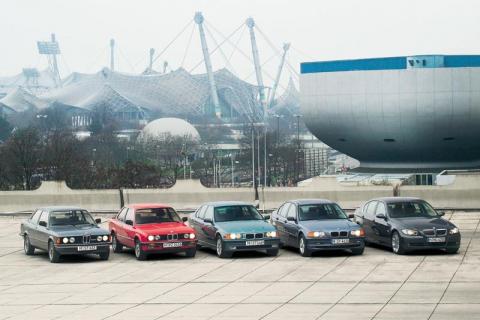
The passing of time is inexorable, but at BMW research and development never stop either. We leave behind the 1970s and 1980s (see part I) and dive fully into the 1990s to continue up to the present day. Let’s see how the story goes on.
Third generation (E36), 1990 to 2000
This is the first 3 Series with faired-in headlights and a significantly longer and more spacious body than the two previous generations (for reference, the four-door saloon measures 4,470 mm in length). In 1992 the two-door version arrived, called the coupé, and a few months later the convertible and the M3 appeared. In 1994 the 3 Series Compact (almost 20 cm shorter than the saloon) made its debut, and in 1995 the estate (called Touring).
Initially it was only available with petrol engines, in a range configured as follows: 316i (99 CV), 318i (113 CV), 320i (150 CV) and 325i (192 CV). Excluding the M3, in 1994 the top of the range was capped by the 328i with 193 CV (replacing the 325i). Over the years these were updated and new engines were also introduced.
All six-cylinder engines (320i onwards) now came equipped with double overhead camshafts and four valves per cylinder. The coupé versions debuted the VANOS variable valve timing system, which improved the torque curve and delivery as well as reducing consumption.
The first diesel arrived in 1991. This was the 325td, an inline six-cylinder with 115 CV. In 1993 the 325tds (143 CV) appeared, and in 1994 the 318tds (four cylinders and 90 CV).
The new M3 went on sale in 1992. Initially it had a six-cylinder engine (S50 B30), 2,990 cm3 and 286 CV. The 0-100 km/h sprint took 5.9 seconds and top speed was electronically limited to 250 km/h. Four years later, in 1996, it received an engine update (S50 B32). With the changes, displacement rose to 3,201 cm3 and power to 321 CV. The 0-100 km/h time now fell by four tenths of a second.
Importantly, in 1997 the SMG sequential manual gearbox (developed by Getrag) was introduced for the M3, available as an alternative to the six-speed manual.
Fourth generation (E46), 1998 to 2006
Just before summer 1998, in May, the fourth generation arrived. Again it offered an evolution with improvements in power, performance, consumption, comfort and safety. It was four centimetres longer and wider than its predecessor, growth that extended proportionally to the interior. Its development was led by Chris Bangle.
Both the four- and six-cylinder engines underwent a thorough renewal (M43 TU and M52 TU respectively). In addition, with the engine known as the M47, BMW introduced its first direct-injection diesel.
The initial petrol range consisted of two four-cylinder engines (316i with 105 CV and 318i with 118 CV) and three six-cylinder engines (320i with 150 CV, 323i with 170 CV and 328i with 193 CV). In 2000 the top of the range (excluding the M3), the 330i, arrived. It was available in all body styles (saloon, estate, coupé and convertible) and produced 231 CV. It could also be paired with all-wheel drive.
The most significant technological contribution in the six-cylinder engines was double VANOS. Thanks to this technology the engines delivered fuller output across the whole rev range and fuel efficiency was improved.
The only diesel sold at first was the 320d with 136 CV. But the range gradually grew, its extremes at the end of the commercial period being the 318d (116 CV) and the 330d (204 CV). The 320d became one of the star versions, as it was the one that debuted direct injection. The move to Common Rail diesel came with the 330d in 1999. Diesel engines also powered the coupé and convertible versions.
In 2002 came the facelift, and on that occasion the 316i, 318i and 320i received new and more powerful engines. The coupé and convertible had to wait until 2004 for aesthetic changes.
As for the M3, which appeared in 2000, it used an inline six-cylinder engine (S54 B32) with 3,246 cm3 and 342 CV. It was the naturally aspirated engine with the highest specific output BMW had ever created up to that point. It was available in saloon, coupé and convertible bodies with either a six-speed manual gearbox or the six-speed SMG II. The 0-100 km/h time was reduced, in the best case, to 5.2 seconds (with the manual gearbox).
In 2002 the M3 CSL arrived, a lightened and more powerful version of the standard M3. With 360 CV, performance improved noticeably: 0-100 km/h in 4.8 seconds and 0-200 km/h in 16.7 seconds.
Fifth generation (E90), 2005 to the present
The latest one, the one that can currently be bought, so I will go into less detail. It was presented at the 2005 Geneva Motor Show, showing a design completely different from its predecessor. This new generation introduced the term “BMW EfficientDynamics” as a synonym for energy efficiency and sportiness at the same time. This concept is the reason all petrol engines feature high-pressure direct injection (330i and 325i with six cylinders, and 320i and 318i with four cylinders). In the 335i, direct injection is combined with TwinPower Turbo and Valvetronic technology, resulting in one of the best engines built in recent times.
From 2010 onwards all engines met the Euro V emissions standard. Technologies that helped achieve this included brake energy recovery and automatic start-stop (the latter only available with the manual gearbox). The 320d became the leader in performance-to-consumption ratio. With 163 CV of power it returns an average consumption of 4.1 l/100 km (109 g/km of CO2).
For its part, the M3 mounted a V8 engine for the first time in its history (S65 B40). Available from 2008, it produces 420 CV at 8,300 rpm and can go from 0-100 km/h in 4.9 seconds. As an option, a seven-speed double-clutch automatic gearbox (DKG) was offered, which achieved 0-100 km/h in 4.7 seconds.
There is little left before the arrival of the sixth generation. I have no doubt that it too will be imbued with the essence of the 3 Series. Nearly 40 years of history filled with triumphs and success, and everything suggests there are many more to come.
Sources | BMW and Wikipedia


 Peugeot E-208 GTi: a battery-powered toy that revives the spirit of the 1980s sports cars
 New Lexus ES: luxury grows and goes electric
 First contact with the Dacia Sandero Hybrid 155: power and efficiency from €19,890
un comentario
Deja un comentario
El caso del 328 i el mejor auto sedan de BMW con sus proporciones y potencia
equilibrada- un clasico hoy todavia buscado en modelos 2000 y 2001-