SEAT Compact Range / versions Historia Rallyes
It has been 25 years since SEAT reached the top flight of the World Rally Championship with this SEAT Córdoba WRC
 Óscar Sanz
23 October 2023
4 min.
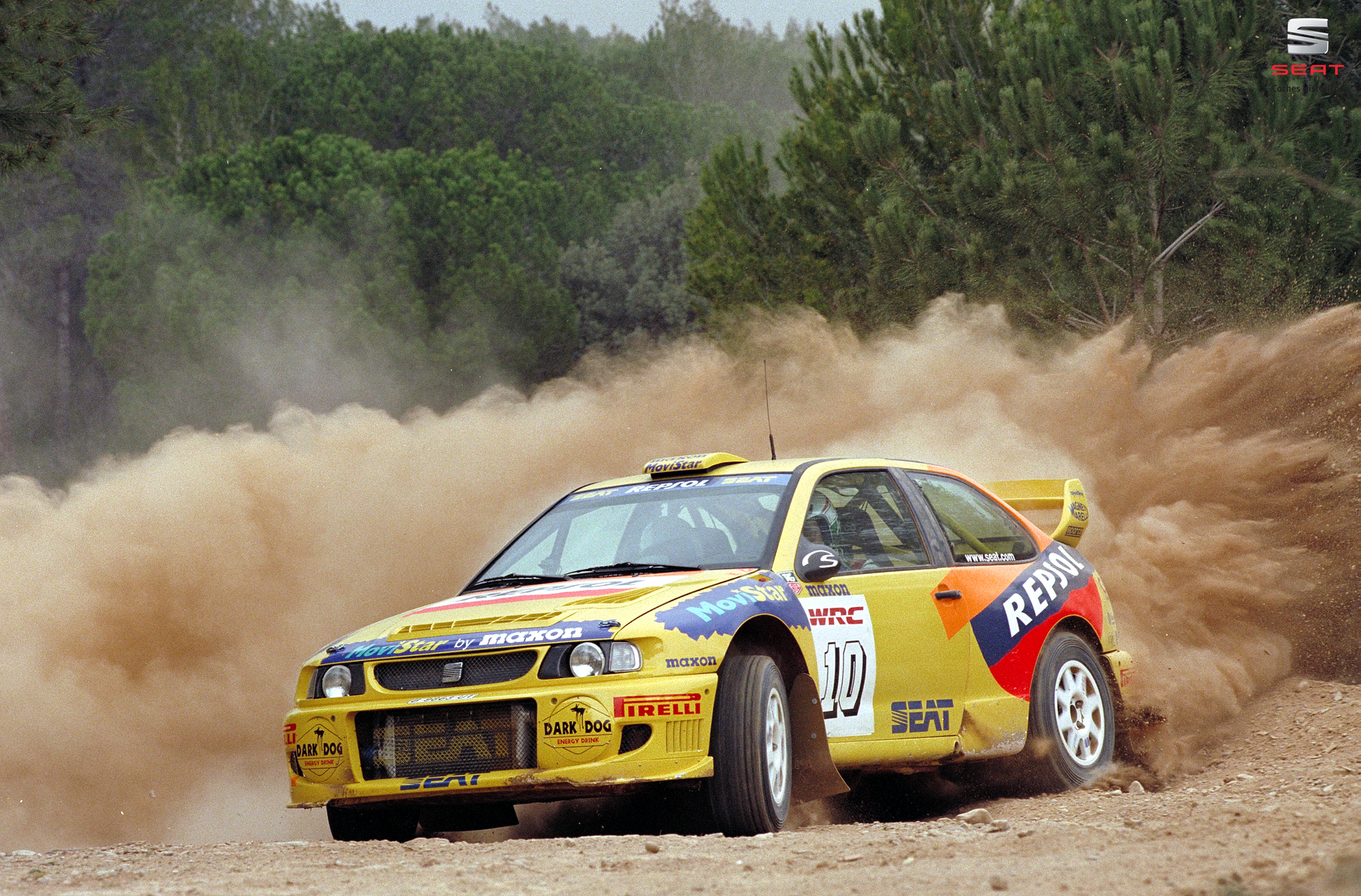
A look back at the glory years of the car that made history in the World Rally Car, exactly 25 years ago, is never out of place
A quarter of a century ago, SEAT entered the history books of motorsport by becoming the first Spanish brand to take on the giants of the FIA World Rally Championship (WRC). Not only did they take part, they also won. The legend began with the SEAT Ibiza Kit Car, which secured two consecutive titles in the FIA World Cup for 2-Litre Rallies in 1996 and 1997. However, SEAT had greater ambitions, and in 1998 they took a bold step that would mark the history of the brand.
The adoption of the new World Rally Car regulations in 1997 marked a turning point by allowing manufacturers to develop a rally prototype based on a series-production model. Initially, SEAT considered using the Ibiza, but the regulations required a base vehicle more than four metres long. Therefore, SEAT chose the Córdoba SX 2.0 16v as the basis for its new project. Transformed into a 4×4 with a 300 CV turbo engine, the SEAT Córdoba WRC debuted in May 1998 at the Porto Motor Show, impressing everyone with its aggressive styling and its distinctive Bengal Yellow colour.
While it continued its success in the 2-Litre World Cup with the Ibiza Kit Car, SEAT introduced the “SEAT WRC” into competition. Its debut at the 1998 Rally of Finland marked the start of an exciting journey of development and refinement for the following season. The 1999 season began strongly, with the SEAT Córdoba WRC achieving its first overall podium at the Rally of New Zealand, thanks to Toni Gardemeister.
The SEAT Córdoba WRC Evo2 replaced its predecessor in Finland and remained in competition until the Rally of New Zealand, before being succeeded by the Córdoba WRC Evo3. The latter, launched in 2000, featured significant improvements, from the engine to weight distribution and the cabin. The SEAT Córdoba WRC completed its final season at the Rally of Great Britain, where four cars lined up in an emotional farewell.
The history of the incredible Seat Córdoba WRC
The SEAT Córdoba WRC, a true titan of rallying, was divided into three notable evolutions: the Evo1, Evo2 and Evo3. The first, homologated in August 1998, made its debut at the 1998 Rally of Finland and ended its career at the 1999 Rally of New Zealand. Equipped with a 1,995 cc, 4-cylinder in-line engine, this vehicle delivered 300 CV at 5,300 rpm and a maximum torque of 470.7 Nm at 3,500 rpm. Its transmission featured all-wheel drive and a 6-speed sequential Hewland gearbox, while its suspension used Öhlins gas-hydraulic springs and dampers. The front brakes featured 378 mm diameter ventilated discs with 6-piston AP calipers on tarmac. It also rode on Speedline alloy wheels, 18” on tarmac and 15” on gravel. Its dimensions were 4,150 mm long, 1,770 mm wide, 1,500 mm high, with a wheelbase of 2,443 mm, and a minimum weight of 1,230 kg under the regulations.
The Evo2, homologated in August 1999, debuted at the 1999 Rally of Finland and ended its career at the 2000 Rally of New Zealand. Sharing the same engine as the Evo1, with 300 CV at 5,300 rpm and 470.7 Nm of maximum torque at 3,500 rpm, it featured significant improvements to its front braking system with 378 mm diameter ventilated discs and 8-piston AP calipers on tarmac. Its dimensions saw slight variations, measuring 4,170 mm long, 1,770 mm wide, 1,400 mm high, with a wheelbase of 2,443 mm and a minimum weight of 1,230 kg under the regulations.
Finally, the Evo3, homologated in August 2000, debuted at the 2000 Rally of Finland and concluded its career at the 2000 Rally of Great Britain. Like its predecessors, it featured a 1,995 cc, 4-cylinder in-line engine, delivering 300 CV at 5,300 rpm and 539 Nm of maximum torque at 3,500 rpm. The transmission featured all-wheel drive and a 6-speed sequential Hewland gearbox with joystick-type shifting. The front brakes featured 378 mm diameter ventilated discs and 8-piston AP calipers on tarmac. The dimensions remained practically the same, at 4,170 mm long, 1,770 mm wide, 1,400 mm high, a wheelbase of 2,443 mm, and a minimum weight of 1,230 kg under the regulations. These evolutions of the SEAT Córdoba WRC proved to be true feats of engineering, taking SEAT’s competition spirit to new heights in the world of rallying.
SEAT Córdoba WRC image gallery


 Kia offers an electric range of 10 models, 50 versions and 400 possible combinations
 The seven finalists for the 2027 European Car of the Year (COTY) are exclusively electric
 Peugeot E-208 GTi: a battery-powered toy that revives the spirit of the 1980s sports cars
Deja un comentario