Hyundai Inster Electric Cars Tests SUV Urban
It is the new electric urban SUV from Hyundai, called the INSTER, and it is one of the cars that has surprised me most recently
 Antonio Roncero @roncero_antonio
19 February 2025
8 min.
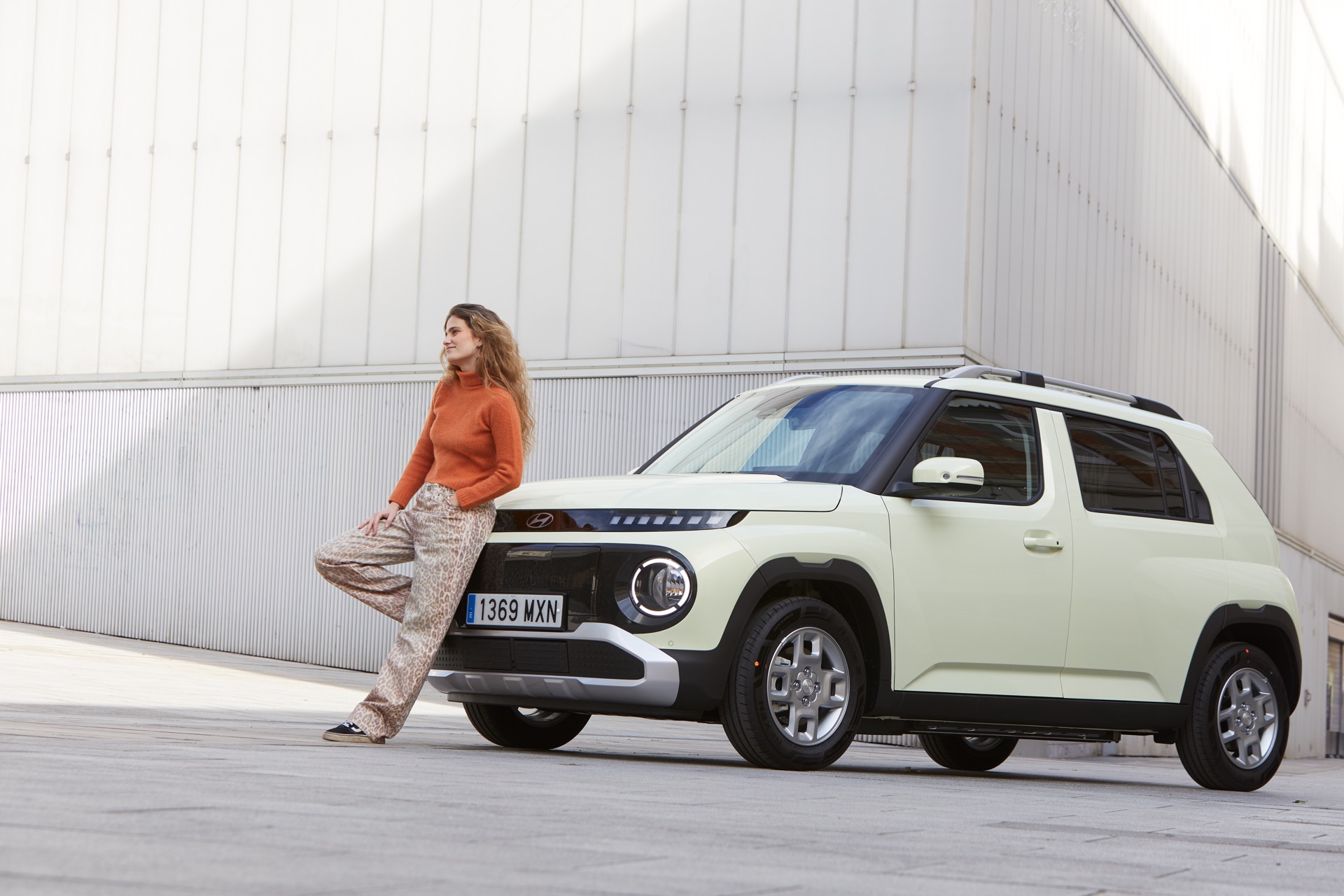
Hyundai had quite a surprise in store for us with the new Inster. Because I have to admit that, at the start of a year full of novelties of all kinds, the small urban SUV from Hyundai is one of the cars that has surprised me most, ahead of cars with far greater technological content and, at least on paper, more “passionate” character. In just 3.83 metres of length, the Hyundai Inster fulfils its purpose to perfection, which is to let us move with great agility around the city. Its main rivals also do this, such as the Dacia Spring, the Citroën ë-C3 , the Leapmotor T03 or the Renault 5 E-TECH.
But the Inster has “something more”. Or rather, “a lot more”. Because the small Hyundai is a car that is not only likeable and eye-catching for its design. Just get behind the wheel and look at its offer to see that it provides a quality of finish and equipment possibilities well above the standards you would expect from an urban car. And you do not need to cover many kilometres to discover that it is not afraid of journeys on country roads or motorways either. In addition, it offers interior space and versatility that many cars, electric or not, longer than 4 metres would envy. But let us take things one step at a time.
Small on the outside, big (very big) on the inside
Let us return to its exterior dimensions and proportions. I have already said it measures 3.82 metres long, but proportionally it is narrow (1.61 metres) and tall (1.57 metres), which, together with details such as the roof bars, gives it a certain SUV air that is amplified in the interesting Inster Cross version, with specific design elements that give it a much more adventurous look. The wheelbase is 2.58 metres, which pushes the wheels almost to the corners and leaves very short overhangs.
The best thing is for you to judge for yourself from the images. But whether you like it or not, you will surely agree with me that aesthetically it is, to say the least, a striking car. Not as much as a Renault 5 E-TECH, on that we agree, but it attracts many glances, and in the short time the first test drive lasted, largely through central Madrid, it seemed to me that it mainly catches the attention of women. The available colours also play a big part in the fresh, original image of the Inster, with six new shades for the brand, some as eye-catching as Abyss Pearl Black, Buttercream Pearl Yellow, Siena Orange metallic or Aero Matt Silver. The front pillar can be painted black on some versions, while the wheels range from 15 to 17 inches.
But where the Inster really stands out is inside, and not just for space. It is a real surprise to see how Hyundai has managed to make the most of the Inster’s cabin. Despite being a narrow car, occupants in the front seats have plenty of room, without that sense of being too close together that you do get, for example, in a Dacia Spring. Headroom is also very good, with space to spare even for taller occupants. And the two rear seats are incredible, with very comfortable seats and more legroom than any car of its size… and than many that exceed 4 metres in length. Furthermore, with the ability to slide the rear bench longitudinally by up to 16 centimetres, you can favour passenger space or boot space. It is also possible to recline the backrests of these seats for more comfortable travel, or fold the front seatbacks forward to carry long objects.
Boot capacity ranges from 238 litres in the least favourable position for luggage (and the best for passengers, with the bench slid back and the backrests reclined) up to 351 litres with the rear seats moved forward and the backrests in their normal position, a position that in no way eliminates the possibility of still using the rear seats. With the rear seats folded, boot volume exceeds 1,000 litres. Incredible.
And since we are on the subject of the interior, I also want to mention another aspect in which the Inster seems to me to be ahead of its rivals: the quality of finish and the sense of good build and fit. Hyundai achieves this very easily by using many of the controls, trims, buttons, switches and materials that we find in higher-end models, such as the Hyundai IONIQ 5, to name just one from the brand’s electric range. I like the configuration with two independent 10.25-inch screens, the multimedia system in an elevated position, and conventional physical controls kept for the infotainment and climate control so you do not have to navigate through menus. It is a pity that the connection to Apple CarPlay and Android Auto is wired, although that has an easy and inexpensive solution using one of the many adapters on the market that make the connection wireless.
Up to 370 km of combined range… and more than 500 km in the city
The Inster is available in two engine and battery versions. The standard 97 hp (71.3 kW) version is paired with a 42 kWh battery, giving a WLTP combined range of 327 km, and up to 473 km in the city. The more powerful version, with 115 hp (84.6 kW), has a battery with slightly more capacity, 49 kWh, which raises the range to 370 km (518 km in the city). Both offer the same maximum torque, 147 Nm. Top speed is limited to 140 km/h on the less powerful version, which accelerates from 0 to 100 km/h in 11.7 seconds. The figures for the more powerful one are 150 km/h and 10.6 seconds, respectively. The announced homologated consumption figures are very low, between 14.3 and 14.9 kWh/100 km.
The integrated on-board charger is 11 kW, and it supports DC fast charging – up to 75 kW or up to 85 kW depending on the battery – which allows recovery from 10 to 80% charge in half an hour in both versions. A Vehicle-to-load (V2L) function is available as an option, with a power outlet inside the vehicle (in the lower centre console), or via an adapter to power external equipment or devices. A heat pump is also optionally available.
In a first test drive I was able to drive the Inster with the most powerful engine in the best-equipped version, and the feeling behind the wheel is excellent. As a good small car, thanks to its size and a favourable turning circle, it handles with great ease in the city. But at least this 115 hp version, and I would dare say the less powerful one will not be far behind, also does not shy away from country roads or motorways, where it shows the footing and composure of a larger car. There are four driving modes – Eco, Normal, Sport and Snow – and, as in the rest of the brand’s electric range, the Inster also has steering-wheel paddles that let you choose between different levels of regenerative braking, including an automatic one and an “i-pedal” mode that is very practical in the city, which even allows the car to come to a complete stop without using the brake pedal. As for consumption, pending a more thorough test, the Inster seems content with very little energy, and exceeding 300 km on a single charge – I am talking about the most powerful version – in mixed use, or reaching 450 km in the city, will not be hard.
Equipment and prices of the Hyundai Inster
There are three trim levels available: Klass, Maxx and Tecno. The entry-level Klass trim is only offered with the less powerful version, the Tecno is reserved for the 115 hp one, while the intermediate Maxx trim can be chosen with both engines. This is the range configuration and prices, including campaigns and discounts, but excluding possible purchase aid under the MOVES Plan, which would bring the starting price down to 15,780 euros at best.
- Inster 97 hp 42 kWh Klass: €24,990
- Inster 97 hp 42 kWh Maxx: €26,690
- Inster 115 hp 49 kWh Maxx: €28,000
- Inster 115 hp 49 kWh Tecno: €31,600
All versions come with very extensive standard equipment, including the two digital screens, active cruise control, parking sensors and keyless entry. The intermediate trim is worth considering, as it adds elements such as alloy wheels, heated steering wheel and front seats, electrically folding exterior mirrors and wireless phone charging. Tecno versions add LED headlights, V2L bidirectional charging, 360-degree camera, interior ambient lighting system, blind-spot detection and rear cross-traffic collision prevention assistant, among other features.
Nor should we forget the benefits of Hyundai’s “Always Plugged In” Plan, which includes interesting services – that also add value – such as a free charger and installation, 5 years of free roadside assistance and a 5-year vehicle warranty with no mileage limit. The high-voltage battery warranty is 8 years.
Hyundai Inster – Image gallery
Technical specifications of this car


 Kia offers an electric range of 10 models, 50 versions and 400 possible combinations
 The seven finalists for the 2027 European Car of the Year (COTY) are exclusively electric
 Peugeot E-208 GTi: a battery-powered toy that revives the spirit of the 1980s sports cars
Deja un comentario