Ë-Berlingo Berlingo Citroen Partner Peugeot Electric Cars Comparisons Furgonetas Tests
Peugeot e-Partner vs Citroen ë-Berlingo: comparison of small electric vans for urban self-employed workers
 Iván Navarro
8 November 2026
5 min.
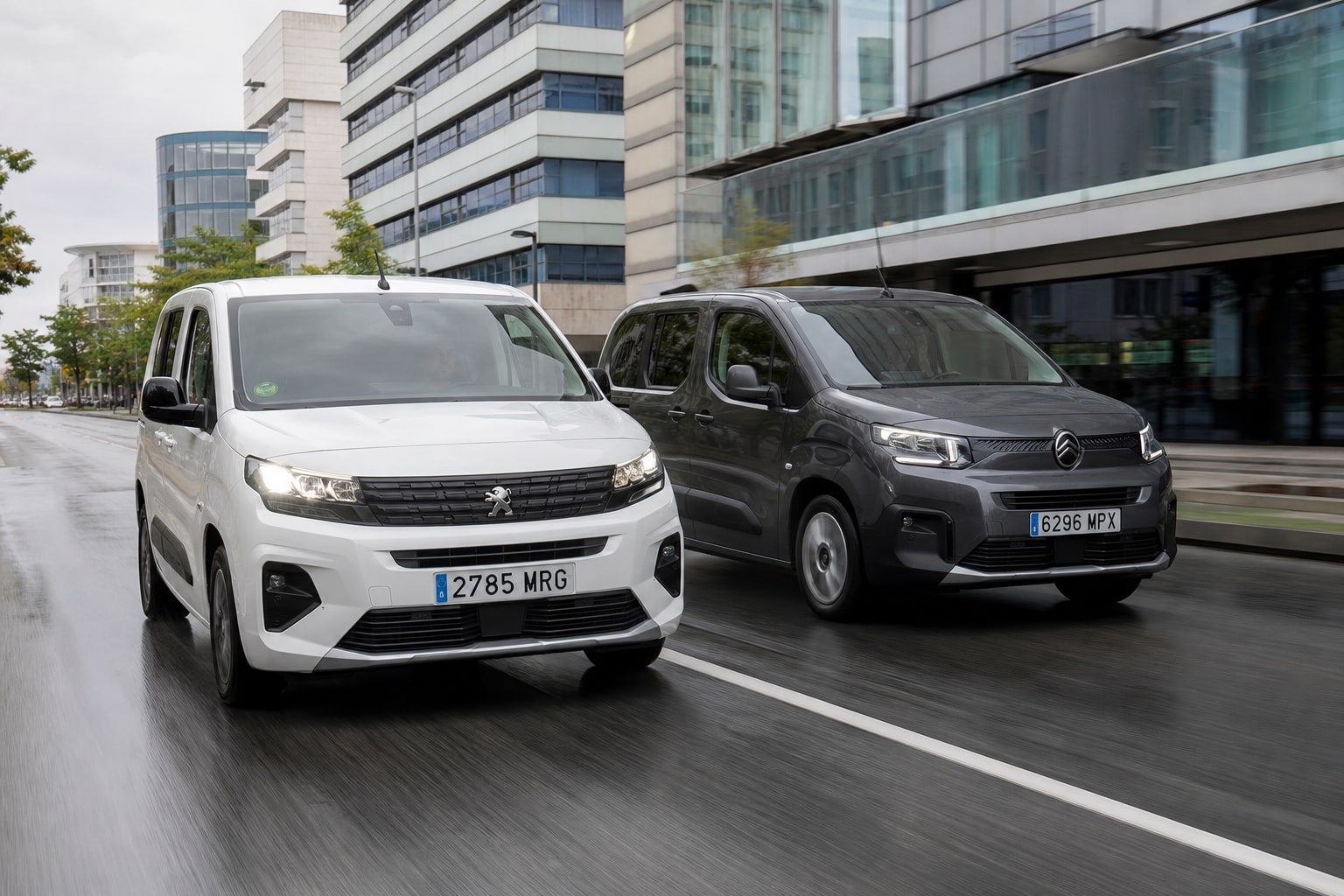
We compare the Peugeot e-Partner and the Citroën ë-Berlingo, two electric vans that are twins mechanically but differ in character, price and ergonomics for the self-employed courier working in the city.
Every week, the same questions come up at any Stellantis dealership in the city: should I get the Peugeot or the Citroën? The doubt makes sense. They share a platform, a motor and even the same battery pack, but they are sold with different messages and, above all, at different prices. Let’s separate what is really behind the badge from what truly benefits a self-employed worker who needs to move goods around the centre without paying ZBE charges or fuel.
Two vans, one platform: what they really share
The Peugeot e-Partner and the Citroën ë-Berlingo are built on Stellantis’ EMP2 platform, and that shows in everything you cannot see. Same 100 kW (136 CV) electric motor, same body philosophy, same compact van approach designed for stop-start city driving rather than crossing the peninsula. The homologated range is around 340 km (up to 343 km WLTP in the most favourable versions) in both cases, which in real urban use, with stops, starts and some rear cargo, translates into a full working day of deliveries without ever touching a fast charger. The differences lie in the details: battery size, suspension tuning, interior finish and, of course, price.
Peugeot e-Partner: specs and price from €38,000
The Furgón M Carga Incrementada 136 50kWh version delivers a real 136 CV and a 50 kWh battery that backs up that 340 km of homologated range (up to 343 km WLTP). The starting RRP is around €38,000, the more expensive of the two, although Peugeot justifies it with an interior that feels a step above in perceived quality.
| Model | Power (kW) | Power (CV) | Top speed | Range | Battery | Fuel |
|---|---|---|---|---|---|---|
| Peugeot e-Partner Furgón M 136 50kWh | 100 kW | 136 CV | ≈135 km/h | ≈340 km (up to 343 km) | 50 kWh | Electric |
Citroën ë-Berlingo: specs and price from €36,000
The ë-Berlingo N1 Talla M 136 50kWh You! starts from an indicative RRP of €36,000, two thousand euros less than its French sibling with the lion on the badge. Same 100 kW and 136 CV, same homologated range of around 340 km (up to 343 km WLTP), with a 50 kWh battery (some spec sheets quote a slightly higher nominal capacity) and a top speed of around 135 km/h, which in the city is no practical limitation at all.
| Model | Power (kW) | Power (CV) | Top speed | Range | Battery | Fuel |
|---|---|---|---|---|---|---|
| Citroën ë-Berlingo N1 Talla M 136 50kWh You! | 100 kW | 136 CV | ≈135 km/h | ≈340 km (up to 343 km) | 50 kWh | Electric |
i-Cockpit vs conventional dashboard: ergonomics make the difference
Here there is a real difference, not just marketing. The Peugeot features its characteristic i-Cockpit: a small steering wheel and an elevated instrument cluster that you read over the top of the rim rather than through it. People either love it or find it uncomfortable, there is no middle ground, and for a driver who gets in and out of the van twenty times a day, that initial adjustment matters. The Citroën, by contrast, opts for a much more conventional dashboard, with the instrumentation behind the steering wheel in the traditional position. In my view, in a working vehicle where immediate familiarity is worth its weight in gold, Citroën’s approach is more practical. That said, the Peugeot conveys a superior sense of modernity the moment you sit down.
Range and charging: which performs better in urban delivery?
On paper, a technical tie: around 340 km homologated (up to 343 km WLTP) in both. In practice, both start from a 50 kWh battery, so the real-world margin is very similar. For parcel delivery in central Madrid or Barcelona, with routes of 80-120 km a day, either one is more than enough without needing to recharge at midday.
Price and incentives: Plan Auto+ and the RRP warning
The €38,000 of the e-Partner and the €36,000 of the ë-Berlingo are indicative manufacturer’s recommended retail prices, without dealer discounts, one-off campaigns or public aid. It is worth keeping this in mind before comparing figures with what you will actually pay in the contract. The Plan Auto+ can significantly reduce the final outlay for self-employed workers who meet the current requirements; the exact amount should always be checked on the official plan website, as it changes over time.
Payload and daily use for the self-employed
Neither loses any meaningful load capacity from carrying batteries under the floor, one of the advantages of starting from a platform designed from the outset for electrification. For those who currently deliver with medium diesel vans and are considering the switch to electric, the change in habits is smaller than it seems: same routes, same cargo volume, far lower energy cost per kilometre.
Comparison table and verdict
| Model | Power | Range | Battery | Price from | Score |
|---|---|---|---|---|---|
| Peugeot e-Partner | 136 CV | ≈340 km | 50 kWh | €38,000 | 7.8/10 |
| Citroën ë-Berlingo | 136 CV | ≈340 km | 50 kWh | €36,000 | 8.1/10 |
In our view, the ë-Berlingo takes the extra point on price, but anyone who values a more distinctive ergonomic layout and a superior perceived finish will not go wrong paying the premium for the e-Partner. There is no absolute winner, just two personalities built on the same mechanical base.
Frequently asked questions
Which is cheaper, the Peugeot e-Partner or the Citroën ë-Berlingo?
The ë-Berlingo starts from an indicative RRP of €36,000, about €2,000 below the e-Partner, which is around €38,000. Both prices are indicative manufacturer RRPs, with no discounts or aid applied.
Do they have the same range?
Yes, both are homologated at around 340 km (up to 343 km WLTP), with a 50 kWh battery in both cases.
What real difference is there beyond the design?
The most notable is the ergonomics of the driving position: the Peugeot uses the i-Cockpit with a small steering wheel and elevated cluster, while the Citroën keeps a conventional dashboard that is more familiar to any driver.
Can I access the Plan Auto+ with either of them?
Both are electric vehicles that, in principle, fit within the Plan Auto+ framework for self-employed workers and businesses, although you should confirm the requirements and current amount on the official website before closing the purchase.
Technical specifications of the cars in this article


 Kia offers an electric range of 10 models, 50 versions and 400 possible combinations
 The seven finalists for the 2027 European Car of the Year (COTY) are exclusively electric
 Peugeot E-208 GTi: a battery-powered toy that revives the spirit of the 1980s sports cars
Deja un comentario