Review and opinion: Jeep Avenger e-Hybrid, a city SUV for escaping the city
 Antonio Roncero @roncero_antonio
24 April 2025
10 min.
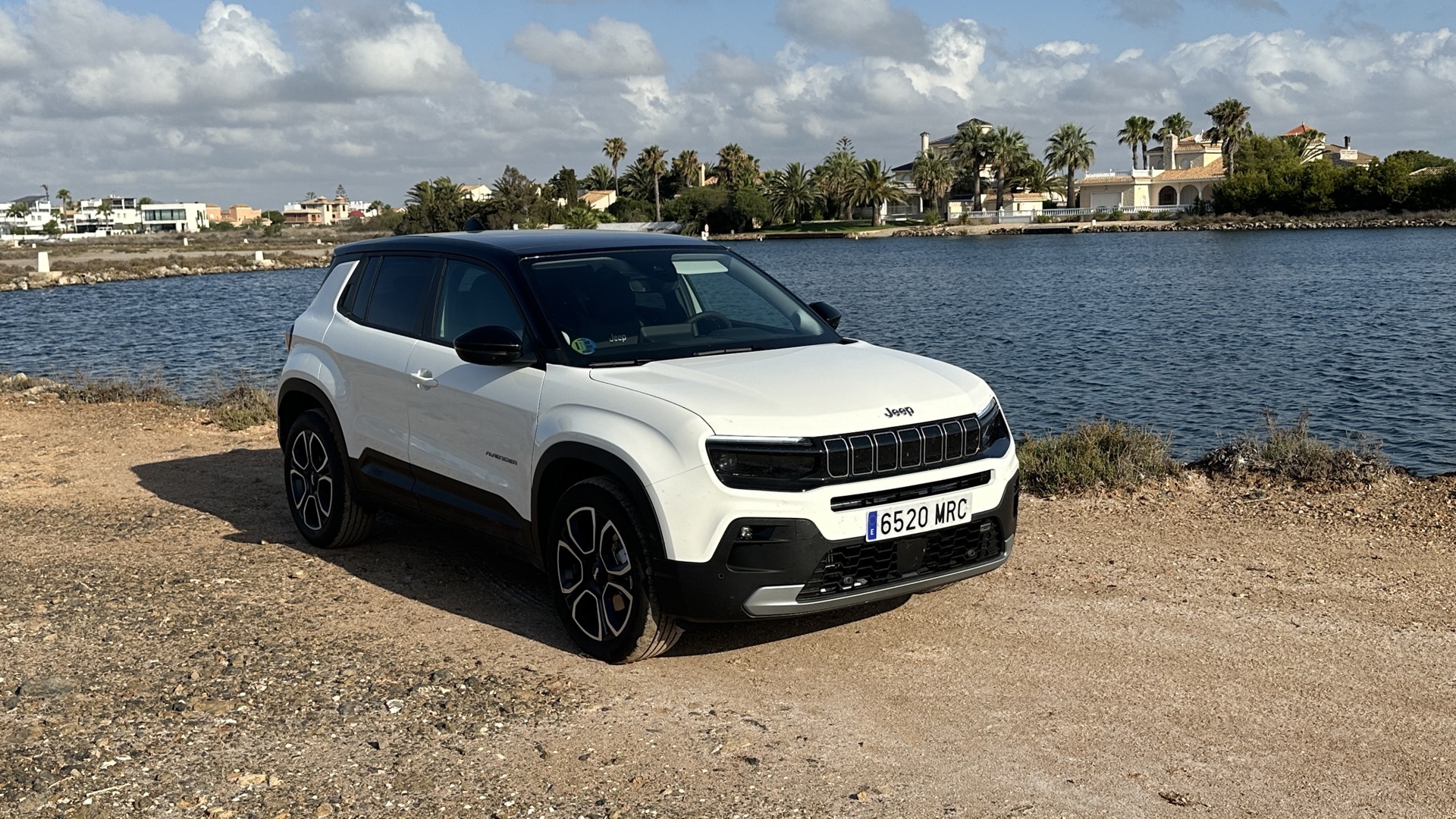
The e-Hybrid version with mild hybridisation and ECO label is the most recommendable in the Avenger range, and it turns the small city SUV from Jeep into a good car for all kinds of use.
The smallest of the Jeep range keeps “growing”: the range now includes a petrol version with no hybridisation at all, the Avenger e-Hybrid with 48-volt mild hybrid technology, the all-wheel-drive variant Avenger 4xe recently added to the range, and the 100% electric Avenger version, the Avenger Full-Electric.
Of all of them, the most recommendable is the Jeep Avenger e-Hybrid, which is also very well positioned against rivals in this category, such as the Ford Puma, the Toyoya Yaris Cross or its “cousins” with which it shares engine and platform: the Opel Mokka and the Peugeot 2008.
Several days living day to day with the Avenger e-Hybrid, including a trip with the boot well loaded, have allowed me to confirm the good impressions this version left on me during the first contact, and to verify that this Jeep can be a good car for all kinds of use if you don’t have great space requirements.
Range and prices of the Jeep Avenger e-Hybrid
The Avenger e-Hybrid sits in the range between the 1.2 Turbo 100 CV version with no hybridisation and the new Avenger 4xe. Compared with the former, it costs 2,000 euros more for the same equipment, but there is no doubt: you get a car that is much more pleasant to drive and with better performance, which also clearly uses less fuel, with automatic gearbox as standard and ECO label from the DGT. I would only consider the 1.2 Turbo without hybridisation as an alternative if the dealership offered me a very large discount… and I was going to use the car mainly in the city.
As for the Avenger 4xe, the difference is more than 6,000 euros for having a slightly more powerful petrol engine (136 CV), a second 28 CV electric motor to provide all-wheel drive (there is no mechanical connection between the front and rear axles, and the rear suspension becomes multi-link), and a special exterior trim. It may be an option for the more “adventurous”, but don’t think you’ll get much further off the tarmac or in difficult conditions -snow or ice- than with the Avenger e-Hybrid fitted with good All Season tyres, for example.
The prices of the Avenger e-Hybrid are as follows:
- Avenger e-Hybrid Longitude: 27,100 €
- Avenger e-Hybrid Altitude: 29,100 €
- Avenger e-Hybrid Summit: 33,500 €
Although the Longitude trim already comes very complete, my recommendation would be to take the step up to the Altitude, which for 2,000 euros more already includes adaptive cruise control, 17-inch wheels, LED fog lights, 180-degree rear camera with panoramic view and automatic high beams, as well as upholstery and interior trim with a better presence.
The Summit versions add 18-inch wheels, a sunroof, full-LED headlights, the infotainment pack, a 360-degree camera or interior ambient lighting, but they cost almost 4,500 euros more than the Altitude, on which you can always fit the panoramic roof (1,000 euros), the Leather & Winter pack (1,330 euros) or the Infotainment Pack (1,500 euros) as separate options.
The Jeep Avenger e-Hybrid inside
At just 4.08 metres long, 1.78 metres wide and 1.53 metres high, you cannot expect a very spacious cabin from the Avenger. Its weak point is the rear seats, with little space sideways and for the legs, which makes them not very recommendable for adults. Furthermore, access to these seats is not comfortable, because the opening to get in is small and the doors open little. They are perfectly valid for children, or for fitting child seats.
In the front seats there is no problem, with a driving position closer to that of a saloon than to an SUV and all the seat and steering wheel adjustments to find yourself comfortable. As for the boot, its 380-litre capacity is not far from the best in the category, and it gives a lot of flexibility thanks to its very regular shapes. The floor can be placed at two heights, and the backrests fold down very easily in sections against the bench, which stays fixed. In my case, I can say that I ended up fitting all the luggage I wanted to take on the trip without having to fold any of the seats, as I had initially planned to do.
The dashboard design is simple and pleasant, and it can be personalised with a painted trim available in different colours that runs across its full width, to give it a less serious and more eye-catching look. I like that a row of physical controls is kept to operate the main air-conditioning functions without having to go through the touchscreen, although for others, such as choosing the air outlets, you do have to. And I don’t like so much how the transmission controls are resolved, which are large buttons placed below those of the air conditioning. The problem here is that if you want to switch between the “D” and “B” gearbox modes while driving to change the intensity of engine braking, they are far apart and in the end you give up on it.
Otherwise, the seats don’t hold you as much in corners as you might think from their design, but they have seemed comfortable to me for long journeys -this unit had leather upholstery-, there are many practical spaces to empty your pockets (especially in the centre console), and the multimedia system is correct, although it would benefit from a menu organisation with a bit more logic or faster operation, especially when moving between the different screens and, above all, the operation of the car’s navigation. The integration with Android Auto and Apple CarPlay works very well, and in my case I always end up using external navigation apps, such as Waze. The instrument screen, also digital and 10.5 inches (7.5 inches with the entry-level trim) does not offer many configuration possibilities, but it shows the necessary information clearly and without complications.
For this year 2025, the Avenger range has received some improvements, among which the integration of ChatGPT into the voice assistant stands out, as well as simplifying the list of options and improving standard equipment. What does not change is the materials used in the interior. I think it was a good opportunity to introduce some soft-plastic covering, which would improve the sense of quality the Avenger conveys inside, where all the parts are hard plastic with a simple look, although there are no complaints regarding fit and finish.
At the wheel of the Jeep Avenger e-Hybrid
It seems incredible how a “simple” mild hybrid system has transformed a car that, with the 1.2 engine without hybridisation and a manual gearbox, never quite convinces. And I say “simple” because, despite its name, the Avenger e-Hybrid is not a conventional hybrid, like for example those of Toyota. But this technology, an evolution of the first mild-hybrid systems in which the electric motor could not propel the vehicle on its own at any time, is proving to be a magnificent alternative. Many models from the Stellantis group brands use it, and Audi itself is integrating its system, called MHEV plus, into its new launches.
Now, the Avenger e-Hybrid is very pleasant to drive in the city, it responds on the road with the car loaded with much more composure than you might expect for its official 110 CV of power, and it uses very little fuel. The secret is an electric motor of almost 30 CV that is capable of driving the wheels on its own, and is not only used to start moving or to travel at low speed -up to about 1 km and without exceeding 30 km/h- without burning petrol, but also assists the petrol engine. If you sharpen your senses a little you can notice that transition between the car starting to move solely on the electric motor and when the combustion engine comes into action. Once under way nothing is noticeable; the only “clue” will be given by the instrumentation, where an indicator shows the percentage of kilometres covered during the journey in which the car has been propelled by electricity, with the combustion engine switched off.
The brand says that in the city up to 50% can run in electric mode, but this sounds like the homologated consumption figures, and the figure would be far from reality. In fact, the Avenger uses very little in the city, around 6.5 l/100 km. If it really drove half the time in electric mode, the figure would be much lower. And while we’re on consumption, it’s worth noting that on the motorway, using active cruise control -which, incidentally, works very well at keeping the car centred in the lane and maintaining distance- I achieved an average of 7.1 l/100 km over about 1,500 km, using active cruise control and ECO mode. Another figure: over the 3,000 km recorded by the on-board computer since the last reset before returning the car, the cumulative average consumption was 6.9 l/100 km. That is more than 1 l/100 km difference with the 100 CV Avenger 1.2 without hybridisation, which also goes much less. Really, the Avenger e-Hybrid uses very little.
The driving modes are selected from a button on the centre console, and besides Eco we can choose the Normal and Sport programmes. You notice a difference in thrust, and also in the way the gearbox behaves, which can also be operated manually via the paddles on the steering wheel. In certain situations, for example if you need to accelerate hard, the engine noise goes from being barely noticeable to making itself heard, but never in an annoying way or one that compromises comfort. In normal driving situations you notice more, for example the aerodynamic noise if you’re travelling light, or the rolling and suspension noise when crossing rough surfaces, potholes or lying policemen, as if there were little insulation. I liked the feel of the brakes, although at first you have to adapt and get the feel for them, because the initial braking when you don’t need to press the pedal hard is handled by the energy recovery system, and the difference is somewhat noticeable. I also found the LED headlights, standard on the top trim, magnificent for night driving.
And if I want to leave the tarmac? Well, the truth is that the 200 mm of ground clearance, favourable body angles (20 degrees approach and 34 departure), the hill descent control and the specific driving modes Sand, Mud and Snow, which adjust traction control and throttle response, give it a lot of versatility. Not enough for serious adventures, but enough to drive with reasonable confidence on tracks and paths in good condition.
Jeep Avenger e-Hybrid | Image gallery
Technical specifications of this car


 Peugeot E-208 GTi: a battery-powered toy that revives the spirit of the 1980s sports cars
 New Lexus ES: luxury grows and goes electric
 First contact with the Dacia Sandero Hybrid 155: power and efficiency from €19,890
Deja un comentario