SEAT tests shared mobility services in Sant Cugat del Vallès
 Jaime Gomez
20 July 2017
3 min.
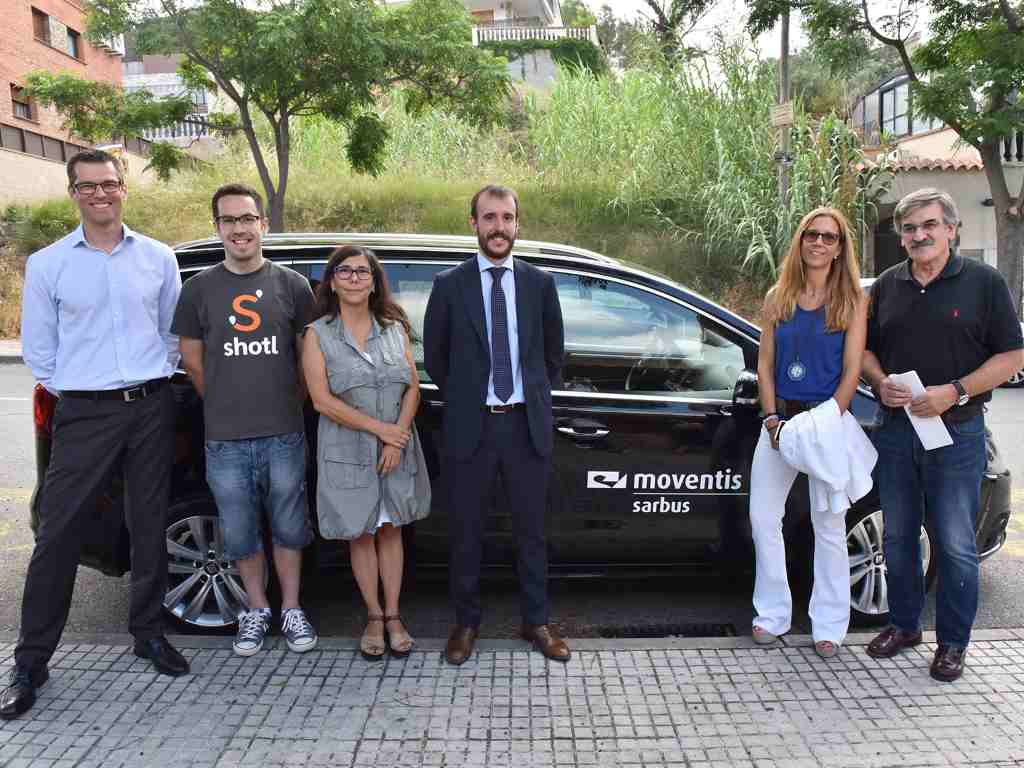
SEAT will study, in Sant Cugat del Vallès, a city pioneering its transformation into a SmartCity in Spain, a new shared mobility service with the Alhambra.
In collaboration with Shotl, Moventis and Media Urban SL, SEAT is set to launch a shared mobility service in Can Barata (Sant Cugat del Vallès, Barcelona), one of Spain’s pioneering towns for becoming a SmartCity in Spain. For one month, the Spanish company will carry out a pilot test of a shuttle service with the seven-seat Alhambra as the vehicle, offering flexible routes adapted in real time to the needs of the town’s residents.
The aim of this pilot experience is to analyse and provide more efficient urban mobility that addresses some of the existing mobility problems in the town, such as traffic congestion, improved environmental quality, increased efficiency of certain bus routes, etc.
The pilot test will take place during the second half of July and the first half of September, between the Can Barata neighbourhood and the FGC Volpelleres station, offering effective alternatives to a bus line with irregular demand and low occupancy. In this way, SEAT continues to drive its strategy of collaboration and reinforcement to help provide easy-to-use mobility ecosystems.
Through the Shotl app, users of the shuttle will be able to request the service and check estimated waiting and arrival times at their destination. The system consolidates requests, enabling shared mobility and transport on the same route for several people at once, thereby contributing to a more efficient and connected mobility model. Moventis, the operator of urban transport in Sant Cugat del Vallès, will run the service, providing the human resources and coordinating the available assets.
The pilot test led by SEAT, Shotl and Moventis for the citizens of Sant Cugat del Vallès represents a major step towards more efficient, sustainable and digitalised mobility. It will allow mobility habits to be studied and analysed, providing a basis for working on and innovating solutions, while also consolidating SEAT’s position as a leading car company in connectivity.
This is not the first time SEAT has taken part in a project of this kind. Earlier this year, SEAT created CarNet — a car research hub, together with Volkswagen Group Research and the Universitat Politècnica de Catalunya (UPC), dedicated to exploring future mobility concepts and solutions in Barcelona — and a pilot programme with the collaboration of RACC and Shotl, through which users, UPC students and RACC staff were taken to their destination together with other travellers on a similar route.
And at the SmartCity Expo World Congress last November 2016, where the progress achieved to date on the Barcelona Smart Shuttle concept was presented, a simulation determined that, with 500 vehicles operating this type of on-demand transport service, an average occupancy of 4.5 passengers per vehicle could be achieved, and 2,000 private vehicles could be replaced during peak hours. This would mean a reduction in CO2 emissions and would facilitate and speed up urban mobility in the city of Barcelona.


 Peugeot E-208 GTi: a battery-powered toy that revives the spirit of the 1980s sports cars
 New Lexus ES: luxury grows and goes electric
 First contact with the Dacia Sandero Hybrid 155: power and efficiency from €19,890
Deja un comentario