Skyactiv-X: the combustion engine is not dead and Mazda wants to prove it
 Daniel Valdivielso @valdi92
30 November 2017
4 min.
Mobility is changing incredibly fast, and car manufacturers must keep up. Mazda shows us its vision of the future in a day full of surprises
Times are changing faster than it seems. Car manufacturers know it, and they must progress at the same speed.
The electrification seems to be the solution for almost everyone, but Mazda believes the combustion engine still has a lot to teach us.
Where are we and how did we get here?
The world is moving at breakneck speed, an analogy that can be applied without hesitation to the automotive world. Customers’ needs and demands change, and with them the market, which tries to adapt to users’ requests even before those requests take shape in society.
The car has always been associated with freedom and the ability to move. But no one should forget that a car is an expensive investment for the user, and that it also pollutes from the start of its construction until it is destroyed in a scrapyard. It is clear that pollution figures have skyrocketed worldwide in a scandalous way over the last decades, but manufacturers keep working tirelessly to further reduce the environmental impact of the car.
Large urban centres are suffering, more and more frequently, the effect of air pollution for which all of us, to a greater or lesser extent, are responsible. The concentration of harmful elements means that authorities have to take increasingly drastic measures, which, once again, affect us all.
Is it only the cars’ fault?
That road transport is one of the elements that directly influence pollution is something no one dares, at this point, to even question. However, we have seen how in recent times an abusive campaign has been waged against the car and against fossil fuels.
It seems that the only “escape route” for manufacturers is the electrification of their range, which does not necessarily have to be the case. Mazda is one of the brands that defends to the greatest extent the reasonable use of traditional combustion engines, improving their efficiency and performance.
Is electricity the solution? Should we eradicate the use of fossil fuels?
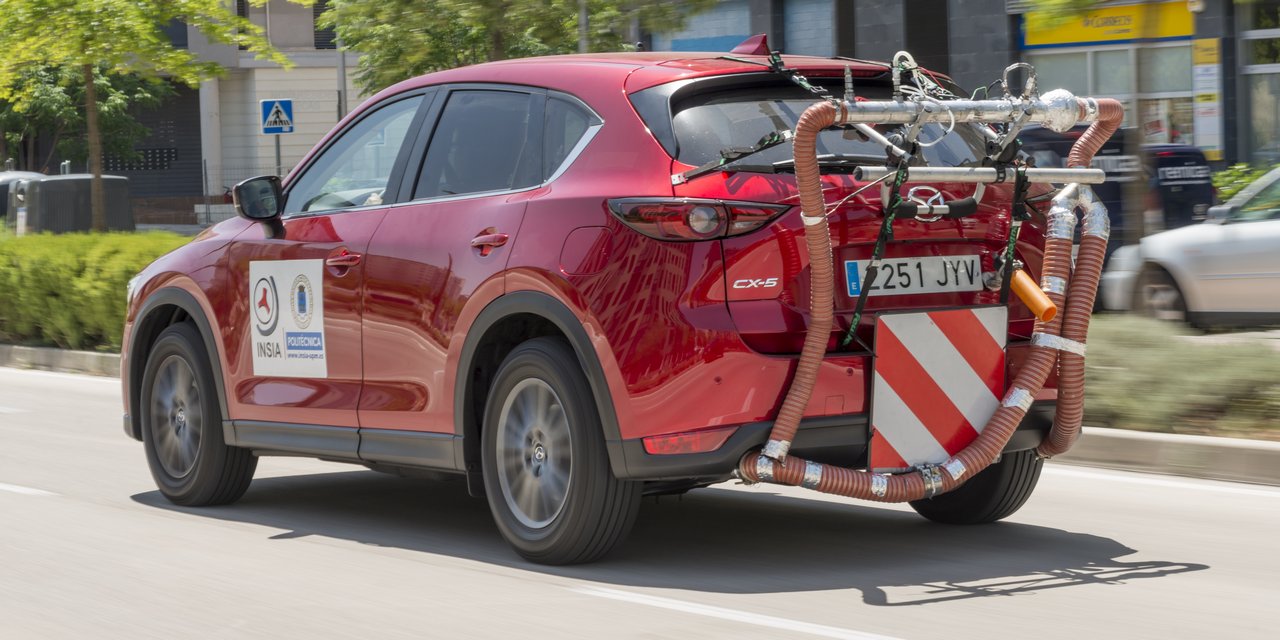
Mazda, through a study carried out by the Madrid-based institute INSIA (Centro Superior de Investigación del Automóvil de la Comunidad de Madrid), has analysed the operation of various diesel and petrol engines, as well as hybrid alternatives currently on sale. All of this within the most rigorous framework possible, which also studied the environmental conditions of cities such as Madrid.
After selecting three petrol models (Mazda CX-5 Skyactiv-G 160 CV, Renault Kadjar TCe 130 CV and Seat Ateca TSI 150 CV), four diesel models (Mazda CX-5 Skyactiv-D 150 CV, Hyundai Tucson CRDi 136 CV, Honda CR-V i-CTDi 120 CV and Audi Q3 TDI 150 CV) and one hybrid model (Toyota RAV4 Hybrid), it proceeded to analyse their CO2 emissions under real-world driving conditions.
The result is, to say the least, surprising, with deviations of over 40% in some models, showing that diesel vehicles still have the lowest CO2 emissions over their full lifecycle of use, even below hybrid models. Something similar happens with electric vehicles, with CO2 emission figures derived from electricity production higher than those of models with combustion engines.
This is how Mazda sees it: Rightsizing and Skyactiv-X
Mazda’s vision for the future is clear: by 2020, more than 80% of vehicles will be internal combustion, and they will remain cleaner than electric vehicles if power generation does not rely on renewable resources. That is why Mazda is preparing its flagship launch: Skyactiv-X, an internal combustion technology that promises to improve power and consumption figures by around 30%.
The Skyactiv-X technology will make the Mazda models equipped with it, from 2019 onwards, the first mass-produced vehicles to use petrol engines with compression ignition through extraordinarily efficient ignition management, using spark plugs at times of low power demand and progressively modifying their operation under high-demand conditions.
Nevertheless, Mazda is not oblivious to the importance of electricity in the future of the car. That is why it is preparing the arrival of hybridisation across its range, which will take place from 2019 onwards, when a new generation of Skyactiv-D diesel engines will also arrive, with better consumption figures and extremely clean operation. For Mazda, the combustion engine still has a great deal to say.


 The seven finalists for the 2027 European Car of the Year (COTY) are exclusively electric
 Peugeot E-208 GTi: a battery-powered toy that revives the spirit of the 1980s sports cars
 New Lexus ES: luxury grows and goes electric
Deja un comentario