Toyota Hybrid Cars Compact ECO Tests
Test drive and buying guide Toyota Corolla Hybrid: keys to choosing well
 Antonio Roncero @roncero_antonio
27 January 2025
10 min.
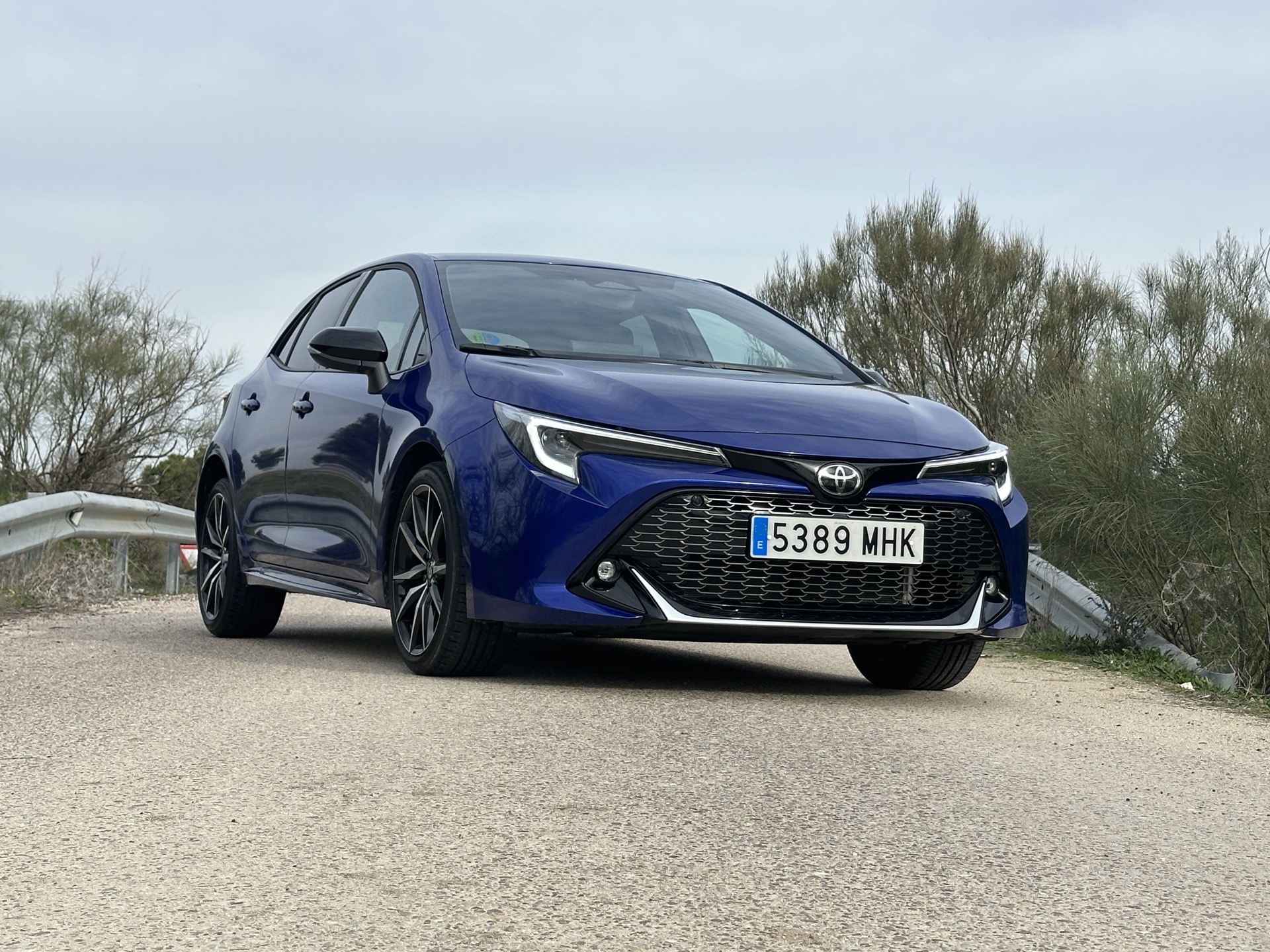
The Toyota Corolla remains a true “best seller” in our market, surpassed only by the Dacia Sandero. These are the keys to its success… and the ones you need to bear in mind to choose a Corolla wisely.
Besides being a seasoned veteran -the current model is an update of the model launched in 2019-, the Toyota Corolla is a regular among the top spots of the best-selling cars in our market year after year, surpassed only by a much simpler and cheaper car such as the Dacia Sandero. And as the saying goes, “there must be something in the water when they bless it”.
Clearly, the Corolla’s sales success is no accident. There are several reasons, but among the main ones is the well-known -and well-deserved- reputation that the Toyota brand as a whole, and the Corolla and its hybrid powertrains in particular, have earned for being very reliable cars. Then there is the fact that the range lets you choose up to three body styles: the 5-door compact, the Corolla Sedan with three-box design and 4 doors, and the attractive Corolla Touring Sports estate. Add to this hybrid engines –ECO environmental label from the DGT– that have always stood out for their low consumption, good build quality, up to six trim variants to choose from and a competitive price, and there you have the result: the Corolla is the best-selling model of Toyota in Spain in 2024, the first among compacts and the second best-selling worldwide, behind the Sandero and ahead of the Ibiza.
But what should you consider if the Corolla has caught your eye and you have doubts or don’t know which version to choose? Let us try to help you.
This is the current Toyota Corolla range: up to 6,700 euros off
As I was saying, the Corolla range offers three body styles (5-door, Sedan and Touring Sports) and four trim levels (Active Plus, Style, Style Edition and GR Sport), although only the Touring Sports is available with every equipment variant. The Style Edition is not offered for the 5-door, and the Sedan is only available in Style trim, plus an equipment grade called ECO aimed at fleets.
As for the engines, there are two options for the 5-door and Touring Sports bodies: the 140H with 140 CV, and the 200H with 196 CV. The Sedan is only offered with the less powerful engine. And I’ll take this opportunity to point out that these two engines are a big step up in performance, efficiency and driving pleasure over those offered before the 2023 update, the 125H with 122 CV and the 180H with 184 CV. Engines, by the way, with which the Corolla also managed to stay among the best sellers…
Among the latest changes made to the range, last year brought two new body colours, the digital key that lets you use your phone to unlock and start the car (only on some trims), and a particle ionising filter for the cabin.
Toyota offers discounts off the advertised RRP ranging from 4,300 to 6,700 euros, depending on body style and engine. With these discounts applied, here are some considerations worth keeping in mind when talking about the prices of the Toyota Corolla Hybrid:
- The 5-door 140H Corolla is available from 26,000 euros in Active Plus trim. It is the most affordable version in the range
- For the same engine and trim, the appealing estate version, the Corolla Touring Sports, costs 1,500 euros more
- The 200H with the more powerful engine is only paired with GR Sport trim on the 5-door Corolla, and you can choose it in Style and GR Sport trim on the estate
- Where you can choose, for the same trim, the 200H costs 2,500 euros more than the 140H
Let’s look at what all this means in more detail, as we move on to choosing the Corolla that best suits you, according to your needs.
Which engine to choose, the 140H with 140 CV or the 200H with 196 CV?
The first thing I’d tell you when choosing an engine is that, this time, the 140H strikes me as a very recommendable option for any use. That couldn’t be said of the previous Corolla 125H, which could fall short when pulling away from the city. Besides the gain in pure performance (almost two seconds faster to accelerate), this engine is a big improvement over the previous one in driving pleasure. You can clearly feel the greater role of the electric motor in supporting the combustion engine (it has gained almost 25 CV), which translates into more responsiveness from low revs.
And, more importantly: that “lawnmower” effect characteristic of Toyota hybrids with previous generations of the hybrid system, although it hasn’t disappeared completely, no longer feels annoying. The system works the same way: when you accelerate hard, the first thing you notice is that the combustion engine revs up a lot, and while you keep accelerating it stays there, spinning at high revs as the car gains speed. But now not only is the operation smoother and the noise much better insulated. In addition, the transition between the drop in revs and the subsequent rise when you have to ease off the accelerator pedal and accelerate again is much more disguised. All this means the Corolla 140H is now also a car suited to motorway travel or driving on country roads, which in the previous generation could sometimes drive you to despair.
Otherwise, at low speed, especially on urban routes and in the outskirts, the Corolla 140H stands out for very smooth and even quiet driving. Although its strong point remains its consumption, which is very low in town or on the open road as long as you can maintain a steady cruise. Averages in mixed use scraping just under 5 l/100 km are within reach almost without trying, and you can travel on the motorway perfectly well without missing more performance and without exceeding 6 l/100 km.
In short: the entry-level Corolla 140H is, this time, a very recommendable engine. It’s true that the 200H offers better performance without barely penalising consumption. But it’s 2,500 euros more for the same equipment, and on the 5-door it is only offered with GR Sport trim, with which it might make a bit more sense… although in no case should you expect from the 200H a particularly sporty feel or performance, despite its almost 200 CV.
Equipment and body style: the wallet decides
Choosing the body style in the Corolla range will depend more on each person’s needs and tastes than on household finances, because the 1,500 euros the Touring Sports costs extra is a safe investment if frequent use of the rear seats and boot is among your priorities. The 5-door Corolla falls below the category average, with about 360 litres for the 140H version, and almost 50 fewer in the more powerful one. The estate, however, exceeds 580 litres in the worst case -the 140H comes close to 600 litres-, and it is also a very eye-catching car aesthetically.
As for the Corolla Sedan, it is an option mainly aimed at fleets, which is why it has a specific trim version called ECO. The offer is limited to the 140H Style, and it costs 1,000 euros more than the estate, that is, 3,500 euros more than the 5-door. And with 470 litres, it doesn’t have a huge boot either; but there it is, it’s still one more option.
Quite a different matter is equipment, and here you do need to do your sums carefully. On the 5-door, the entry-level Active Plus trim is already very complete, but the GR Sport has a bigger discount, which reduces the final difference to 1,000 euros. In exchange, you get much more striking exterior styling, with a sporty touch without being overly flashy. Standard on this version are 18-inch alloy wheels with 225/40 tyres, front and rear parking sensors, heated front seats, bi-LED headlights and all the GR Sport identifying details, both outside and inside. It’s worth it.
In the case of the Touring Sports estate there is no GR Sport trim with the smaller engine, but the Style trim is offered between the entry-level Active Plus version and the more luxurious Style Edition. It’s 1,500 euros more, but again the step up is worth it for the additional equipment it includes.
There is an optional package called GR Sport Premium, which costs 5,500 euros, but may be of interest to those who want a “fully loaded” Corolla. The good news is that it includes a lot of extra equipment, such as adaptive headlights, a head-up display, a panoramic roof, two-tone paint, leather upholstery, JBL sound system, hands-free tailgate, rear cross-traffic alert, blind-spot detection and safe exit assist. The downside is that it is only offered with GR Sport trim and the 200H engine, and that you cannot configure a Corolla to your own specification starting from a less equipped version and choosing only what you need.
Behind the wheel of the Toyota Corolla Hybrid
Getting down to business, the truth is that the Corolla has improved enormously across the board, becoming one of those cars that isn’t the best at almost anything -and I say almost because it does rank among the best for consumption-, but does practically everything well. It doesn’t fall short in terms of the perceived build quality of the materials and fit and finish, it has a very good driving position –the seats in this GR Sport version have won me over-, plenty of storage spaces for emptying your pockets, and physical buttons for controlling main functions such as climate control, without having to go through the touchscreen.
The multimedia system has also improved greatly, which, although not among the most advanced, now does its job well since the last facelift, both in the layout of the menus and in the smoothness of its operation. In addition, the touchscreen, whose size has grown to 10.5 inches, is mounted in an elevated position and is very easy to read. It is compatible with Apple CarPlay and Android Auto, and the Toyota Smart Connect functions -online services through the data connection included in the car- are free for the first few years. The digital instrument display with the new 12.3-inch screen also makes the Corolla look more high-tech and modern. The rear seats are not its strong point, with dimensions below the category average in width, legroom and headroom, and I already said that the boot is small, something solved by opting for the estate body.
The dynamic behaviour is certainly at a high level, with steering that feels precise, great comfort over bumps and an agility on winding roads that makes you wish for an engine with a more sporty feel and a transmission with “real” gear changes. It is also a very easy car to drive thanks to its predictable reactions, never doing anything strange even if you make a mistake and have to brake or correct the line mid-corner. And it’s safe, especially now that the operation of the driver assistance systems has been improved and expanded with a new radar.
Toyota Corolla Hybrid – Image gallery


 Peugeot E-208 GTi: a battery-powered toy that revives the spirit of the 1980s sports cars
 New Lexus ES: luxury grows and goes electric
 First contact with the Dacia Sandero Hybrid 155: power and efficiency from €19,890
Deja un comentario