Test drive of the Toyota Yaris Cross: faithful to the recipe Toyota
 Alvaro Avilés
2 February 2022
10 min.
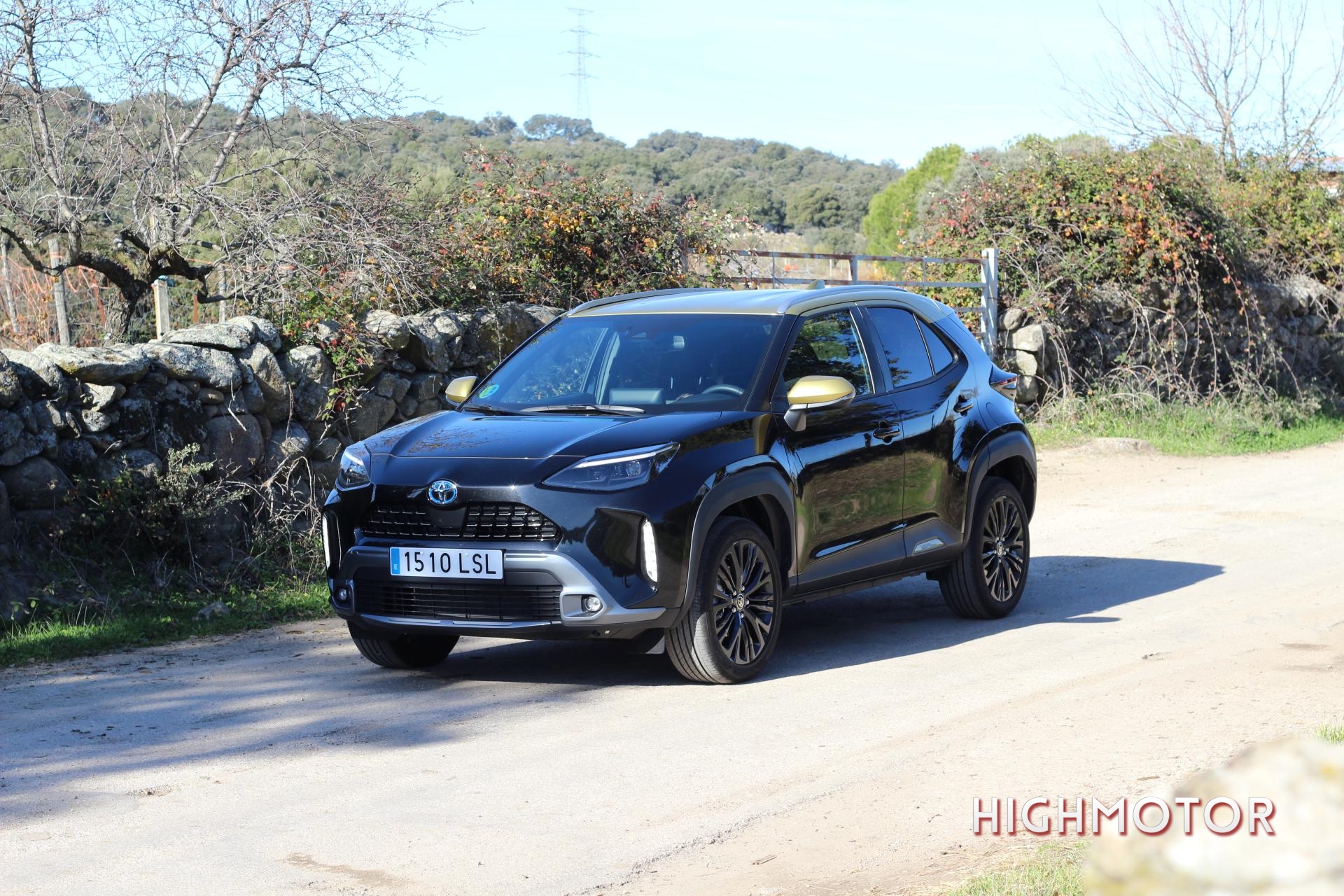
We have put the Toyota Yaris Cross to the test, an urban SUV with hybrid powertrain that promises reduced fuel consumption and generous interior space
If you think of a hybrid car, Toyota will probably be the first brand that comes to mind. Achieving that is no easy task, and just as Coca-Cola has done in the soft drinks market, the Japanese brand has managed to link its name to one of the most important technologies in mobility today.
Looking at sales figures across the European continent, it is easy to see that SUVs are in fashion. Just to give one example, the best-selling car in Spain last year was the Seat Arona, a model we tested last year and for which we have already offered you a complete buying guide.
That is why it is easy to see what characteristics a car needs to become a bestseller: modest dimensions, SUV styling, a complete technology package and, if it has the advantages of the ECO label or the DGT 0 label, even better.
Toyota has spent years accumulating strong results in registration rankings, so it knew what a model with the above characteristics needed in its range. After being slow-cooked, the Toyota Yaris Cross is its interesting proposal: a small SUV based on the Yaris platform but with a more adventurous look and greater interior space.
Completely differentiated from the Yaris
When we stand in front of the Toyota Yaris Cross, it is hard to believe that it shares its platform with the Yaris, and it looks much bigger and more muscular. In fact it is, as the more adventurous sibling of the Japanese city car is 24 cm longer, 6 cm taller and almost 2 cm wider. What remains identical is the wheelbase, so its extra length comes from the long overhangs at both ends of the bodywork.
Aesthetically, the Toyota Yaris Cross stands completely apart from its smaller sibling. The front features very squared shapes that help give it a robust, muscular look.
The horizontal headlights sit at the extremes of the bonnet and, with a black background, blend perfectly with the black bodywork. Lower down, we find distinctive vertical LED lights that act as daytime running lights.
Our test unit came equipped with the Adventure trim, the most complete in the range. As its name suggests, it adds a more off-road look to the Toyota Yaris Cross, so we find elements such as a lower front bumper section that contrasts with the rest of the bodywork and simulates a sump guard.
From the side, the 18-inch black alloy wheels stand out, housed in the now-typical squared wheel arches fitted to the brand’s SUVs. On the lower part of the doors there is a sturdy plastic cladding with a moulding that matches the roof colour and the model badge.
At the rear, we find tail lights that run across the full width of the rear and end by wrapping around the model’s wide hips. As at the front, there is a metal protector that simulates underbody protection.
The customisation options that Toyota offers on the Yaris Cross are really extensive, including options such as two-tone bodywork. Our unit wore an elegant black finish contrasted with an attractive gold. To find fault with the finish, the step left by the second paint layer relative to the first is clearly noticeable, especially on the C-pillar, so it seems that instead of paint we have used a liquid vinyl to change the colour of half the car.
More space than in the Yaris
It is when we open the door of the Toyota Yaris Cross that we most realise we are dealing with a direct descendant of the Yaris. The interior is practically identical, so we get a comfortable, well-resolved driving position, a simple centre console with physical controls for the climate system (thankfully) and seats identical to those of the CH-R, which offer outstanding comfort and lateral support.
One of the main goals of the Toyota Yaris Cross is to offer superior interior space to those who need a modestly sized car for the whole family. And it does, as the rear has enough legroom, outstanding headroom and a width suitable for two people to travel comfortably.
One of the figures that most impresses in terms of space is the boot volume: with its 390 litres of capacity, it sits at the level of models from a higher segment and leaves rivals such as the Hyundai Kona (376 litres) or the Kia Stonic (352 litres) behind.
Continuing with the luggage area, the good idea of covering both the boot floor and the rear seatbacks with rubber mats deserves mention, as they are easy to clean and prevent these areas from getting dirty. Not everything is praise, though: the flimsy parcel shelf covering the space is not what you would expect in a car at this price.
A very clever all-wheel-drive system
The Toyota Yaris Cross has under its bonnet a hybrid system that has covered millions of kilometres in the brand’s models for over 20 years and is now in its fourth generation.
Under the bonnet, it has a three-cylinder petrol engine producing 92 CV which, working together with the electric motor, delivers a combined output of 116 CV and 120 Nm of torque. To transmit this power to the road, the urban SUV from Toyota uses the usual planetary gear transmission of its hybrid models.
One of the great advantages of the Toyota Yaris Cross in Adventure trim is that it features the AWD-I intelligent all-wheel-drive system. Far from being a traditional all-wheel-drive system with a front and rear differential, it uses a small 7.4 CV electric motor on the rear axle.
Far from being designed to offer superior off-road capability, it has been conceived to make the Toyota Yaris Cross AWD-I more efficient than front-wheel-drive versions. The small electric motor works mainly when pulling away, so on low-grip surfaces it greatly reduces wheelspin and therefore consumption.
Although this system is intended to make the Toyota Yaris Cross less thirsty rather than to deliver off-road driving, it features a hill descent control system capable of holding the car without touching the brake.
The Toyota Yaris Cross on test: how does it drive?
Once we are behind the wheel of the Toyota Yaris Cross, two virtues stand out above the rest: smoothness and manoeuvrability. The brand’s urban SUV makes it clear from the outset that its natural habitat is the city, with very good visibility and a turning circle that allows it to be manoeuvred perfectly even in the tightest spaces.
Driving this type of car requires a certain adaptation period, as its transmission makes it very clear at all times how you should drive. The Toyota Yaris Cross is driven calmly: if you dig in your heels and press the accelerator decisively, the transmission sends the revs soaring and, much like a scooter, a rather annoying drone resonates into the cabin.
The 116 CV produced by the hybrid system is enough for the car to move with ease but, hampered by the transmission, it feels like considerably less when you push it, for example when overtaking.
That is why the Toyota Yaris Cross encourages a relaxed style of driving, so achieving consumption of around 5.5 l/100 km — 0.1 more on the combined figure in our test — is entirely achievable.
Although the powertrain is anything but sporty, the chassis of the Yaris Cross surprises with agile behaviour and a composure more typical of a higher segment, so if you take a corner with enthusiasm, the car holds its line without complaint.
A very complete equipment list on the Adventure trim
During our test of the Toyota Yaris Cross, we had the chance to drive the Adventure trim, the most complete in the range.
To justify a premium of around 4,000 euros over the most basic variant in the range, the Adventure trim comes with a generous catalogue of standard equipment: 18-inch alloy wheels, tinted glass, rear-view camera, dual-zone climate control, heated front seats, digital instrument cluster, wireless smartphone charging…
Special mention goes to the new Toyota Smart Connect infotainment system with its 9-inch touchscreen. It features a much more modern and intuitive new interface than in previous models and buttons on either side of the screen that are far better integrated. It is also compatible with Android Auto and Apple CarPlay, allowing you to connect your phone wirelessly.
As for its range of driver assistance systems, the Toyota Yaris Cross includes lane-keeping assist, collision warning with emergency braking, rear cross-traffic alert and adaptive cruise control.
The high-beam assist also comes as part of the pack. This was one of the most negative points in our test of the Toyota Yaris Cross, as its erratic behaviour switches on the high beams when it shouldn’t. This results in constant dazzling of oncoming cars, so after receiving a few flashes in protest, you will be forced to switch it off.
Is it a good buy?
The Toyota Yaris Cross arrived last year in one of the most competitive segments of the market, and the number of rivals and the sales they accumulate make things really difficult for it.
However, the legacy of Toyota hybrids is a guarantee, so there is no doubt this car will sell well. The decision is simple: if you love its styling, the space offered by a Yaris is not enough for you and, above all, you don’t mind the 7,000 euro difference over its smaller sibling, the Toyota Yaris Cross could be a good buy.
Technical specifications of this car


 Kia offers an electric range of 10 models, 50 versions and 400 possible combinations
 The seven finalists for the 2027 European Car of the Year (COTY) are exclusively electric
 Peugeot E-208 GTi: a battery-powered toy that revives the spirit of the 1980s sports cars
Deja un comentario