This is how Volvo makes its exclusive crystal knobs
 Mónica Redondo @MonicaRedondoD
2 January 2020
7 min.
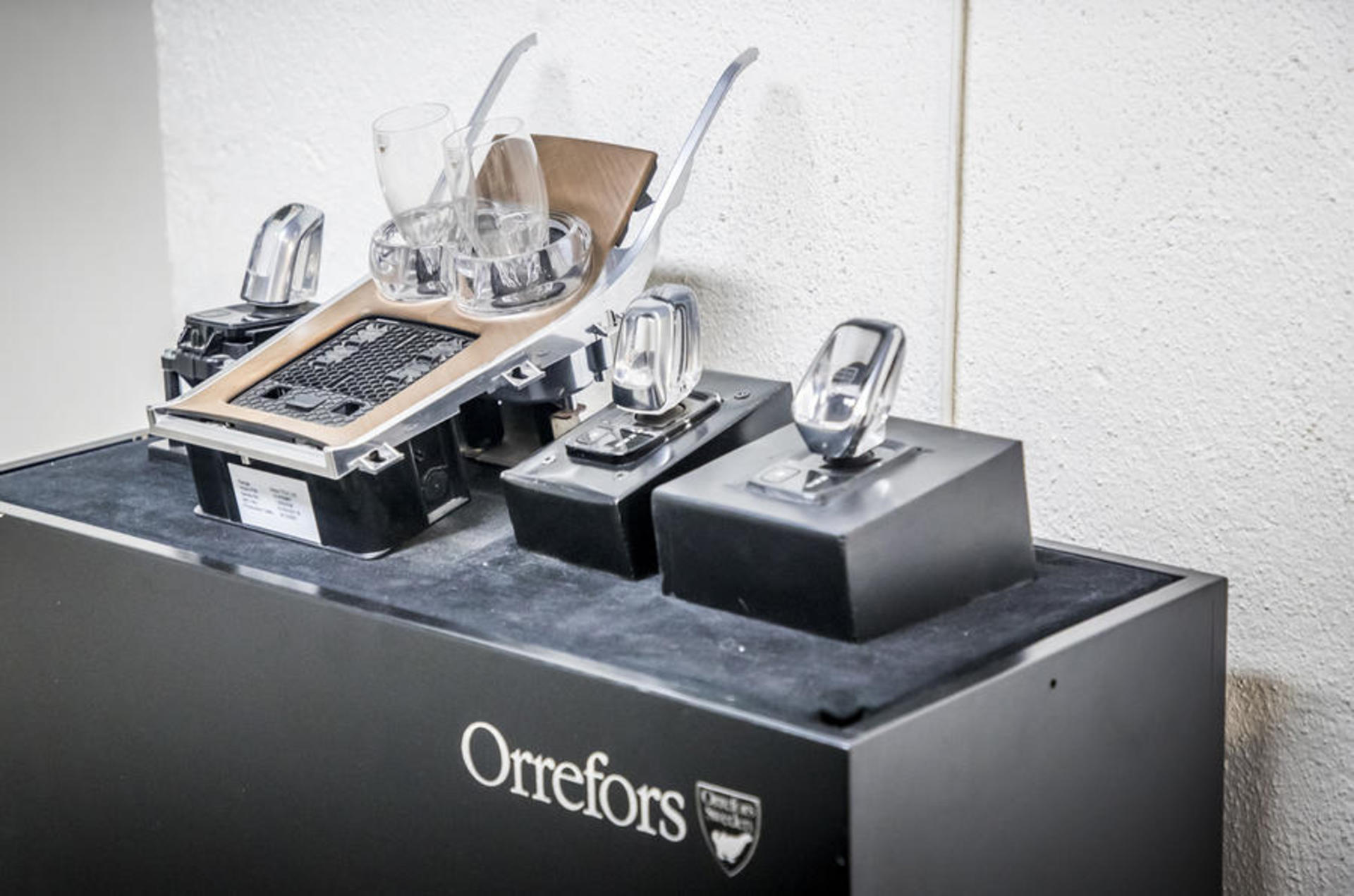
Volvo wants to offer a luxury extra on its models that comes in the form of a crystal gear selector option. This is how they are made!
When the glassworks was founded in the small Swedish town of Kosta, its owners did not foresee that one day it would make gear selectors for cars. After all, it was 1742, when demand for car parts was somewhat limited.
However, 277 years later, the Kosta shop is an unlikely starting point for the production of gear selectors for Volvo. These are not ordinary gear selectors, of course: the Orrefors Crystal Eye units are handmade from crystal, blown and shaped with tools and techniques that are almost identical to those used in the 18th century.
They are beautiful, terribly elegant and, for some drivers, completely unnecessary: swapping a regular selector for a crystal one does not improve gear-change times at all in, for example, a Volvo XC90. But they are becoming increasingly popular, and Volvo is expanding their availability across its range.
“I loved the idea of taking something from outside the industry and bringing it into a car,” says Anders Bergström, colour and materials designer at Volvo. “We wanted to build on our Scandinavian heritage, which gave me the idea of using crystal.”
Would you equip your Volvo with this luxury gear selector?
A gear selector works, says Bergström, because “it had to be a substantial lump. The beauty of crystal is that you see it come to life. The gear selector is at the centre of the car, and you touch it, so you feel the material and enjoy it that way too.”
Surprisingly, it took 10 years to turn that idea into reality. To find out why, we headed to the rural Småland region, the heart of Sweden’s Glasriket — the Kingdom of Crystal.
Natural resources (silica-rich sand and vast forests to provide fuel) fuelled the glass industry there, and dozens of glassworks are dotted around the region.
The town of Kosta is named after the founders of the glassworks. The nearby town of Orrefors gained its own glassworks in 1898. The Orrefors and Kosta Boda firms merged in 1990 (consolidation is not just a trend in the automotive industry) and, since 2013, their artisanal operations have been combined in Kosta.
The shop is the heart of the Orrefors-Kosta operation. Inside are a series of large furnaces, each of which is the centre of a glass production line. It is far from a modern car factory, with no robots or automation. Everything is made by hand.
Each furnace has a team of four, and two teams make two types of Crystal Eye: one for the Volvo XC40 and a larger one for the Volvo XC60, the Volvo XC90 and the Volvo V90. “Bigger cars need a bigger selector,” says Bergström. “It’s a bit of a showstopper.”
How are Volvo’s crystal selectors made?
A crystal gear selector begins life as sand. The granulated, lead-free batch is prepared locally by the Glasma brothers’ firm to what Lars Sjögren, head of the Crystal Eye production team, calls “a special secret recipe”. Yes, secret sand. “It’s all about the mix of elements,” says Sjögren.
The first task is to melt the secret sand, which takes 16 hours at 1400 °C and is done in a clay pot in each furnace. Because of limits on how much sand a pot can melt, each team uses two furnaces, swapping halfway through each day. Once the sand has melted, the furnace is turned down: at 1400 °C, the molten glass is too hot to work. At 1180 °C, apparently, it is just right.
Production begins with a glassblower expertly hooking a blob of molten glass of suitable size onto the end of a metal rod and carefully lifting it to a bench, where it is rolled into a rough shape.
It is formed into its gear-selector shape using a cast-iron mould before being placed on a rack. It is then rotated as it moves along a line, being cooled by a fan or heated by a flame. It looks random, but it is science: the process strengthens and polishes the glass.
Often, a glassblower will pause, look closely at the gear selector they are working on, sigh slightly, and then plunge the metal rod into a nearby bucket of water. That is a reject, and the standards are demanding. The team produces around 50 units an hour, but only 35 or so will make the cut.
According to Sjögren, employees spend at least five years at the company even before they begin to learn how to make glass. Most have been there for decades and focus on a single product. At this stage, I have been in the hot shop for about 30 minutes, but I am still determined to have a go.
A glassblower eventually lets me “help” by carrying a rod loaded with a molten glass selector from one station to the next. He kindly warns me that it is hot (although the bright molten crystal at the end is a clue). I feel I am doing a decent job turning the selector, although every unit I approach is thrown straight into the water bucket. I only manage to increase the reject rate.
The surviving selectors are placed in an annealing oven, a kind of oven in which the glass goes through another heating and cooling cycle, emerging eight hours later at room temperature. The Orrefors logo is then added: on the XC40 selectors it is printed, and on the larger unit it is created inside the glass in a 3D effect. Sjögren will not explain how. It is another secret. Still, the logo is a mark of respect.
A completely manual process
Once this is done, there are more checks by another expert glassblower, who examines each selector thoroughly. Beside him is a container full of selectors that did not meet their standards. The most common fault? “Bubbles,” says Sjögren, with a shudder. Sjögren hates bubbles. “If there is one bubble, we will reject it.” Since I clearly have no future in glassmaking, perhaps I can help with quality control. Except, rummaging through the reject container, I find units with bubbles so small that I can only see them when Sjögren points them out.
Fortunately, high reject levels do not generate waste: rejected units are simply melted down and reused. “Sustainability is really important to us,” says Sjögren.
By Sjögren’s count, each gear selector is checked at least six times before being dispatched to Volvo, ready for installation in a car. The multitude of checks is partly down to standards and partly to the challenge of meeting the strict regulations required for car parts.
“It is not easy being a supplier to a car company,” says Sjögren. “We have to be able to guarantee that the production of every gear selector is the same. We are not car manufacturers: we make glass tableware. Volvo needed a lot of help to sort it out.”
Volvo’s luxury selectors also have to undergo extreme temperature tests and prove they could survive when a Volvo is driven over extremely rough roads — not tasks usually required of, say, a champagne glass. So far, not a single selector has broken. “It will never happen,” says Sjögren. “Never, never, never.”
Both companies think the effort is worth it. “It is helping us be more innovative and raising awareness of our company,” says Orrefors boss Ulf Kinneson. “It shows what else we can do.”
The pride shines through, as does the amount of effort put into production for something that is, essentially, completely unnecessary. Except that in a increasingly tech-focused world, glass gear selectors are a tangible link to something more solid. “It is something real customers can hold on to,” says Bergström. “Crystal is a cutting-edge and timeless material, but we are using it in a new way.”


 Peugeot E-208 GTi: a battery-powered toy that revives the spirit of the 1980s sports cars
 New Lexus ES: luxury grows and goes electric
 First contact with the Dacia Sandero Hybrid 155: power and efficiency from €19,890
Deja un comentario