Dacia Sandrider Otras competiciones Todoterrenos
This is the Dacia Sandrider, the brand's off-road prototype for the 2025 Dakar
 Victor Alós Yus @sepelaci
23 December 2024
3 min.
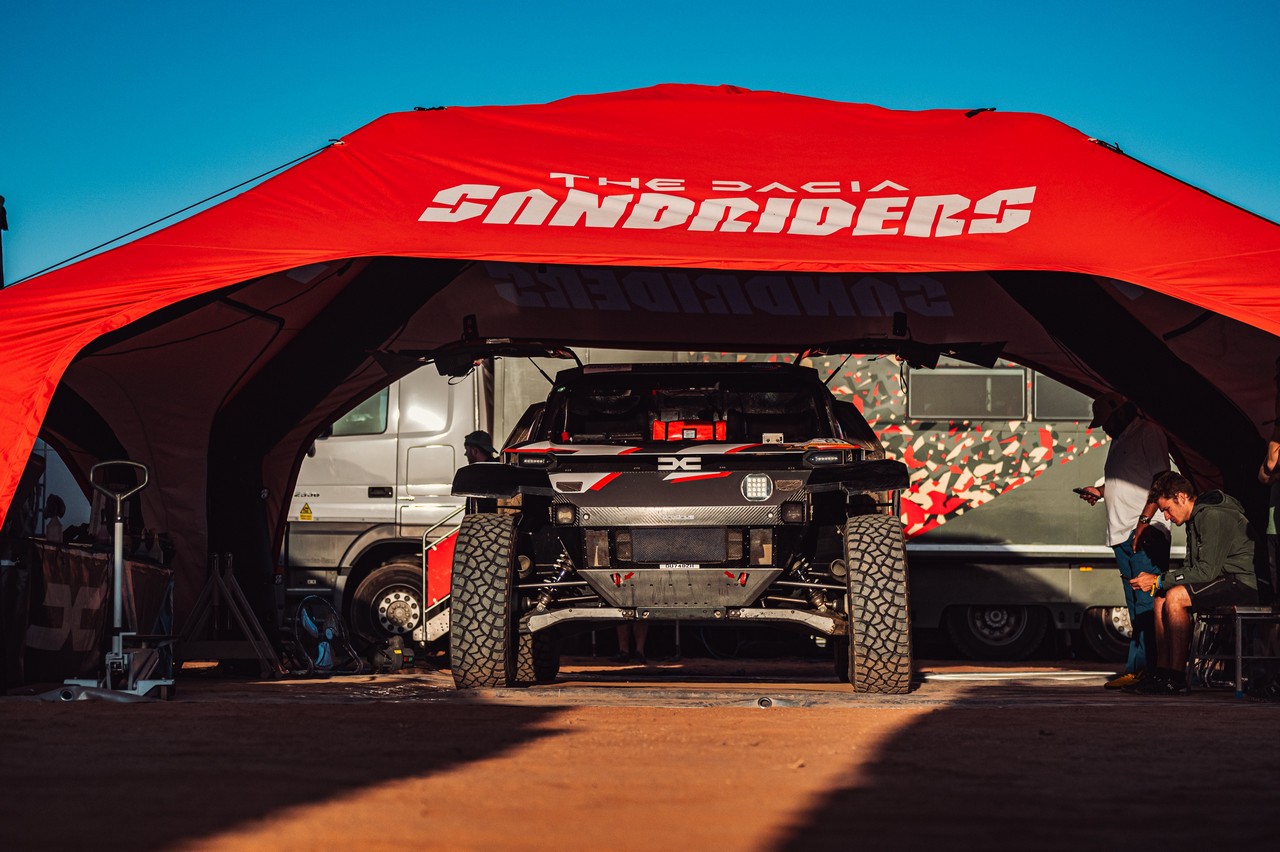
The Dacia prototype for the 2025 Dakar is ready to take on this demanding event, which takes place very shortly and is one of the toughest.
Dacia faces one of the most important challenges on the rally calendar, so it has had to design and develop a prototype that lives up to the demands of this event. The model in question is called Dacia Sandrider and follows the line of a reliable car ready to deliver the service required of it. A lightweight car, with a robust and adventurous design.
This prototype does not debut at the 2025 Dakar, but has previously been tested at the Rally of Morocco, where it proved it was capable of meeting the demands of the Dakar. To give its best in the demanding African event, the Sandrider features all-wheel drive and a tubular chassis, on which sits a carbon fibre bodywork. These two elements have been developed together with Prodrive.
It has no excessive ornamentation or superfluous parts. It has the necessary panels to ensure correct aerodynamics and to reduce fuel consumption to the bare minimum. The cooling intakes and the overall design are prepared to reduce aerodynamic drag and achieve a 10% increase in drag and a 40% increase in downforce compared with similar vehicles.
There are details such as the short bonnet, the colours that avoid glare and the placement of the spare wheels, which are easily accessible for the drivers, that improve usability and the occupants’ control of the vehicle.
Galería de fotos -
DACIA SANDRIDER DAKAR 2025
A chassis designed to win
The Sandrider is equipped with double-wishbone suspension and a 4×4 transmission prepared to face the most demanding challenges of the event.
The engine hidden under the bonnet of this vehicle for rallies is a 3.0-litre twin-turbo V6 block paired with a sequential gearbox. It is a compact engine that helps keep weight under control and is positioned to offer the most suitable balance for every moment.
It delivers 360 CV at 5,000 rpm and a maximum torque of 539 Nm, reached from 4,250 rpm. To run, it uses synthetic fuel, which delivers the best performance. This synthetic fuel is supplied by Aramco and combines renewable hydrogen with captured CO₂, so polluting gas emissions are considerably reduced.
Practical solutions for the Dakar
The engineers and designers have thought of everything and offered practical solutions to make the Dakar easier to endure. Drivers can access the tools needed to deal with any setback that arises during each stage, but comfort has also been considered.
The Sabelt seats are upholstered in specific antibacterial fabrics with moisture regulation. The dashboard has been designed to offer better visibility of the terrain, and the instrumentation is modular, so each crew can adjust its placement to suit their needs and preferences.
The effect of the sun’s rays has been reduced thanks to a special coating added to the carbon fibre panels, which will be patented given its good results. This model will compete in the T1+ category and will have a team made up of three top drivers: Nasser Al-Attiyah, Sébastien Loeb and Cristina Gutiérrez.
 Peugeot E-208 GTi: a battery-powered toy that revives the spirit of the 1980s sports cars
 New Lexus ES: luxury grows and goes electric
 First contact with the Dacia Sandero Hybrid 155: power and efficiency from €19,890
Deja un comentario