CHR+ Electric Cars Tests Uncategorized SUV
We drive the new Toyota C-HR+, a battery-electric SUV ideal as a first car
 Rafa Guitart @GuitartRafa
27 March 2026
7 min.
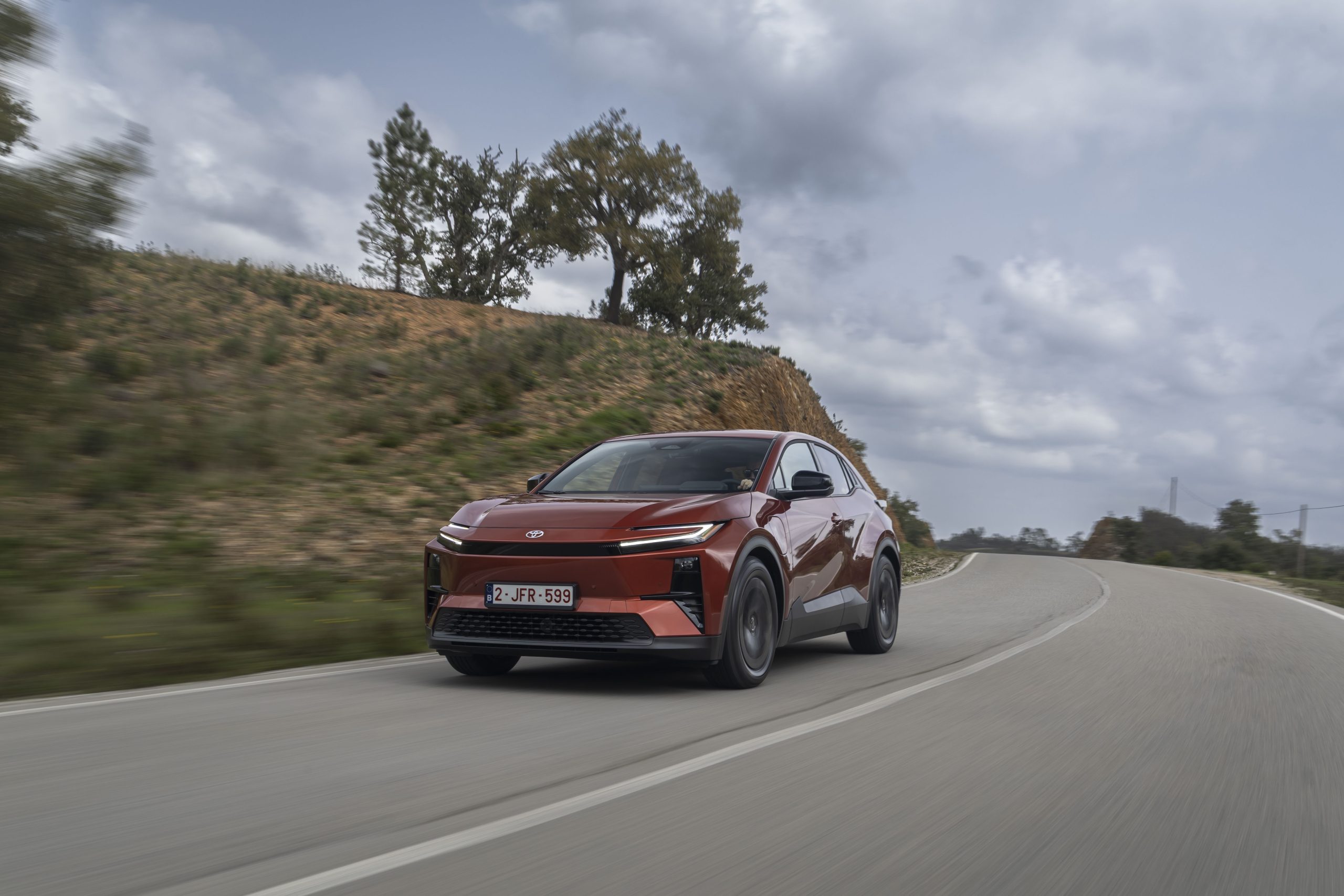
It is not a version of the well-known C-HR, although it shares a certain aesthetic resemblance. However, the new 100% electric model offers more space, greater smoothness and comfort of use at a really attractive price.
The second 100 percent electric model from the brand has a very appealing size, measuring 4.53 metres long, 1.87 wide and 1.59 high, with a wheelbase of 2,750 mm, which gives it ideal proportions to be the first model in a family. It also offers a boot capacity of 416 litres, with very good access through its large power-operated tailgate. It claims a drag coefficient of 0.26, which helps improve efficiency and range.
Mounting the battery under the floor, attached to the lower chassis, increases torsional rigidity by 30% and lowers the centre of gravity by 65 mm compared with the Toyota C-HR, while maintaining a ground clearance of 185 mm.
The new Toyota C-HR+ is available in two versions, with either front-wheel drive or all-wheel drive, in two different trims. The Advance, with front-axle drive, delivers 224 CV and promises a maximum range of up to 609 km. The Spirit, with all-wheel drive, raises the power to 343 CV and reduces the range to a maximum of 509 km.
It is offered in Persian Red and Lunar Grey in a single-tone finish or, on the higher trims, in a two-tone combination with a black roof. Obsidian Black, Manhattan Grey and Iceberg Pearl White are also available, the last two in both single-tone and two-tone versions. The 20-inch alloy wheels are standard on the Spirit trim.
77 kWh battery
In both cases it features a 77 kWh gross-capacity lithium-ion battery (72 kWh net), paired with a 165 kW electric motor on the front axle, and the all-wheel-drive versions raise output to 252 kW.
The platform used in the C-HR+ e-TNGA allows the fitting of a rear electric axle, or eAxle, to provide all-wheel drive. In this case, the combined system output reaches 343 CV (252 kW) and promises a 0 to 100 km/h acceleration time of 5.2 seconds.
Both motors work together with the 77 kWh battery, improving throttle response and traction, with the ability to distribute torque between the front and rear axles depending on each situation.
All versions of the Toyota C-HR+ Electric feature a 77 kWh gross-capacity lithium-ion battery, although a lower-capacity variant (57.7 kWh) is available in some markets. Thanks to the battery preconditioning system, it can DC fast-charge at a maximum power of 150 kW, which means it can go from 10 to 80% in about 30 minutes. For AC charging, the Advance versions include an 11 kW on-board charger, while the Spirit trim offers faster charging via a 22 kW three-phase AC charger. It also features a low-consumption water-to-water heat exchanger, which heats the cells evenly and allows constant operation.
The system allows the battery to reach its ideal temperature before charging begins. Battery preconditioning can be activated in three different ways: manually through the multimedia system, scheduled in advance to start at a specific time, or automatically when heading to a charging station via the navigation system.
It incorporates several measures to reduce the impact of air conditioning on range, such as a heat pump that consumes less, since it uses the thermal energy in the outside air to heat or cool the cabin, thereby reducing energy consumption compared with a conventional system.
The heated front seats and steering wheel are standard equipment on all versions, reducing reliance on the cabin heating system; they use less energy than conventional climate control and act quickly.
The battery and electrical system care programme includes a warranty of up to 10 years or one million kilometres, provided an annual battery inspection is carried out. For the remaining components, up to eight years or 160,000 kilometres are offered.
Complete equipment
As is customary with electric vehicles, the C-HR+ offers the MyToyota app for smartphones, which allows checking vehicle information, battery level, climate control, or remote locking and unlocking.
It also features a comprehensive set of driver assistance and safety systems, including a blind-spot monitor, automatic light switching, parking sensors with automatic braking, and rear cross-traffic alert. The Spirit trim also adds front cross-traffic alert, lane change assist and a 360º camera, among others.
Elegant design
Its exterior retains the DNA of the C-HR, with a highly stylised coupé-SUV silhouette, although it is longer and has a larger boot. The interior also uses the brand’s characteristic elements, particularly those seen in the electric bZ4X: simple, durable and practical. It features two large digital screens, a seven-inch one focused on driving information, consumption, range and so on, while the central 14-inch screen handles navigation and entertainment.
The steering wheel includes numerous controls for audio, the on-board computer and cruise control, among others. In the very wide centre console, two wireless chargers for smartphones have been fitted, but a glovebox with a lid has been dispensed with. It does have a central armrest and several compartments beneath the console, but a traditional glovebox usually offers more space and privacy.
The rear seats are also very roomy and offer plenty of legroom, thanks to the generous wheelbase. The boot, although not exceptionally large, has a load floor adjustable to different heights, with enough capacity to store the charging cables underneath.
Very pleasant
We had the opportunity to drive the 224 CV Advance variant, front-wheel drive, with 235/60 R18 tyres, and found it very well balanced. It has sufficient power, reasonable consumption and exceptional ease of use. It delivers a smooth, refined ride, with quick response, no noise or vibration, and offers great driving pleasure. If the accelerator pedal is used with care, consumption figures of around 13 kWh/100 km can be achieved.
On motorways and dual carriageways, where driving tends to be at more constant speeds, consumption at legal speeds can be around 19 kWh/100 km, which is not bad for a model of this weight (1,960 kg) and size. Efficiency is improved by the four levels of regenerative braking, which are selected via paddles on the steering wheel. It allows deceleration of up to 0.15 G when the accelerator is released, and recovers more energy on downhill stretches, slowdowns and similar situations.
Regarding DC charging, we did not manage to see it exceed 107 kW, although it must be said that the weather conditions were not the most suitable for maximum charging efficiency. Later, when we have the chance to carry out a more thorough test, we will verify consumption and charging figures more precisely. Nevertheless, a linear charge at those power levels is not bad.
Attractive price
Without doubt, one of the model’s best arguments is its price, since it has a list price of 35,375 euros if purchased outright.
With the Auto+ programme, the model benefits from aid of up to 3,375 euros, and Toyota Spain offers an additional discount of 1,125 euros intended to cover 100% of the Auto+ programme aid. Adding other possible incentives, such as the 3,000 euro income tax deduction and the 1,000 euros from the Energy Saving Certificate, the final price after aid comes to 28,000 euros, a very attractive figure for an electric model in this category.
Image gallery
 Peugeot E-208 GTi: a battery-powered toy that revives the spirit of the 1980s sports cars
 New Lexus ES: luxury grows and goes electric
 First contact with the Dacia Sandero Hybrid 155: power and efficiency from €19,890
Deja un comentario