Renault Scénic Electric Cars Tests SUV
We test-drove the new Renault Scenic E-Tech: evolution and revolution
 Rafa Guitart @GuitartRafa
11 December 2023
9 min.
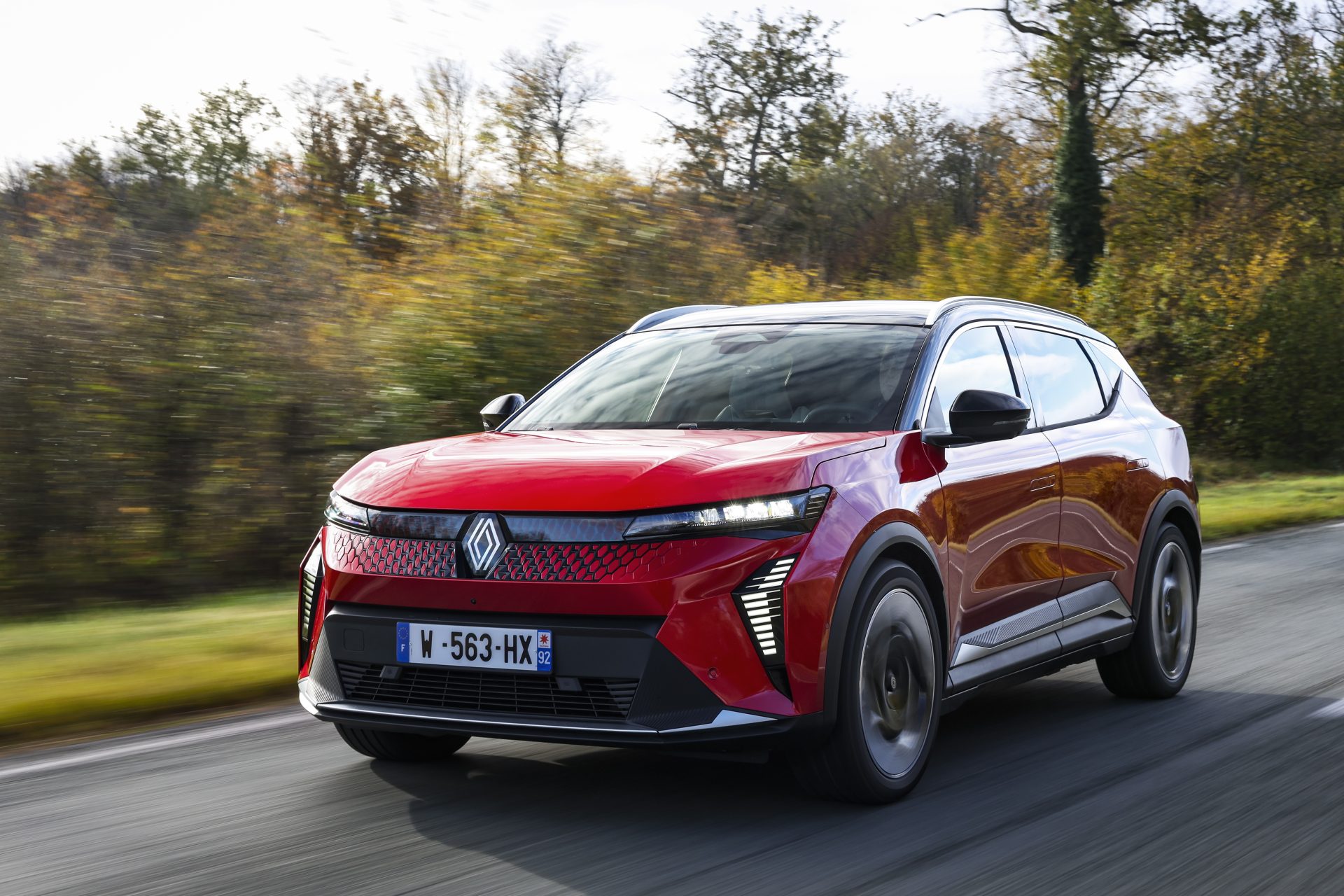
The new edition of the Scénic becomes a new family SUV format that, powered exclusively by electricity, will offer power outputs of 170 or 220 CV, batteries of 60 and 87 kWh, and a maximum range of up to 625 km
It only keeps the name of its predecessor, since 27 years of market success weigh heavily on the brand’s naming. A model that pioneered the category, with four generations aimed at families, equipped with a multitude of practical features, a wide variety of engines and, even, four-wheel drive systems.
Now that times have changed, SUVs have become fashionable and electric propulsion almost a must, Renault has decided to completely revolutionise its compact family model, transforming it into a mid-size family SUV. Its positioning is curious, as it already has several models in the same segment with a very similar purpose: Arkana, Austral, Scénic and, very soon, also the Rafale.
The brand announces that 24% of the materials used in the production of the Scenic are recycled (79% in textile materials for seats and trim; 80% in the dashboard and 51% of the materials used in manufacturing the steering wheel). More than 90% of the total materials used in the vehicle will be recyclable at the end of its useful life, including the battery.
It shares some elements with the Megane E-Tech, but it is a considerably larger model, as it measures 27 cm more in length, 10 cm more in width and 6 cm more in height, with a wheelbase 10 cm longer. That is, it measures 4.47 metres in length, 1.86 in width and 1.57 in height, with a wheelbase of 2,785 mm, dimensions closer to those of the previous-generation Scénic. It still offers many practical aspects, such as a 545-litre boot (including the underfloor space) expandable up to 1,670 litres, rear seatbacks that fold in 40:20:40 sections, a retractable rear armrest with holders for phones or tablets with USB power sockets, a flat floor, 15 litres of capacity under the boot floor and a towing capacity of up to 1,100 kg. As in previous editions of the model, it has front-wheel drive with an independent suspension system, which is now reinforced with a low centre of gravity and a weight of 1,730 kg in the small-battery versions and 1,850 kg in the large-battery ones.
Two engine and battery versions
It will come with two different versions depending on battery capacity and engine power: one with 60 kWh and 170 CV, with a range of 425 km, and another with 87 kWh and 218 CV of power, capable of promising a WLTP range of 625 km (370 km when driving on the motorway at a sustained speed of 130 km/h, the limit in France). The official performance figures are very reasonable for this type of family vehicle, with 0-100 km/h acceleration of 9.3 s in the 170 CV variant and 8.4 seconds in the 220 CV one, while top speeds have been limited to 150 and 170 km/h, respectively.
Pending confirmation of the versions and trim levels available for the Spanish market, the launch is in principle planned for the Evolution and Techno trims, with 170 and 220 CV engines with 60 and 87 kWh batteries; Esprit Alpine, in the 220 CV version and 87 kWh battery, with 20-inch wheels, as well as the Iconic, which also reserves the 220 CV engine, the large battery, 20-inch wheels, Harman Kardon sound system, etc. In all cases, a heat pump system is fitted as standard for the climate control system and battery temperature preconditioning to facilitate charging.
The price range starts at around 40,000 euros for the 60 kWh version with the 170 CV engine, while the large-battery versions (12 modules and 192 cells), long range, could carry an extra cost of about 5,000 euros.
Renault claims to have achieved very efficient consumption figures in both cases, with consumption of 16.3 kWh/100 km in the less powerful model and 16.8 kWh/100 km in the 220 CV version. For its part, charging power is 7 kW at 230 V single-phase AC or 22 kW three-phase (standard in some countries and optional in others), while maximum DC charging is 130 kW for the small-battery version and 150 kW peak power for the large one, for a couple of minutes (2% of the charge), so the average charging power would be around 110 kW.
The brand also promises to have substantially reduced charging times, as the battery preconditioning system activates automatically when the car’s navigation system is used for journeys. It announces AC charging times at 7 kW of 0-100% in 13 hours; at 22 kW of 0-100% in 5 hours, and 15-80% at 150 kW DC in 30 minutes, which would recover about 2 hours of motorway driving (roughly 50 kWh of charge).
Family interior
Not only because it reminds us a lot of the latest-generation Megane, it also has elements we have seen in other models from the brand. It features the practical gear selector on the steering column, a 12.5-inch digital instrument cluster and a 12-inch vertical infotainment screen. It includes the Android operating system with Google for maps and a voice assistant recognising more than 70 commands, 5 ambient sound modes designed by Jean-Michel Jarre, 3 acoustic modes to warn pedestrians, electric seats with relax massage on versions with electric adjustment and even a solar roof with liquid crystal darkening system, which allows the surface to be partially or fully darkened electrically and which has no impact on the overall weight.
It can also be fitted with an interior rear-view mirror with rear camera to improve rearward visibility when all seats are occupied. It may have up to 30 driving assistance and safety systems, covering assistance, prevention, protection and rescue. The new model thus features the Safety Coach system, which helps improve safe driving based on different parameters, a specific water intake for firefighters on the battery itself, an SD switch to isolate the battery power from the vehicle and a Q rescue code to identify the status of the high-voltage lines between the battery and the vehicle’s various devices.
The engine braking regeneration system with paddles on the steering wheel is interesting, with three levels of use, which is very practical for reducing speed and generating energy during deceleration. Drivers can select four different Multi-Sense driving modes: Comfort, Sport, Eco and Perso, which vary different response parameters of the engine, steering and climate control, depending on the needs of each moment.
We found the motorway range calculation system especially useful, as it takes into account the high energy consumption and low level of regeneration that occur when driving in these conditions. This is generally one of the most criticised aspects of electric models, which advertise ranges 30% higher than those achieved when driving at a sustained speed on the motorway.
Thanks to the layout of controls and instruments, the driving position is very comfortable and spacious, as there are hardly any elements interfering with driving. The incorporation of a very square steering wheel stands out – as we already saw in the Megane – with 2.3 turns of the steering wheel lock to lock.
The space in the second row is generous, especially for legroom, although headroom and width are also notable. It has rear air vents for passengers, folding seatbacks and a reasonable boot capacity, although the width of the loading opening is somewhat limited.
Very pleasant to drive
There is no bad electric car; at least in smoothness, power delivery, absence of noise and vibration. In the case of the Scénic, some aspects we criticised at the time in the Megane have been improved, such as power delivery, lack of wet grip under strong acceleration, or the behaviour of the accelerator and brake pedals.
We only had the opportunity to drive the 87 kWh version with the 220 CV engine. In this case, smoothness is one of its virtues: it does not deliver the breathtaking acceleration of some electric models, but offers a sufficient level of performance for a model whose purpose is mainly family use. It offers an instant response in any driving mode, without abrupt reactions.
In terms of suspension, it offers balanced behaviour: it is not especially soft, but neither is it uncomfortable, at least when driven unladen. It is true that it has large-diameter, wide tyres (235/45 R20), which aid rolling and limit loss of grip under acceleration, although the low profile makes road imperfections more noticeable.
Through the Multisense modes, different combinations can be made to personalise the driving, most notably in the Eco mode, which limits engine response to reduce energy consumption and improve range. In addition, the three levels of regeneration, adjustable via the paddles on the steering wheel, favour dynamic and efficient driving, almost without needing to touch the brake.
The car feels pleasant and light at all times, and indeed it is, because a weight of 1,850 kg for an electric model of this size with an 87 kWh battery is quite modest.
Regarding consumption, driving at a brisk pace, we managed to get slightly below 20 kWh/100 km, which is a reasonable figure for these route and temperature conditions, although somewhat removed from the 16.8 kWh homologated for this version. Nevertheless, if those driving conditions were maintained, we could comfortably exceed 430 real km. However, we will have the chance to carry out more conclusive tests shortly to check consumption under more stable driving conditions.
Technical specifications of this car


 Peugeot E-208 GTi: a battery-powered toy that revives the spirit of the 1980s sports cars
 New Lexus ES: luxury grows and goes electric
 First contact with the Dacia Sandero Hybrid 155: power and efficiency from €19,890
Deja un comentario