We test the new BMW X2, a sporty compact that will make you look at SUVs with different eyes
 Antonio Roncero @roncero_antonio
11 March 2024
12 min.
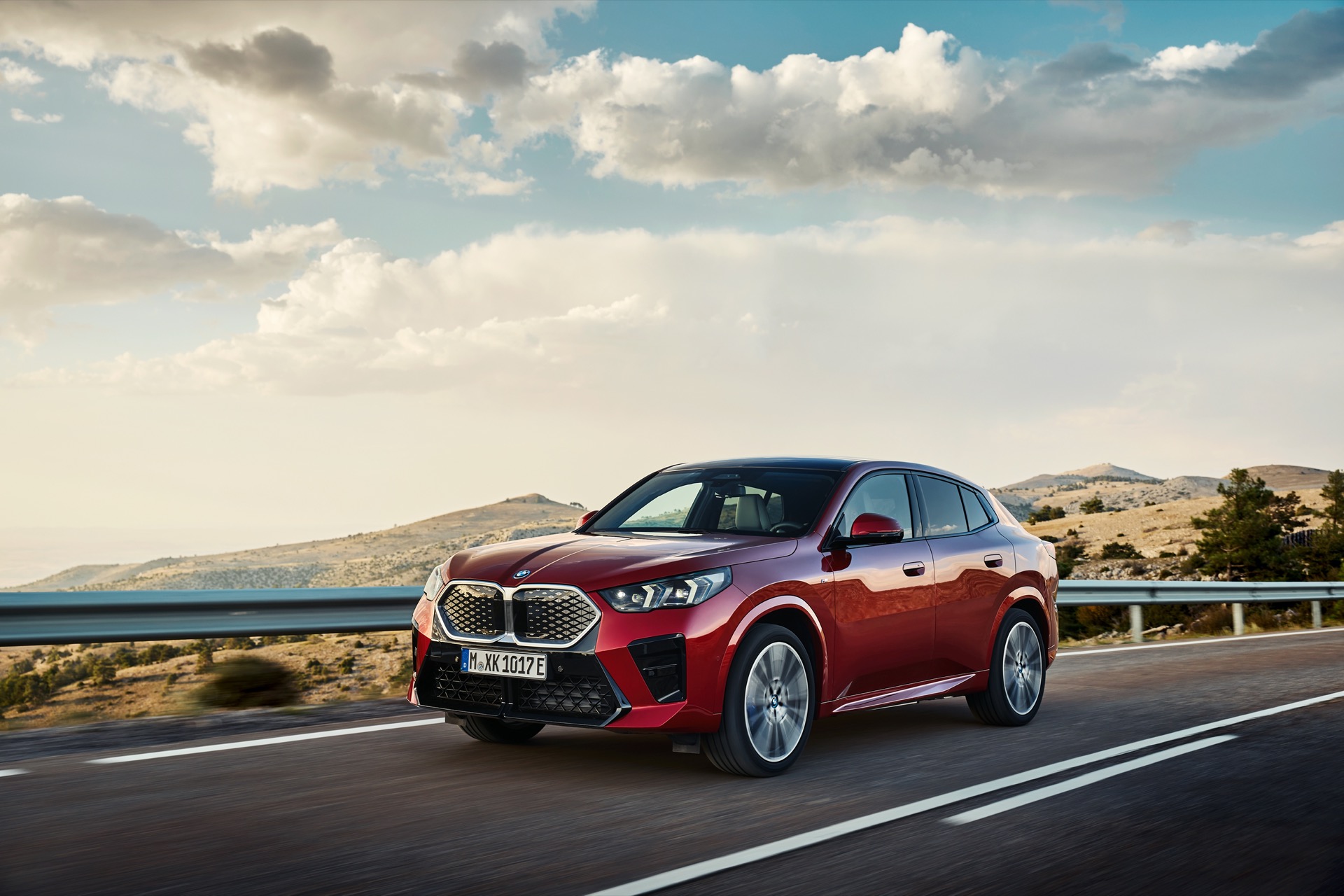
The second generation of the BMW X2 becomes a true SUV coupé that catches the eye with its design and wins over with its sporty feel, without giving up great versatility for everyday use. In addition, it now also comes with fully electric versions.
BMW has really shifted gears with the second generation of the BMW X2. A model that, finally, fits perfectly into the brand’s strategy, in which the even-numbered versions of the “X” family correspond to the coupé variants of the odd-lettered SUVs. The previous X2 was closer to a compact with crossover ambitions than to a genuine SUV coupé derived from the X1, as the X4 versus X3 are; or the X6 versus the X5.
Just look at its silhouette. Although we cannot ignore a considerable increase in size. In fact, the new BMW X2 is not only 20 centimetres longer than the previous generation model, but it even exceeds the length of the X1 by 5 cm, although it is that many centimetres lower. Its width and height also increase by 2 cm and 6.5 cm, respectively. Its dimensions are now: 4.55 metres long, 1.85 metres wide and 1.59 metres high, practically identical to those of the Audi Q3 Sportback, one of its main rivals.
Now the X2 is genuinely a SUV coupé… and practical for everyday life too
This increase in size, logically, has two immediate consequences: a clear improvement in interior space and boot capacity compared with the previous X2, which in my opinion was closer to a compact with crossover aspirations than a true SUV. Now, aesthetics aside, with its 560 litres of boot capacity (up to 115 litres more than before, and some 20 more than the X1) and much more usable rear seats, the new X2 remains a good everyday companion, but also for long journeys with passengers and luggage. And it also matches what the market demands: SUVs, of all types and all sizes.
Logically, due to the downward sloping roofline, access to the rear seats and the headroom there is not as favourable as in the X1, something taller passengers will notice. The pity is that the X2 does not retain the always practical option of adjusting legroom in the rear by sliding the bench, something the X1 does offer. And to settle the matter of interior space and boot, it must also be borne in mind that the mild-hybrid versions -the sDrive 20i and the xDrive 20d- lose about 45 litres due to the presence of the battery, and luggage volume stays at 515 litres, which is still a very good figure.
On the exterior design I will not dwell much longer, but I would like to highlight a couple of things. Firstly, the aerodynamic coefficient: a Cx of just 0.25 is a very good figure for a car like this, which in its “transformation” from X1 to X2 not only adopts a rear with a clear downward line, but the windscreen is also much more raked.
I was also struck by the design of the rear, with more angular lines than we are used to from BMW recently, which has sparked debate, especially among the brand’s enthusiasts. I must say that in the flesh, the first impression is also somewhat “quirky”, but it soon grows on you because it achieves what it sets out to do, which is to convey a sense of sportiness. The wheels can be up to 21 inches, there are thirteen body colours to choose from (eleven metallic), including a striking new Dragon Fire Red, and both the grille of the eye-catching front grille and the design of the air intakes change depending on the trim, which makes it possible to identify the basic versions from the M Sport or M Sport Pro.
The sportiness also goes inside…
Inside, the BMW X2 retains the dashboard design of the X1, with the spectacular BMW Curved Display featuring two screens, a 10.2-inch one for the instrumentation and another of 10.7 inches for the multimedia system, and the floating centre armrest that integrates a panel with some controls. But sporty touches are not lacking, both in the trim and in the design of the steering wheel or the seat options. Overall I felt very comfortable in the various versions I was able to drive during the first test of the X2 range, both in driving position and in ergonomics and seats; though those were the sporty versions, so we will have to see the “basic” ones. And as could not be otherwise with the X1 as a reference, the sense of quality, fit and feel of all the controls is first-rate.
But if there is one novelty compared with the X1, which the SUV will also soon equip and which struck me a lot, it is the update of the display and operating system -in other words, the operating system- to the version that BMW calls ID9, to get the most out of the curved screen and the intelligent personal assistant. It requires attention, adaptation and a configuration to your liking using the Quick Select shortcut function, given the number of functions and the world of possibilities it opens up for controlling the systems from the screen itself or through natural language recognition, if you do not want to get lost among so many menus.
But it opens a world of possibilities, such as wireless equipment updates after purchase, an app store to install third-party apps, Digital Key Plus BMW key on the mobile phone… I was able to try the “Augmented View” function, available as an optional add-on to the navigation system, and I assure you it is amazing how easy it is to follow a route thanks to the floating arrows that appear in advance indicating where to turn.
The BMW X2 engines: petrol and diesel, with ECO label eligibility
The BMW X2 engines are the same as those used in the X1, although the SUV coupé is not offered with the 136 PS sDrive18i or with the two plug-in hybrid variants. Incidentally, I had not said so until now: the price premium of the X2 over the X1 is not always the same, it varies slightly depending on the version, but it is around 1,600-1,800 euros. All versions have the Steptronic double-clutch gearbox, which works magnificently.
By power and price, the entry step is the sDrive18d, which produces 150 CV. Sufficient for a car that already weighs quite a bit, but with fuel consumption and smoothness of operation as its best virtues, above performance. The sDrive20i is not much faster, but it already moves in acceleration ranges closer to 8 seconds to reach 100 km/h from a standing start, while the diesel needs almost 9. Assisted by the electric motor of the 48-volt MHEV system, the small three-cylinder is very pleasant to drive and uses very little, although at least for me it does not make me forget the fantastic four-cylinder petrol engine with which the previous-generation X2 was born, and which is now BMW reserves for larger models, from the 3 Series upwards.
The second diesel alternative, the xDrive20d, also has mild hybridisation. But it offers only 13 CV more than the sDrive18d, and is paired with all-wheel drive. I think this version would have benefited from going to 180-190 CV, to better offset the weight increase that all-wheel drive entails and to clearly distance itself in performance from the sDrive18d. In all cases, the steering feel of the X2 is clearly more agile than the X1, with very responsive steering and suspension that leans towards firm.
BMW X2 M35i xDrive: the sportiest
The most expensive, most powerful and sportiest model in the X2 range is the M35i xDrive, with the 2.0-litre turbocharged petrol engine producing 300 CV and 400 Nm of maximum torque, four-wheel drive, adaptive M suspension lowered 15 mm, mechanical limited-slip differential, sports exhaust and 20-inch wheels as standard. The engine is an evolution of the one used in the M135i xDrive, now operating on the Miller cycle with modifications to the intake, exhaust, valve timing and lubrication system. With an electronically limited top speed of 250 km/h, it accelerates from 0 to 100 km/h in 5.4 seconds using “Launch Control“. It also has the so-called “M Sport Boost” function, which is nothing more than the sportiest driving mode, and which can be activated by holding down the left paddle on the steering wheel.
The standard equipment of the M35i xDrive includes sports seats upholstered in an exclusive combination of leather and Alcantara with contrasting stitching. Externally it is distinguished by its grille, the M exterior mirrors, the M spoiler and the rear diffuser with four exhaust outlets. Optionally you can choose M sports seats, 21-inch wheels and the M Compound high-performance brakes, with 385 mm perforated discs and four-piston calipers on the front axle, and 330 mm discs on the rear axle.
Among SUVs of this size with engines around 300 CV and such a sporty approach, the first alternative to consider to the X2 M35i xDrive would be the CUPRA Formentor VZ, with 310 CV, with as sporty a feel as the X2 and much cheaper. At the other extreme, an Audi RS Q3 Sportback is more expensive, but also in another league in terms of sensations, with its 5-cylinder engine and its 400 CV.
Also with fully electric versions: the BMW iX2
For the first time, the X2 also comes with 100% electric versions, which following the brand’s nomenclature are called BMW iX2, and are equivalent in mechanical configuration and battery to those of the iX1, although in this case with greater range as the X2 has more favourable aerodynamics and frontal area for fighting the wind.
The iX2 eDrive20d uses a 150 kW (250 CV) motor with 250 Nm of maximum torque on the front axle, accelerates from 0 to 100 km/h in 8.6 seconds and has a top speed limited to 170 km/h, with a homologated WLTP range of between 438 and 478 km. The iX2 xDrive30 uses a motor on each axle to deliver a system output of 230 kW (313 CV) and a maximum torque of 494 Nm, allowing it to accelerate from 0 to 100 km/h in 5.6 seconds, a figure comparable to that of the X2 M35i xDrive, although the top speed here is limited to 180 km/h. The homologated range in this case is between 417 and 449 km. Compared with the combustion-engined versions, boot capacity remains a good 525 litres.
The battery is always 64.8 kWh in capacity. It can be recharged in about 6.5 hours using alternating current at 11 kW, or in under 4 hours on a three-phase 22 kW charger. With direct current it accepts charging power of up to 130 kW, which allows recovering about 120 km of range in 10 minutes, or going from 10 to 80% in half an hour, under ideal conditions. During the test drive I was able to briefly drive the most powerful version on a stretch of winding road with good asphalt. I found it a car you can enjoy a great deal behind the wheel, although it requires driving with particular attention due to the immediacy of response to the accelerator and the quickness of the steering; however, for this kind of driving I would choose the M35i xDrive.
Equipment and prices of the BMW X2
The prices of the BMW X2 range for the Spanish market start at 45,800 euros for the entry version, and go up to 72,000 euros for the top-of-the-range X2 M35i xDrive. The X2 range with combustion engines is as follows:
- X2 sDrive18d: 45,800 euros
- X2 xDrive20d: 49,900 euros
- X2 sDrive 20i: 47,300 euros
- X2 M35i xDrive: 72,000 euros
As for the BMW iX2, the price of the eDrive20 version is 50,700 euros, and 58,200 euros for the xDrive30.
All versions include as standard the leather-wrapped sports steering wheel, power tailgate, air conditioning, cruise control with braking function, parking assistant, LED headlights, the BMW Curved Display with the two screens and the ConnectedDrive services. From here on, BMW offers the possibility of expanding the equipment through packs, such as the M Sport and M Sport Pro with a clear sporty accent; or the Premium and Innovation packs, which integrate all kinds of driver assistants and aids.
Keeping in mind the entry sDrive18d version of 150 CV, especially for those who travel a lot, for 1,500 euros more I find the 170 CV sDrive20i especially interesting, which has better performance, can be very economical and has the ECO label. If you want diesel and the ECO label, it has to be the xDrive20d, which rises to 49,400 euros because it is paired with all-wheel drive. But trust me, although the 2-litre turbodiesel of the BMW remains one of the best diesel engines on the market, the small three-cylinder petrol will surprise you.
BMW X2 2024 – Image gallery
Technical specifications of this car


 Peugeot E-208 GTi: a battery-powered toy that revives the spirit of the 1980s sports cars
 New Lexus ES: luxury grows and goes electric
 First contact with the Dacia Sandero Hybrid 155: power and efficiency from €19,890
Deja un comentario