Honda ZR-V Hybrid Cars ECO Tests SUV
We tested the Honda ZR-V Hybrid, the SUV version of the Civic that will win you over with its comfort and low fuel consumption
 Antonio Roncero @roncero_antonio
5 April 2024
12 min.
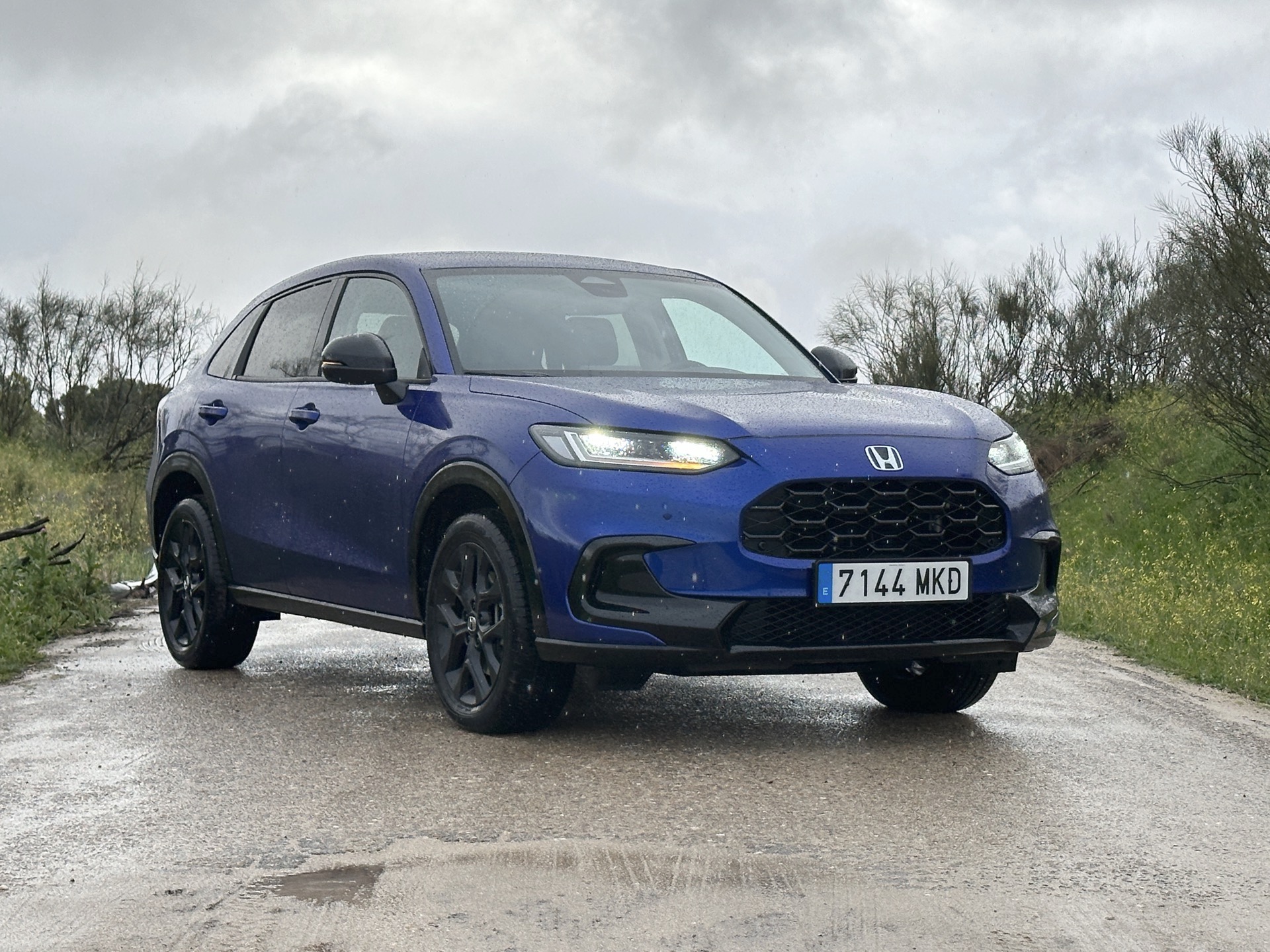
Just as the Honda Civic is a car that catches the eye and stands out from its competitors immediately thanks to its design, the Honda ZR-V, the SUV version of the Civic, is one of those cars we could describe as rather discreet. I’m sure that, were it not for the brand logo, many people wouldn’t recognise that it’s a Honda from its lines alone. But it’s also true that, although it doesn’t fall in love with you, that somewhat, shall we say, conservative line has its advantages: it’s hard to find anyone who dislikes it.
At 4.57 metres long, the ZR-V sits in the range between the HR-V and the CR-V, the former slightly more compact, the latter larger and with a more family-oriented approach. According to Honda, the ZR-V is its “sportiest hybrid”. Aesthetically it shows some differences in the design of the grille, the air intakes or the exhaust outlets depending on the chosen trim. The unit we tested is a Sport, in blue with black-finished alloy wheels. Personally I think it doesn’t do it justice: the pearl white, which you can also see in the photos with the Advance trim, suits the ZR-V much better regardless of the wheels chosen. Body colours in red or black, always metallic, are also available.
And there are two exterior packs that enhance the car’s image. On one hand the Aero pack, which includes a front aerodynamic spoiler, a tailgate trim piece, side skirts, a tailgate spoiler in body colour and grey mirror caps; and on the other the Robust pack, distinguished by wheel-arch add-ons acting as mudguards, prominent side steps and a front lower trim piece that simulates a sump guard.
The interior of the Honda ZR-V: quality and comfort
The dashboard lines of the ZR-V are practically identical to those of the Civic, with a very pleasant design in which two things immediately stand out: the sense of quality conveyed by the materials used, both visually and to the touch, above the average for the class; and the presence of physical controls, the old-fashioned kind, for the climate control, something increasingly rare given the prominence of touchscreens. In the Civic’s case, the screen is 9 inches, very well integrated into the dashboard and within easy reach, so you can operate it and access any part of the display without practically having to move your back off the seat. In addition, on the left-hand side it has direct-access buttons for some of the main functions.
Since we’re on the multimedia section, while it’s true that at first the system can seem a little dated in the presentation of its menus and with a screen size that is starting to look small compared with what we’ve been seeing lately even in smaller cars, the truth is it works very well, both in fluidity and range of information, and when it comes to wirelessly integrating your phone, at least with Apple CarPlay, which is how I tested it. I also liked the instrumentation, with a digital display that represents “classic” gauges very clearly and legibly. In the Advance versions the instrument screen is larger and is complemented by a head-up display.
Where we find more differences is in the design of the centre console, with an open lower area between the front and the armrest that offers a surface for flat items such as a phone – although the dedicated spot for the phone with the wireless charger is further forward – and with USB sockets on the sides, one conventional and one USB-C. Instead of a gear lever or a rotary dial, Honda uses a curious selector for the drive position, with buttons of different design, size and shape of activation for the “P”, “R”, “N” and “D” positions. The advantage is that the upper area of this console is clearer, though personally I prefer and find more comfortable and easier to use a small lever or a single button with sequential function. Behind it sits the control for choosing driving modes, a button to activate the hill descent control and the automatic parking brake.
The driving position is “more like a saloon car” than in other SUVs, and I really liked the seats: comfortable, with good support and an upholstery in this Sport version that looks very hard-wearing. I find the steering-wheel controls could be improved: they aren’t laid out so you can comfortably operate them all with your thumbs, since some are rather far apart. On the plus side, from the wheel you can activate or deactivate the lane keeping assist and control the distance to the vehicle ahead when using the adaptive cruise control, something I particularly appreciate instead of having to go to the screen and navigate through different menus. Behind the wheel there are paddles to control the intensity of the energy recovery system when you lift off the accelerator; I’ll tell you more about that later.
As for space, I mentioned at the start that for those seeking a family car, the CR-V is the SUV from Honda to look at; even so, the ZR-V’s rear seats are adequate when it comes to travelling, but passengers should think carefully about what they bring: the boot is 390 litres, which is few relative to the car’s size and, above all, compared with its main rivals, where cars such as the Kia Sportage, the Renault Austral or the Mazda CX-5, for example, exceed 500 litres.
A hybrid with the feel of an electric car
One peculiarity of the Honda ZR-V, as in all Honda models with the e:HEV hybrid propulsion system, is that unlike “conventional” hybrids, most of the time it is an electric motor that drives the wheels. It is therefore a powerful motor, with 184 hp, which is the power figure the car advertises. There is a second, smaller electric motor that never drives the wheels; it only works as a generator to produce electricity. And a 2-litre, 4-cylinder petrol engine that operates on the Atkinson cycle, produces 143 hp and whose main job is to drive the generator, although in certain circumstances it connects to the wheels via a clutch.
The operation is as follows: the car always starts in EV mode, and the Hybrid mode only engages if the battery charge drops below a certain level or when you press the accelerator hard demanding a lot of power. Then the combustion engine comes into play, but only to produce electricity by driving the second electric motor that acts as the generator. In the third mode, called Engine, it is the only one in which the petrol engine propels the vehicle. And it does so through a fixed gear ratio, so there is no gearbox as such. For this reason Honda has programmed the system so that the combustion engine varies its operating speed, giving the impression that you’re driving a car with an automatic gearbox with fixed ratios. It largely manages it, and besides, the engine doesn’t sound bad at all. Only when you accelerate flat out does it become clearly noticeable, but never in an annoying or unpleasant way.
It may seem very sophisticated, and in reality it is. But it is very effective and, in practical terms, the best part is that you won’t notice anything odd, nor does it require any more attention to driving. On the contrary, here the driver can’t choose between the different operating modes of the hybrid system; the car does everything automatically. The main advantage is that, since the electric motor takes on the main responsibility for propelling the car, the response is very smooth and pleasant. Especially when driving in town, though also on country roads or motorways, as it has good acceleration and recovery capacity, even when travelling with a full load.
What can the driver control beyond the pedals and the steering wheel? Well, on one hand the Eco, Normal, Sport or Snow driving modes from the button on the centre console; and on the other, the intensity of braking via the paddles on the steering wheel. You’ll end up using the first one little; it acts on steering assistance and throttle response, but to be honest there aren’t very marked differences at the wheel: either you set “normal” and forget about it, or you choose “eco”… and you forget about that too unless you hit a winding road or want to feel the push on acceleration more immediately, because the power reserve is always there, you just have to press the accelerator fully. As for the paddles, which by the way have a magnificent feel, it’s more of the same. They don’t provide very strong deceleration even at the maximum of the four predefined energy recovery levels, and except in “Sport” mode they don’t retain memory and the selected level deactivates after a few seconds, so you end up forgetting about them.
If in terms of dynamic sensations the ZR-V delivers what you’d expect from a car with this level of power, standing out for the aforementioned smoothness and driving pleasure, when it comes to efficiency the Japanese SUV sets itself apart with figures that, lately, we have only also seen in another SUV with a peculiar hybrid system, the Austral E-TECH, one of our favourites in this category. With the ZR-V it’s possible to use very little fuel, and to finish routes with the on-board computer showing around 5 l/100 km without paying much attention to driving, especially on urban routes or ring roads. On the motorway it isn’t as efficient as the Austral, but it’s not difficult to keep between 7 and 8 l/100 km, which is not bad at all.
As for dynamic behaviour, the ZR-V stands out for a firm suspension and a precise steering that provide an agile feel, without ever compromising the ride comfort, which is very high both because of the way the suspension “swallows” potholes – helped by the chosen tyres, 225/55-18, nothing exaggerated – and because of its soundproofing. A car that invites relaxed driving, but with a “little something” different from other hybrids whether you want to prioritise smoothness or at some point decide that consumption takes a back seat.
Equipment and price of the Honda ZR-V
And we come to the most delicate part when assessing a car like the ZR-V: its price. Because it requires an outlay of around €7,000 more than a Civic with which it shares its platform and engine, and it is also more expensive than its main rivals. The entry version, the ZR-V with Elegance trim, costs around €43,000; the Sport is priced at €45,000, and the Advance reaches €47,000.
To put it in context, a Renault Austral E-TECH Hybrid with 200 hp starts from around €36,500 in Evolution trim, and the top of the range, the Esprit Alpine, comes to around €42,500, less than the cheapest ZR-V. Another good reference, the Kia Sportage HEV, with 230 hp, is available from €38,000, although the sporty GT-Line 4×2 version, which costs €46,000, gets closer to the ZR-V’s price. A Lexus UX 250h, also with 184 hp and that “premium brand” plus that can also be associated with Honda, costs under €39,000 in Business trim, although it moves away from the Honda in the higher versions, reaching €55,200 with the F Sport trim.
That said, the ZR-V’s equipment is very generous. All of them come as standard with the Honda Connect multimedia system and the complete Honda Sensing driver-assistance package, dual-zone climate control, rear-view camera, LED headlights with automatic high beam – which, by the way, work very well – and 18-inch alloy wheels. The Sport adds mixed fabric and imitation leather upholstery, ambient interior lighting, a wireless phone charger, an electric tailgate and privacy glass. And the Advance adds heated steering wheel, instrumentation with a 10.2-inch screen instead of 7″, the head-up display, the Bose audio system with 12 speakers and a subwoofer (note that this takes around 10 litres from the boot) and full perforated imitation leather upholstery.
Honda ZR-V e:HEV | Image gallery
Technical specifications of this car


 Kia offers an electric range of 10 models, 50 versions and 400 possible combinations
 The seven finalists for the 2027 European Car of the Year (COTY) are exclusively electric
 Peugeot E-208 GTi: a battery-powered toy that revives the spirit of the 1980s sports cars
Deja un comentario