Arkana Renault Hybrid Cars Tests SUV
You don't need to spend a fortune to get a coupé-style hybrid SUV: you can have a Renault Arkana E-TECH from under 30,000 euros
 Antonio Roncero @roncero_antonio
30 August 2024
10 min.
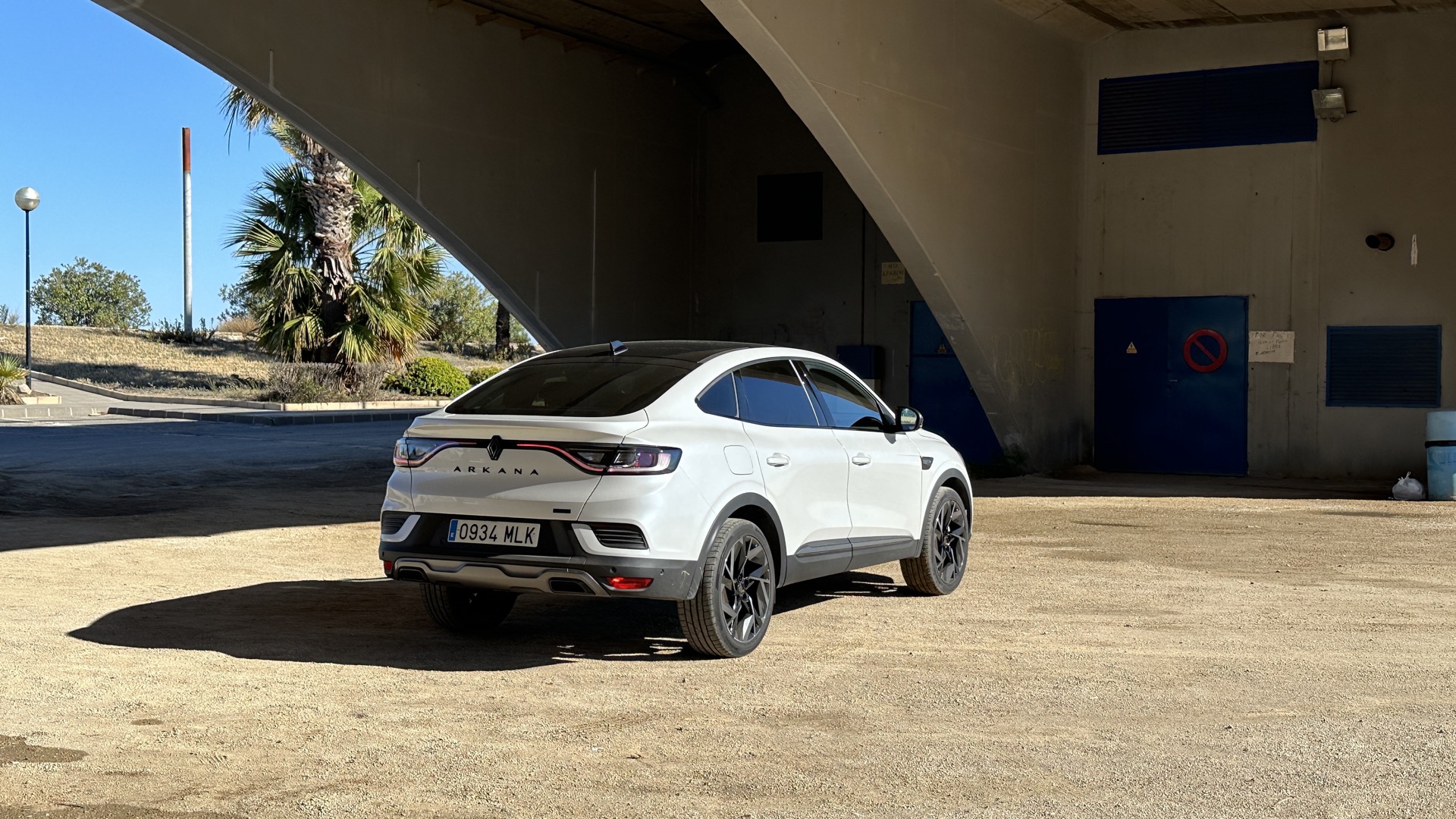
There is no other SUV with coupé bodywork and a hybrid engine on the market that is more affordable than the Renault Arkana E-TECH, available from around 30,000 euros, and now also with the sporty esprit Alpine trim.
The Renault Arkana has two of the most sought-after features today among buyers looking for a new car: SUV bodywork and hybrid powertrain. There are quite a few options on the market that meet these conditions. But if we also add a coupé silhouette, which is increasingly fashionable, and a price between 30,000 and 35,000 euros, the list shrinks so much that you could count the candidates on one hand.
Under these premises, the new Toyota C-HR would enter a hypothetical list of candidates. And without such a markedly coupé line, we could also add cars that exude a certain sporty aura, more through their steering feel than their design, such as the CUPRA Formentor and the Alfa Junior. Moving up a couple of steps in price, within the Renault range itself there is the new Rafale. And then we move on to premium-brand models that require a budget above 50,000 euros, such as the BMW X2 or the Audi Q3 Sportback.
That said, the Renault Arkana E-TECH is the only hybrid coupé SUV available below the 30,000-euro barrier. And this is, without doubt, one of the keys to its success, not only in the Spanish market, where it has been sold since 2021, but also in Europe. A model that received a light update in the summer of last year, its main novelty being the arrival of the esprit Alpine version to the range, which is precisely the one we have tested.
Arkana esprit Alpine: a design that catches the eye
I have to admit that I like the Arkana much more now than before the restyling, at least in this esprit Alpine version. It’s true that the changes in the update were minimal: grille, new logo, removal of chrome trim and slightly tinted rear light clusters. But the extra elements of the esprit Alpine suit it wonderfully, as does this combination of pearl white bodywork with a black roof. Of course, choosing the esprit Alpine trim means paying a premium: specifically, 3,500 euros more than the intermediate techno trim, which is the one I find most advisable.
What does the esprit Alpine add for that extra cost? Well, a whole host of exterior and interior styling details, plus the winter pack, which includes heated electric front seats (the driver’s with lumbar adjustment) and a heated steering wheel. The Arkana esprit Alpine stands out for some applications with gloss black details; for the 19-inch two-tone alloy wheels (with a design that I personally find rather overdone); the magnificent sport seats upholstered in a combination of Alcantara and a microfibre called ECOTEP; the embroidered logos on the seatbacks; the tricolour stitching on the seats, door panels, steering wheel and seatbelts; and the slate-effect finish on the dashboard decorative inserts.
To sum up, if you want that differentiating touch and can afford it, the esprit Alpine is the perfect “factory tuning”. But if not, the techno version is worth it over the evolution, and you save a good chunk compared with the esprit Alpine… money you can invest, all or in part, in the optional packs that interest you. There is a parking aid pack (870 euros), the Bose audio pack (720 euros), the aforementioned winter pack (520 euros), the black roof (450 euros) or the openable panoramic roof with spoiler-type opening (1,120 euros). In addition, there is a large number of options available as dealer accessories, from bike racks, towbars and multifunction organisers for the cabin or boot, to exterior personalisation packs, seat protectors and even a LED underbody lighting kit.
Interior: more space than it seems and a good multimedia system
The Arkana’s restyling brings no significant changes inside. In this esprit Alpine version, the contrast between areas with materials of good visual and tactile quality and those that use hard plastics becomes more evident, but the overall finish is correct. I have already said, but I don’t mind repeating, that the seats in this trim seem magnificent to me, and so does the steering wheel, although the price to pay is high. The instrumentation is digital, with a 10.2-inch screen, while the multimedia system screen is 9.3 inches, positioned vertically (on the less equipped Arkanas the screens are 7 inches in both cases).
One thing I like about the Arkana is that it keeps physical controls for many functions, with a row of buttons below the touchscreen (multisense driving modes, video camera, heated seats, automatic parking activation or EV mode), easy-to-use rotary controls for the climate system, and additional buttons on the dashboard to the left of the steering wheel (lane-keeping system activation, heated steering wheel, headlight height control and instrument cluster brightness adjustment).
The multimedia system screen is not very large by today’s standards, nor does it stand out for its resolution. But it does what it has to do well: responds correctly to touch commands and, above all, offers very easy and intuitive operation. And it is not the outstanding latest-generation system based on Google Automotive that the Austral or the new Captur already feature. In addition to the usual cup holders and the wireless phone charging tray, there is a usable space between the seats, with a sliding armrest that allows a very comfortable driving position.
Despite its coupé line, the rear seats are very practical. The sloping roofline does not hinder access, and there is enough room for two adults to travel without cramping, although legroom is not its strong point. When it comes to luggage, the Arkana benefits from the large opening of the tailgate and a boot with very regular shapes. The E-TECH versions lose about 35 litres of capacity compared with the combustion and mild-hybrid variants, but their 480 litres remain a good figure, and the floor can be placed at two heights to divide the load. Optionally, for 200 euros, an emergency spare wheel can be fitted, which sits under the floor.
Behind the wheel of the Renault Arkana E-TECH: more efficient than sporty
I have driven the Arkana E-TECH in all kinds of situations: city, mountain roads, interurban routes and a couple of long motorway journeys, and what struck me most is how little it consumes. What I like least is something that happens to practically all non-plug-in hybrid cars, but which I have noticed more in the Arkana than in others: when the road climbs or if you drive demanding a lot from the engine, the battery discharges and there is a clear loss of pulling power and acceleration.
But don’t worry, it is nothing to be concerned about. As I say, this only happens in very specific situations that are not common in daily driving, and it is temporary: as soon as you can lift off the accelerator and let the energy recovery system work, the battery recharges quickly. Related to this, we find one of the few technical novelties of the Arkana E-TECH in this restyling: Renault has added an “E-SAVE” mode that keeps the battery capacity at 40% and does not let it drop below that. This way, although it slightly increases consumption, you can select “E-SAVE” mode if you don’t want to lose performance when you need to demand more from the engine.
As for consumption, with the Arkana E-TECH it is very easy to use little fuel even if you don’t try. The average on urban routes and ring roads, where it is a very pleasant car to drive thanks to the thrust provided by the electric motor, is practically always around 5 l/100 km. And travelling at a relaxed pace on the motorway it uses less than other hybrid cars: between 6.5 and 7 l/100 km. Renault says that, if conditions allow, the system can operate up to 80% of the time in electric mode. It may seem a lot for a non-plug-in hybrid. But the truth is that you end up seeing the “EV” indicator on the instrument cluster for much longer than with any of its rivals using hybrid technology.
Consumption: a “cigarette lighter” in the city
As the following example shows: I was able to drive 30 km on the M-40 in Madrid starting with a range of 180 km and an average consumption of 5.2 l/100 km, and arrive at my destination with an average consumption of 4.7 l/100 km and practically the same range, as the distance covered offset the reduction in average consumption. Admittedly, I was driving in ECO mode, treating the accelerator as if it were made of glass, at speeds between 80 and 90 km/h and taking advantage of a certain “one-pedal” effect. There are no different levels of regeneration here, but when the system is recharging the battery, it is possible to reduce the intensity of regeneration by accelerating very slightly. This comes in handy on some downhill stretches where, if you select “B” on the gear selector, the car brakes a lot, but in “D” it retains less than you would like. Although, as I say, it requires care and constant attention to the accelerator. If you want no complications, the best approach is to drive without paying attention to the consumption indicator and let the car handle everything in automatic mode.
Otherwise, the Arkana E-TECH is more comfortable than agile, with steering feel more family than sporty and, in any case, more “solid” than you might expect from a car that, after all, shares the same platform as the Renault Clio. The suspension work and good cabin insulation favour comfort, and driver assistance features such as active cruise control with lane keeping or automatic high beams make driving much easier.
The main doubt when buying an Arkana may concern which engine to choose, as there is a 140 hp TCe variant with EDC gearbox and mild hybridisation (also with an ECO label) which, with equivalent equipment, costs about 1,500 euros more, offers practically equivalent performance and slightly more boot space. But it is as smooth and pleasant to drive day to day as the hybrid E-TECH… and consumes around 2 l/100 km more on average, so the hybrid strikes me as the most sensible choice.
Renault Arkana E-TECH | Image gallery
Technical specifications of this car
 Kia offers an electric range of 10 models, 50 versions and 400 possible combinations
 The seven finalists for the 2027 European Car of the Year (COTY) are exclusively electric
 Peugeot E-208 GTi: a battery-powered toy that revives the spirit of the 1980s sports cars
Deja un comentario