40 years of dominance: The evolution of the seven generations of the BMW M5
 Óscar Sanz
5 August 2024
3 min.
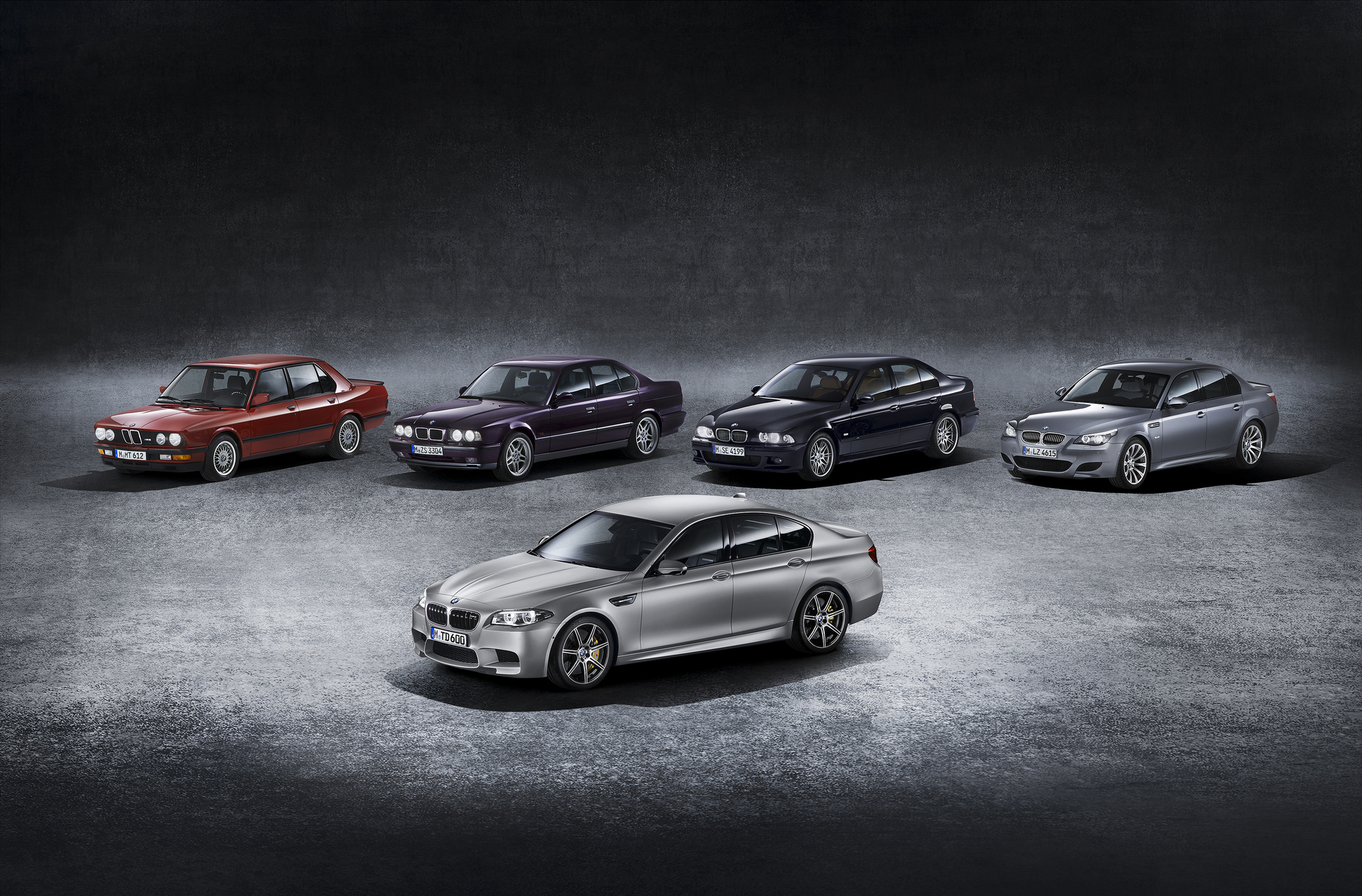
Since 1984, the BMW M5 has been the king of sports saloons. Here we take a look at its seven generations and the one yet to come, the BMW M5 Touring
The BMW M5 has been an icon in the world of sports saloons since its debut in 1984. Over its seven generations it has proven to be one of the most dynamic and versatile models on the market, capable of offering both high-end performance and comfort for everyday use. Today, we take a look at the different generations of this legendary car, from its origins to the most recent model of 2024.
1984: The birth of the M5 (E28S)
The first BMW M5 appeared in 1984, based on the 5 Series E28. Equipped with a 3.5-litre six-cylinder inline engine producing 286 CV, derived from the BMW M1, this vehicle could reach 100 km/h in 6.5 seconds and had a top speed of 245 km/h. This M5 quickly became the fastest four-door saloon of its era, marking the beginning of a legend.
1988: The first evolution (E34S/E34/5S)
The second generation of the M5 arrived in 1988 with a larger and more powerful engine. The E34S featured a 3.6-litre engine producing 315 CV, which was upgraded in 1992 to a 3.8-litre unit with 340 CV. In addition, this generation included a Touring version for the first time, although production was very limited, which makes it a highly sought-after classic today.
1998: The revolutionary V8 (E39S)
In 1998, the M5 E39S introduced a 4.9-litre V8 engine, generating 400 CV. This generation kept rear-wheel drive and a six-speed manual gearbox, allowing the car to reach 100 km/h in 5.3 seconds and an electronically limited top speed of 250 km/h.
2005: The innovative V10 (E60/E61)
The fourth generation of the M5, launched in 2005, featured a Formula 1-inspired V10 engine, with 507 CV and a maximum speed of 7,750 rpm. This model introduced the seven-speed M sequential automated gearbox (SMG) and the Launch Control system, enabling acceleration from 0 to 100 km/h in 4.7 seconds. For the first time, the option to deactivate the speed limiter with the M Driver’s Package was offered, reaching 305 km/h.
2011: Turbocharging arrives (F10M)
The fifth generation of the M5, known as the F10M, debuted in 2011 with a 4.4-litre twin-turbo V8 engine producing 560 CV. This model also featured a seven-speed M double-clutch gearbox and reached 100 km/h in 4.3 seconds. Special editions, such as the “30 Jahre M5” and the “Competition Edition”, raised the power to 600 CV, consolidating the F10M as a true supercar.
2017: All-wheel drive and more power (F90)
The M5 F90, launched in 2017, introduced M xDrive all-wheel drive, improving traction and handling. With a 4.4-litre V8 engine producing 600 CV, this model reached 100 km/h in 3.4 seconds. The Competition and CS versions increased the power to 625 CV and 635 CV respectively, further reducing acceleration times and raising the top speed to 305 km/h.
2024: The hybrid era (G90/G99)
The latest M5, the G90, marks the beginning of a hybrid era. Equipped with the M HYBRID system, it combines a 585 CV combustion engine with a 197 CV electric motor, reaching a total output of 727 CV and 1000 Nm of torque. This model also features all-wheel drive and promises impressive acceleration, maintaining the M5’s tradition of exceptional performance.
In 2024, the BMW M5 Touring will also be launched, marking the return of this practical yet sporty variant since its last appearance in 2007. With this new generation, BMW celebrates 40 years of history, combining advanced hybrid technology with the power that has always defined the M5.

 Peugeot E-208 GTi: a battery-powered toy that revives the spirit of the 1980s sports cars
 New Lexus ES: luxury grows and goes electric
 First contact with the Dacia Sandero Hybrid 155: power and efficiency from €19,890
Deja un comentario