BYD moves ahead into the future with new strategies
 Rafa Guitart @GuitartRafa
8 June 2026
7 min.
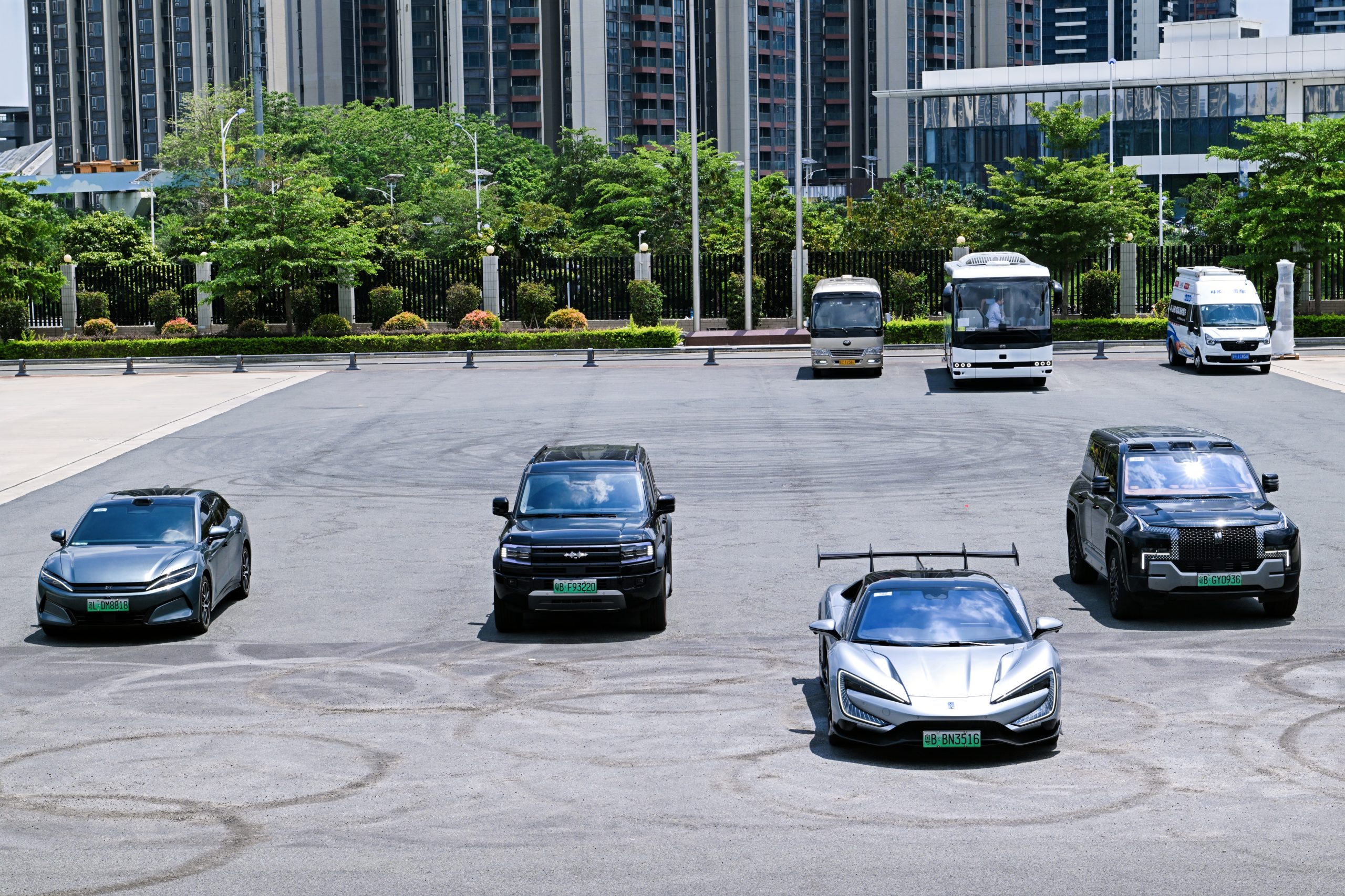
The Chinese manufacturer BYD has unveiled its new strategy for the era of intelligent driving, which aims to achieve zero road traffic fatalities, improve driver assistance systems and harness artificial intelligence for personal assistance.
The Chinese brand announces future-oriented solutions with its new Intelligence Strategy, its ultra-fast charging system and the latest generation of assisted driving. It has already become the global leader in plug-in vehicles and battery technology, having sold more than 16 million units, but the brand wants to go further by leading technologies that improve safety, faster battery charging and artificial intelligence as the main means of personal assistance while driving.
The brand holds more than 65,000 patents of its own, with its strategy focused on the development and manufacturing of batteries, electric motors, electronic control systems and semiconductor chips. It currently employs 120,000 engineers and technicians, with more than 30 industrial parks and 11 research centres.
The goal of BYD is to offer solutions capable of improving people’s lives through the creation of a complete clean energy ecosystem that reduces global dependence on fossil fuels.
A showcase of technology
Taking advantage of the presence of a large number of journalists from around the world at BYD’s main facilities in Shenzhen, in southern China, it has unveiled its main新 developments for the near future, such as the new Intelligence Strategy focused on improving the God’s Eye driver assistance system.
It has also presented its new high-integration microprocessor, the XUANJI A3, the first 4-nanometre driving processing unit (SoC) developed in China.
With the aim of reinforcing its strategy of offering intelligent driving for everyone, it has announced that its entire range of vehicles sold in China will be optionally available with the LiDAR version of the God’s Eye system. This technology combines high-precision LiDAR, HD cameras and millimetre-wave radars to map the environment in 3D and ensure maximum driving safety.
Advanced intelligent driving
With state-of-the-art assisted driving, BYD aims to achieve zero road traffic fatalities, rely on driver assistance systems to improve safety and harness artificial intelligence so that it acts as a super personal assistant.
To achieve this, the company announced that it will invest more than 100 billion yuan (5.389 billion euros) in R&D to develop and strengthen intelligent driving assistance systems, focusing on safety technologies.
The God’s Eye system used in vehicles sold in China uses an artificial intelligence model that draws on information collected by more than 2.65 million vehicles covering more than 160 million kilometres a day. This infrastructure is centred on the new XUANJI 2.0 Architecture, based on satellite sensors and pioneering in the industry; an updated large-scale physical AI model and a self-evolving data recording system supported by a massive number of real-world scenarios, so it can react faster and drive more smoothly.
To carry out all automated tasks safely, the BYD system does not rely on a single technology, but on a concentration of intelligent driving sensors that includes: high-precision LiDAR, to map the environment in 3D and even create “virtual lanes” when the road has no painted lines; HD cameras and millimetre-wave radars that work together to detect obstacles, pedestrians and vehicles.
The Tianshen A models feature 3 DiPilot 600 Lidar units, 5 radars and 33 sensors (Yangguang U8); the Tianshen B have 2 DiPilot 300 Lidar units, 5 radars and 31 sensors (BYD and Denza), while the Tianshen C incorporate a front camera with three DiPilot 100 lenses, 5 radars and 12 high-resolution cameras (BYD).
Thanks to the sensors and AI, the vehicle can handle city navigation, making decisions in real time. Key functions include autonomous turning at intersections and traffic light management; overtaking and lane changes; handling unexpected situations and obstacle avoidance to dodge cones and roadworks diversions, as well as proactively giving way to pedestrians and cyclists. It also covers autonomous navigation at roundabouts and U-turns.
BYD was the first manufacturer in China to receive the national test licence for Level 3 autonomous driving (L3), and its high-end models integrate a hardware redundancy system for steering, braking and propulsion, ensuring that if one component fails, the car maintains control.
The brand has also presented the DiLink AI Intelligent Cockpit system, which incorporates a “super intelligent” agent. Equipped with advanced reasoning capabilities, this digital assistant proactively carries out tasks in constant evolution to provide a seamless on-board experience in any scenario.
High-performance microprocessor
Another notable event for the brand was
the presentation of the new XUANJI A3 super processor, the first 4-nanometre automotive-certified driving processing unit (SoC) developed entirely in China. It offers native support for Level 3 and Level 4 autonomous driving, and its three-chip configuration can reach very high computing power. It claims the lowest energy consumption on the market —20% lower than comparable products— and is already in mass production. This high-integration chip is combined with BYD’s own algorithms, making it possible to double computing efficiency, improving aspects such as safety and performance.
Flash Charging, also for BYD
Fast charging is no longer a privilege of the group’s premium brands; now, with the installation of the new Blade Battery, it is incorporated into the BYD models that use it. This system, based on super chargers with up to 1,500 kW of power, has booster batteries to supply such a large amount of energy. In addition, the design of the charging stations is especially relevant, as each charger has a suspended T-shaped design layout, so the cables hang from the top on a sliding rail, meaning the user does not have to bear the weight of the connector and the heavy-gauge cable.
The system relies on a high-power connection (150 kW or more) together with a group of batteries and an inverter, capable of converting the incoming alternating current into direct current to charge the buffer batteries. In this way, the system allows simultaneous charging of two vehicles from each charging point.
Thanks to this system, the brand announces charging from 10 to 70% in five minutes; from 10 to 97% in 9 minutes at a mild temperature and in 12 minutes in extremely cold conditions (down to -30ºC).
We had the opportunity to see a live demonstration of fast charging on a BYD Plus (not yet sold in Europe), which started from 10% and reached 80% charge in less than 8 minutes (at an ambient temperature of 32ºC).
Although the Flash Charging system is not yet available in Spain, it is planned to start with the commercialisation of the Denza models from this coming summer. It will later be extended to future BYD models equipped with the new Blade Battery, possibly at the beginning of 2027. The brand intends to install between 200 and 300 facilities before the end of the year.
Image gallery

 Peugeot E-208 GTi: a battery-powered toy that revives the spirit of the 1980s sports cars
 New Lexus ES: luxury grows and goes electric
 First contact with the Dacia Sandero Hybrid 155: power and efficiency from €19,890
Deja un comentario