Peugeot Coches clásicos Compact Curiosities
Cars with History: Peugeot 205 on its 30th Anniversary
 Fernando Alvarez
2 February 2013
4 min.
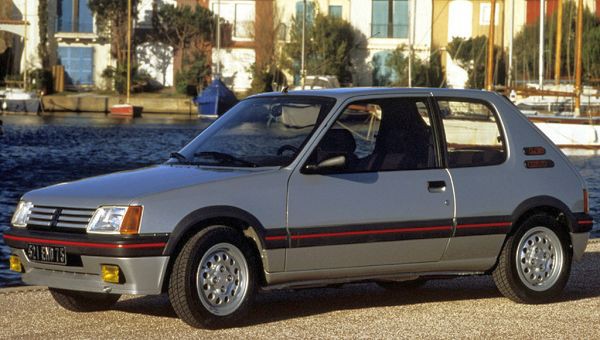
It was 1983 and Peugeot was not going through one of its best moments. The company was submerged in an economic crisis, as well as a crisis of models. With a range of almost obsolete models and fierce competition in its domestic market, completely dominated by its rival Renault, the model that brought the brand back to the surface was a versatile car that left its mark on the rich history of the French marque.
We can say that the 205 saved Peugeot from a bankruptcy that was all but certain. The company’s sporting successes reached their peak when the Peugeot 205 Turbo 16 dominated the WRC year after year, which drove the surge in sales of the road car. A large number of variants of the model accompanied this revival, which continued even after its successor reached the market in 1995.
The Peugeot 205 is one of those cars that came with engines for every taste. Over the years, the 205 was sold with engines of widely varying power, from a modest 1.1-litre (in France) to the well-known 205 GTI or the T16. It also had a Cabrio version with a fabric roof.
In Spain (and by virtue of tariff agreements requiring a certain quota of domestic components), the first 205s were distinctive to our market, as they had some differences compared with the French versions. The most notable was the bulge in the bonnet to make more room for the Simca/Talbot engine (954 cc to 1.6 litres) that was manufactured in Villaverde, as they were larger.
As the different 205 models came along, one of buyers’ favourites was the version with a diesel engine. The diesel models used the XUD7 engine, a 1.8-litre PSA unit taken from the Citroën BX, followed later by the 1.9, used in some other Citroën models but never sold in our country in the 205. Even so, there were more petrol versions than diesel ones in Spain, with two variants with automatic gearbox sold.
The model’s success began in its first months on sale. It did not win awards by the dozen, but it sold a great many units; across its four production plants, up to 2,500 cars a day were produced when demand required it. And although it never won the European Car of the Year award, it did win the Spanish one once. In 1985, the 205 received the Car of the Year award in Spain, beating the Seat Ibiza and the Renault 11.
Peugeot 205 GTI and Turbo 16
If there are cars that defined an entire era (for those of us who are rather keen on a heavy right foot), these are none other than the sporty variants of the 205. At a time when nearly all versatile cars had sporting versions, the 205 GTI had a first variant with 105 horsepower. For the next evolution, larger valves were used, bringing the GTI to 115 or 126 horsepower. The 1.6s differed from the 1.9s in some cosmetic details: cloth seats versus leather seats, disc brakes on all four wheels for the 1.9, or wheel size, 14 or 15 inches.
Although the 205 GTI was a true benchmark from the mid-1980s onwards, the model’s popularity began to decline in the 1990s. Strict emissions control and increasingly expensive insurance for this particular model ultimately reduced sales. Peugeot tried to counter emissions control with a GTI version delivering 122 horsepower, though fitted with a catalytic converter.
The 205 T16 was the homologation variant that allowed the car to enter the famous Group B class of the World Rally Championship. With spectacular 200 horsepower and 16 valves, wider wheel arches, a raised rear end to give access to the engine (whose cover opened), and an all-wheel-drive powertrain similar to the competition car, only 200 examples of this model were built. They were available in Anthracite Grey and were reportedly sold at a price below the cost of construction; in Spain they cost around 8.5 to 9 million pesetas.
And you, do you own or have you owned a Peugeot 205? What experiences have you had with it?


 Peugeot E-208 GTi: a battery-powered toy that revives the spirit of the 1980s sports cars
 New Lexus ES: luxury grows and goes electric
 First contact with the Dacia Sandero Hybrid 155: power and efficiency from €19,890
4 comentarios
Deja un comentario
Peugeot salvó a Citroën unos años antes, ya que Citroën estaba en quiebra a mediados de los años 70, y Peugeot tuvo que apretarse el cinturón mucho para que el nuevo grupo PSA saliera adelante. Y lo lograron.
El 205 era un coche duro, muy duro. Un coche que ha pasado a la historia por ese genial GTI, y el TURBO16 que derrotó a los Audi Quattro en la época de las bestias de los rallyes del Grupo B.
Un buen articulo, pero cabe destacar que su sucesor salio en 1998 y no en 1995.
Un amigo mio tenia un 205 Rallye, una bomba de coche, ahora, tenia que estar regulando la carburacion cada dos por tres, normal, era un carreras cliente para los campeonatos nacionales de rallyes, y mi abuela tuvo un 205 open, que lo heredó mi madre y le duró lo más grande, y un tio mio tenia un 1,9 gti con volante a la derecha y matricula inglesa (vivia alli) otra bomba de coche.
El 205 fue mi primer coche allá por el 93. Claro que no con un motor como el que comentáis sino un modesto 1.1 gasolina.
Compartido con mi hermano, guardo gratos recuerdos de este coche, por el “tute” que le pegamos, 1000 aventuras y viajes, y el “escaqueo” de ambos para llenar el depósito… jeje parecía una apuesta de “la penúltima” jugando con la reserva del depósito.
En fin, aquellos maravillosos años noventa.