Mitsubishi Análisis Sedans Historia Reports
Classic cars with history: Isuzu Aska Irmscher and Mitsubishi Galant AMG
 Guillermo Arnal
16 January 2015
10 min.
Vauxhall issued a statement on Tuesday reminding readers that this 2015 marks the 25th anniversary of the Lotus Type 104, better known as the Lotus Carlton/Omega. That same quarter century has passed since the start of production of one of its rivals, the Mercedes-Benz 500E [W124], which, as you know, had genes from Porsche.
The fame and reputation of these saloons has not diminished over time, quite the contrary. For this reason, and because this year numerous articles are expected to once again remember these two legends, we are going to take a look at other collaborations from that era that gave rise to sporty saloons and whose history has been covered less frequently. Specifically, we propose recalling a couple of creations by two tuners you will surely know: the Isuzu Aska Irmscher and the Mitsubishi Galant AMG.
These two models were restricted to the Japanese market, where giving a Western touch to a vehicle considerably increased its appeal due to the inherent exoticism of foreign brands and cultures in that country. They played in a different league from the German road missiles mentioned, both in terms of segment and performance. However, in Japan and in other countries such as Australia, New Zealand or the United Kingdom, enthusiasts of Japanese youngtimers and of the corresponding manufacturers currently consider them almost cult objects.
Isuzu Aska Irmscher
The retirement of the Florian
Isuzu, although it may seem hard to believe today, had several classes of passenger cars in the ranges of certain markets, including Europe. If we focus on saloons, the last to leave the ship was the Aska (a name taken from the town of Asuka, in Nara Prefecture; they removed the letter u to avoid an incorrect pronunciation). Launched in 1983 as the Florian Aska, this model replaced the already outdated Florian, which had sixteen years of life without major changes and from which derived the more successful 117 coupé designed by Giugiaro and the Faster pick-up.
In its first two years of life, the Aska JJ kept the first name Florian that designated its predecessor.
The first generation, whose code was JJ, was built on the J-Body architecture of General Motors. Of all its siblings, the one it most resembled was the Holden Camira JD. In order to shake off the obsolete image of the Florian and improve that of the new Aska, Isuzu introduced more modern and powerful versions into its range. The Aska JJ150 with the 4FC1-T two-litre turbodiesel engine and 90 CV represented a milestone for the brand, as it was among the fastest vehicles with that type of powertrain in those years in Japan.
[jwplayer file=”https://www.youtube.com/watch?v=5tSvvvEHdz4″ autostart=”false” mute=”off”]
The one that really interests us is the JJ120 equipped with the 4ZC1-T two-litre petrol engine supercharged by a turbocharger that produced 140 CV. An Aska fitted with this engine won its category at the British Rally in 1983, which gave the saloon some publicity.
Even the Bighorn was graced with the touches of the German tuner.
The restyling arrives accompanied by Irmscher
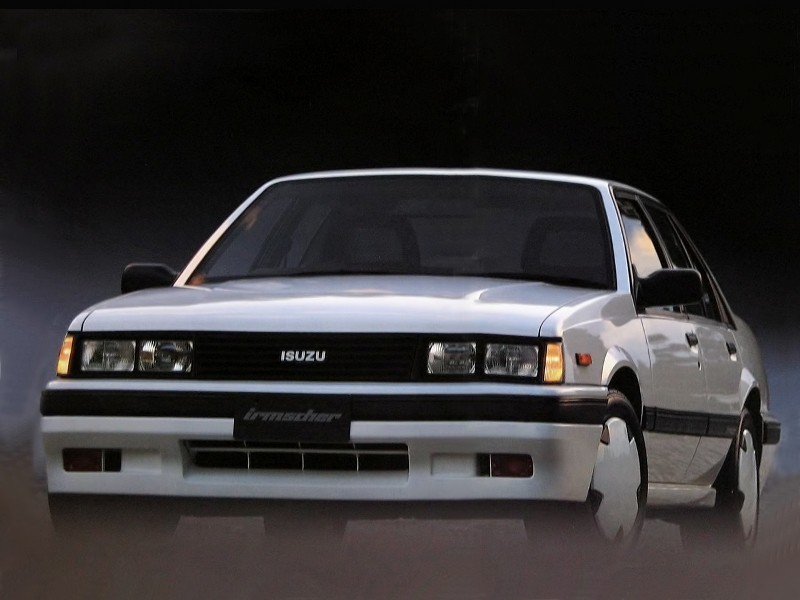
The Irmscher variant was integrated into the Aska range as part of the model update in 1985.Two years later, Isuzu applied a slight update to the Aska’s styling. More interesting was the collaboration agreement that the Japanese brand and the German tuner Irmscher established in 1985. Lasting until 1989, this partnership resulted in versions with exclusive design and performance improvements for the Gemini, Aska, Piazza and Bighorn (here we knew it as the Trooper).
Isuzu, like other Japanese manufacturers that turned to Western culture and influences to make their models more appealing (advertising reflected this wonderfully), completed with the help of Irmscher the achievement of its goal of transforming the Aska into a truly aspirational saloon.
Irmscher’s accessories were discreet, but the mechanical modifications did their job.
Available until 1989, the Aska Irmscher received the same style of external modifications as the Gemini, since those of the Piazza and Bighorn differed somewhat from these models. Side skirts, a discreet rear spoiler and the distinctive wheel trims painted in the body colour defined a version that was clearly distinguishable from a conventional Aska Turbo, but which was not overly eye-catching.
The distinctive slogan on the version showing the rear window was common to the Isuzus prepared by Irmscher.
The Aska Irmscher offered a suspension tuned by Lotus and its 4ZC1-T engine produced 150 CV, ten more than the conventional version.The final touch was a sticker that the Aska displayed on the rear window reading “European Spirit by Isuzu.” In the cabin, just slightly different trim, specific badges and Recaro sports seats revealed that the occupants were in an Aska treated by Irmscher.
Technically, this Aska gained ten horsepower and, best of all, benefited from a tuning of the suspension carried out by Lotus, one of the most valued features of sporty Isuzus of this period. Weighing 1070 kg, the Aska Irmscher could complete 0 to 100 km/h in eight seconds, a respectable figure for its class of vehicle.
Mitsubishi Galant AMG
A short-lived union
Numerous details and images of the past of Aufrecht-Melcher-Großaspach circulate online before its acquisition by Mercedes-Benz, particularly thanks to the parade organised by Mercedes-AMG for the presentation of the GT, so we will not dwell on them much. In the era when the Affalterbach tuner was pumping steroids into the W124, W126 and company, an intriguing relationship arose between it and Mitsubishi that engendered two machines based on reasoning not very far from that which we discussed regarding the link between Isuzu and Irmscher.
The Debonair V AMG had very little to do with the imposing Hammer that the Germans launched in 1987.
Of that pair, the model that usually arouses the most interest (and other less pleasant things depending on taste) among non-Japanese audiences is the Debonair V 3000 Royal AMG from 1987. Whether because of the baroque result produced by the external alterations or because of the contrast when compared with the Hammer launched by AMG that same year, this work by the tuner is not among the most appreciated.
Like Irmscher’s Aska, AMG dispensed with overly ostentatious parts in its interpretation of the Galant.
A German suit for the Galant
The Galant AMG also offered a quite discreet design that differed very little from that of the VR-4.The second fared better: it is the Galant AMG, a more successful and balanced creation than the one based on the Debonair. It was launched in Japan in October 1989, the same year in which attendees at the Geneva Motor Show saw the first prototype of the Lotus Carlton/Omega, and the last units were sold at the end of 1990. Its vehicle concept was very similar to that of the Aska Irmscher, with the difference that the Mitsubishi opted for the naturally aspirated variant of the two-litre 4G63 engine.
Whereas the Debonair V AMG suffered from a rather overloaded appearance, the Galant AMG [E33A] had a more rational design, very close to that of the VR-4 [E39A]. The accessories added to the bodywork included badges from AMG in several areas, a specific grille, which varied depending on the chosen trim (Type I or Type II), and 15-inch wheels, which other Galant versions such as the Super Viento later inherited.
Even in the “basic” trim, the AMG’s cabin enjoyed a level of equipment unusual for a Galant.
The cabin additions configured an extremely elegant interior décor unprecedented in a Galant. The leather upholstery, electric windows, air conditioning with digital control, the CD player and the optional Nardi steering wheel with wood inserts were its main features.
The modifications introduced in the engine are especially noticeable when it revs high.This particular package concealed the aspects of the vehicle where AMG’s influence was most evident. This version shared the 4G63 engine with other intermediate Galants, but where in those the powertrain ran out of puff, in the AMG case it delivered a high level of torque up to 8,000 rpm. The trick to obtaining this performance lay in the new pistons that raised the compression ratio from 9:1 to 10.4:1, a camshaft with more degrees of duration, new oil injectors for the pistons, titanium valve springs, an optimised exhaust flow, an improved intake manifold and a reprogramming of the ECU.
The Galant AMG Type II was identified by its different grille and slightly more complete equipment.
Although it was more powerful than the Aska Irmscher, the Galant AMG did not accelerate as quickly as the Isuzu and fell short of the VR-4 in performance.The Galant AMG [E33A]’s data sheet shows a power increase of 30 CV up to 170, reached at 6,750 rpm, and a maximum torque of 191 Nm at 5,000 rpm. The 4G63 could be combined with a four-speed manual gearbox or a five-speed automatic, both provided with shortened gear ratios, a clutch of larger diameter and a bulkier driveshaft on the passenger side.
The VR-4’s braking system, the suspension springs somewhat stiffer and the more precise steering closed the list of add-ons incorporated into the Galant AMG. It weighed about 1,220 kg, a figure that made it the lightest sporty Galant. Performance fell well short of the VR-4’s, which was much more powerful and benefited from its all-wheel drive: the Galant AMG recorded a 0 to 100 km/h time close to 8.5 seconds, slightly slower than the lighter Aska Irmscher.
Despite its attractive design, the Galant AMG was inferior in several respects to the VR-4, which was more popular with the public and press of the time.
Those who have driven it say the Galant AMG behaves somewhat more abruptly than the VR-4, although its engine has a better response, its steering conveys a more pleasant feel and, overall, it is just as easy to master. Unfortunately, the superiority of the VR-4 harmed this curious creation that the people at Affalterbach rarely remember, so the top of the range stayed as it was.
Via | AutoSpeed, Banovsky’s Car of the Day, Isuzu Aska “J2” owners’ club, IsuzuPiazza.com, Japanese Nostalgic Car (Article on Mitsubishi-AMG, thread on the Isuzu Aska JJ and thread on Isuzu) Mitsubishi AMG Spirits, Retro Rides, Retro Scene Mag and SuckSqueezeBangBlow.
Photos | AutoNavigator.ru (Florian Aska), Flexnet (Galant AMG Type II), Kpinet (front view of grey Aska Irmscher), MeiwaSuisan (front view of white Aska Irmscher), Mitsubishi AMG Spirits (Debonair V AMG), Retro Rides (Galant AMG catalogue), Japanese Wikipedia (Isuzu Bighorn Irmscher) and Yahoo! Japan (rear view of Galant AMG).


 Kia offers an electric range of 10 models, 50 versions and 400 possible combinations
 The seven finalists for the 2027 European Car of the Year (COTY) are exclusively electric
 Peugeot E-208 GTi: a battery-powered toy that revives the spirit of the 1980s sports cars
Deja un comentario