Differences between an LPG car and a natural gas (CNG) car: which one should I buy?
 Antonio Roncero @roncero_antonio
7 January 2020
9 min.
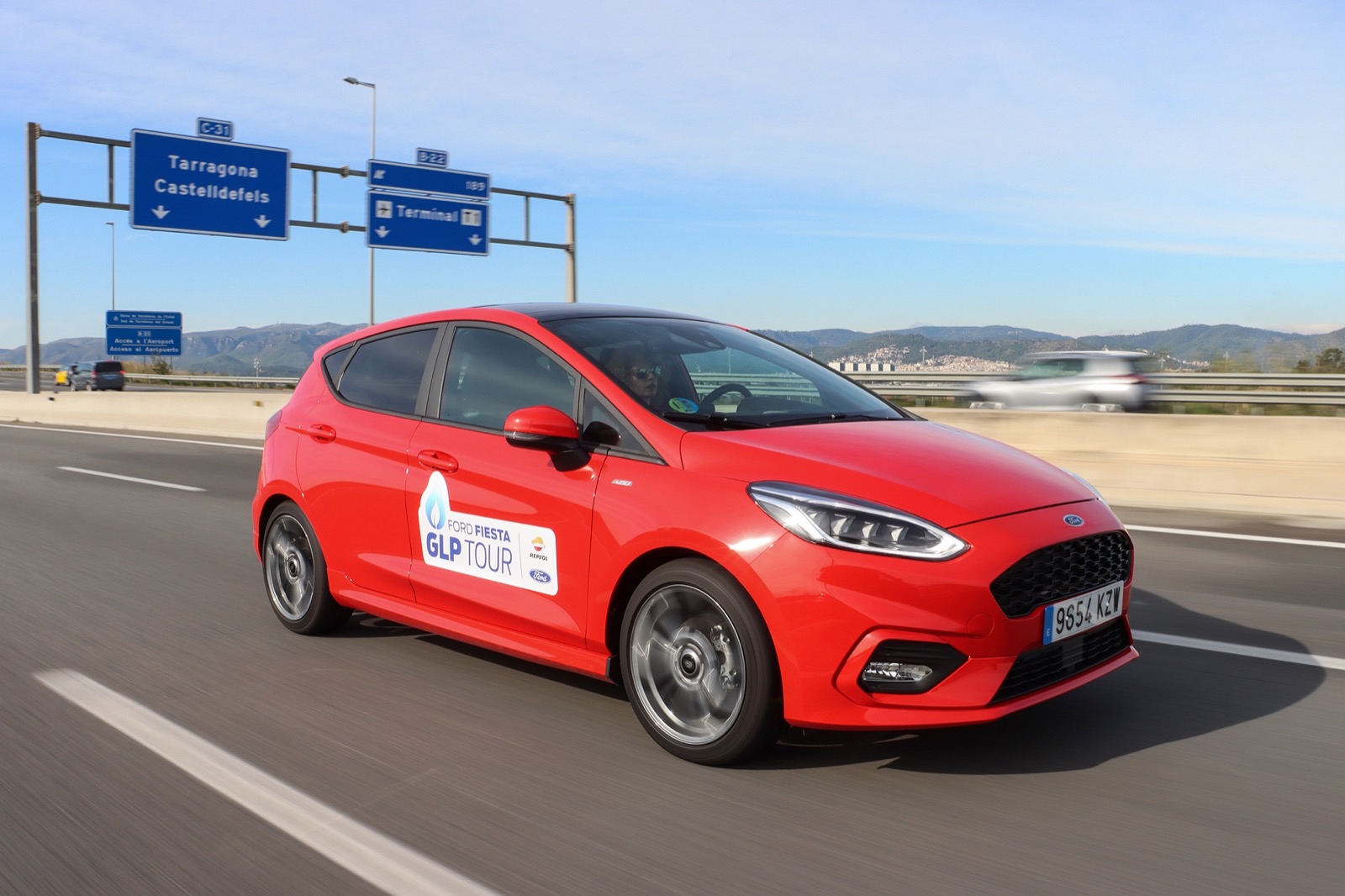
We explain the differences between LPG (Autogas) and natural gas (CNG) cars, which are a great solution if you’re looking for a vehicle that saves money on every kilometre driven and you don’t want to give up the DGT ECO label.
Gas cars continue to win over drivers. There are more options available every year and more gas refuelling points are opening, so many users are being encouraged to consider this solution as an alternative to hybrids for getting a car with the DGT ECO label.
Furthermore, if you drive a lot of kilometres you recover the investment in a short time, because gas cars have a significant advantage in cost per kilometre over petrol cars, diesel and even hybrids, due to the lower price of this type of fuel.
We are therefore dealing with two types of eco-friendly fuel that pollute less than conventional fuels, that allow access to the ECO label and that represent a real saving when refuelling. LPG and CNG cars are therefore an ECO alternative to electrified cars.
But what are the differences between LPG and CNG? What do I need to consider when buying? We are going to explain it in the following points.
The fuel: differences between LPG and CNG
Although both LPG and CNG cars use the same technology as the models they derive from in their petrol versions, that is, they are vehicles with a petrol engine with adaptations to run on gas, the type of fuel is different.
- LPG: also known as Autogas, or Liquefied Petroleum Gas. It is obtained from the first step of the oil refining process and is made up of a combination of propane and butane.
- CNG: stands for Compressed Natural Gas. It is obtained mainly from natural gas deposits and is basically composed of methane.
Both are clean fuels, as they emit fewer emissions during combustion than petrol, up to 95% less nitrogen oxides, also reducing unburnt hydrocarbons, and emitting hardly any particulates. In this sense, the composition of each type of gas is not a factor to consider when buying.
How is it stored in the vehicle?
The way LPG or CNG is stored in the vehicle is one of the main differences between these fuels.
- LPG is a liquefied gas, and is stored in liquid state in adapted tanks, at pressures that can range between 5 and 30 bar; the usual pressure is around 10 bar.
- CNG is stored in the vehicle’s tanks as a compressed gas, at high pressures of about 200 bar. For this reason, the tanks in CNG cars are more sophisticated.
Safety is not a problem in any of the cases, since in both LPG and CNG cars the installation is designed and passes a series of requirements and tests far more demanding than those for petrol cars.
If a leak occurs, in the case of a CNG tank, the gas will dissipate into the atmosphere, initially accumulating at ground level, as it is denser than air. For this reason, in some very specific places there are restrictions on parking this type of vehicle. In the case of a leak from a CNG tank, the fuel would fall to the ground, like any other liquid fuel.
How do you refuel an LPG or CNG car?
In both cases, refuelling with LPG or CNG is a simple process, which we could consider equivalent to refuelling with petrol or diesel. In fact, the Autogas supply hose is located on the same pump as the other fuels.
Gas vehicles incorporate a second inlet with a nozzle or adapter, located next to the petrol tank filler neck. Connecting the pump hose gun to the nozzle is an easy operation that requires no more effort than refuelling petrol, and refuelling times are also similar.
In the following videos you can see how each of these fuels is refuelled
Refuelling LPG
https://www.youtube.com/watch?v=UAFH5gukj4c
Refuelling CNG
https://www.youtube.com/watch?v=qUxC8x_uLxg
How many LPG and CNG stations are there in Spain?
Without a doubt, today this is one of the decisive points, where there are the most differences when buying an LPG or CNG car.
Currently it is not at all difficult to find stations supplying LPG in large cities. In total there are more than 600 supply points available in Spain, of which almost 400 belong to Repsol. It is also not difficult to find where to refuel LPG during a trip, without having to plan the route.
Map of service stations with Autogas LPG
As for CNG, although supply points continue to grow, today there are about 90 operational CNG stations. This is the main disadvantage of CNG compared with LPG, as you can see not only from the number, but also from the distribution of refuelling points on the different maps.
Map of service stations with CNG
Something to bear in mind
An aspect to consider very carefully is the range with each fuel. Generally, LPG cars keep the petrol tank intact. However, the new CNG cars being launched on the market, such as the TGI range of Seat, have opted to increase the capacity of the gas tanks, considerably reducing the petrol one.
This, together with the lower availability of refuelling points, means that in the case of CNG cars you will have to plan a long trip carefully, unless you want to have to stop every few kilometres to refuel petrol if you run out of CNG, until you reach a station supplying this type of gas.
Price of LPG and CNG and consumption differences
These are the current prices of LPG, CNG and petrol:
- LPG: 0.78 euros/litre
- CNG: 0.89 euros/kg
- Petrol 95: 1.40 euros/litre
The consumption of a vehicle running on gas is higher than running on petrol, but the cost per kilometre is lower when the expense is converted to euros, since the fuel price is lower.
The same equation applies if we compare CNG with LPG, although the difference is not as large. But to give a practical example, a compact car with an engine of about 120 CV may consume around 3.5–4 kg of CNG per 100 km, compared with 7.5 litres of LPG.
At the prices mentioned, travelling 100 km with CNG would cost about 3.6 euros, while with LPG the cost would be 5.85 euros. With petrol, estimating an average consumption of 6.5 l/100 km, the cost would be 9 euros to travel 100 km.
How do gas cars work?
Although some brands call this type of car hybrids, in reality they are not, if we consider a hybrid car to be one that has at least two engines, each of which can power the vehicle on its own.
The correct term is to refer to gas cars as bivalent vehicles, which can run on two different fuels: petrol and LPG or petrol and CNG. They run on one or the other, but never on both at the same time.
The driver does not have to do anything. Nor will they notice any differences at the wheel in terms of loss of performance or power when switching between petrol and gas. It is true that when adapted to run on gas, the original engine usually delivers slightly less official power than the petrol-only version, a more noticeable difference in the case of CNG, which has lower calorific value. If anything, running on gas may feel slightly smoother.
For the buyer in practical terms, an important difference is that, in the case of LPG, the driver can voluntarily switch between running on gas or on petrol. To do this there is a button on the driving position, which can be operated at any time while driving.
In the case of CNG, the vehicle will always run on gas. It will only switch to petrol mode if the gas in the tanks runs out, and will return to running on gas after refuelling, all automatically.
Differences between LPG and CNG cars: infrastructure is decisive
In summary, we can conclude that CNG has many advantages over LPG. But it has one disadvantage which, in the end, is decisive.
CNG emits fewer polluting emissions, as it contains less carbon. Fuel consumption is lower, and the cost per kilometre is also more economical in a CNG car than in an LPG one. And as a fuel, natural gas has more extraction reserves.
However, the current infrastructure is the main obstacle when deciding to buy a CNG car, since, at least for now, it is not at all easy to fill the tank.
Other additional advantages of LPG over CNG are its greater range considering the total kilometres that can be covered with both fuels (petrol and gas), and the possibility of choosing at any time which fuel to use. If you want to convert a petrol vehicle to gas after purchase, the switch to LPG is technically simpler (mainly because of the tanks) and therefore also cheaper.
Related information of interest:
–Ten reasons to switch to LPG
–What should you know if you want to install an LPG kit in your car?
–8 things about LPG you probably didn’t know
–All SUVs on the market with LPG


 Peugeot E-208 GTi: a battery-powered toy that revives the spirit of the 1980s sports cars
 New Lexus ES: luxury grows and goes electric
 First contact with the Dacia Sandero Hybrid 155: power and efficiency from €19,890
Comentarios cerrados