Geely Electric Cars ECO Safety Technology
Geely wants to demonstrate that the safety of its cars begins well before they reach the road
 Antonio Roncero @roncero_antonio
11 June 2026
9 min.
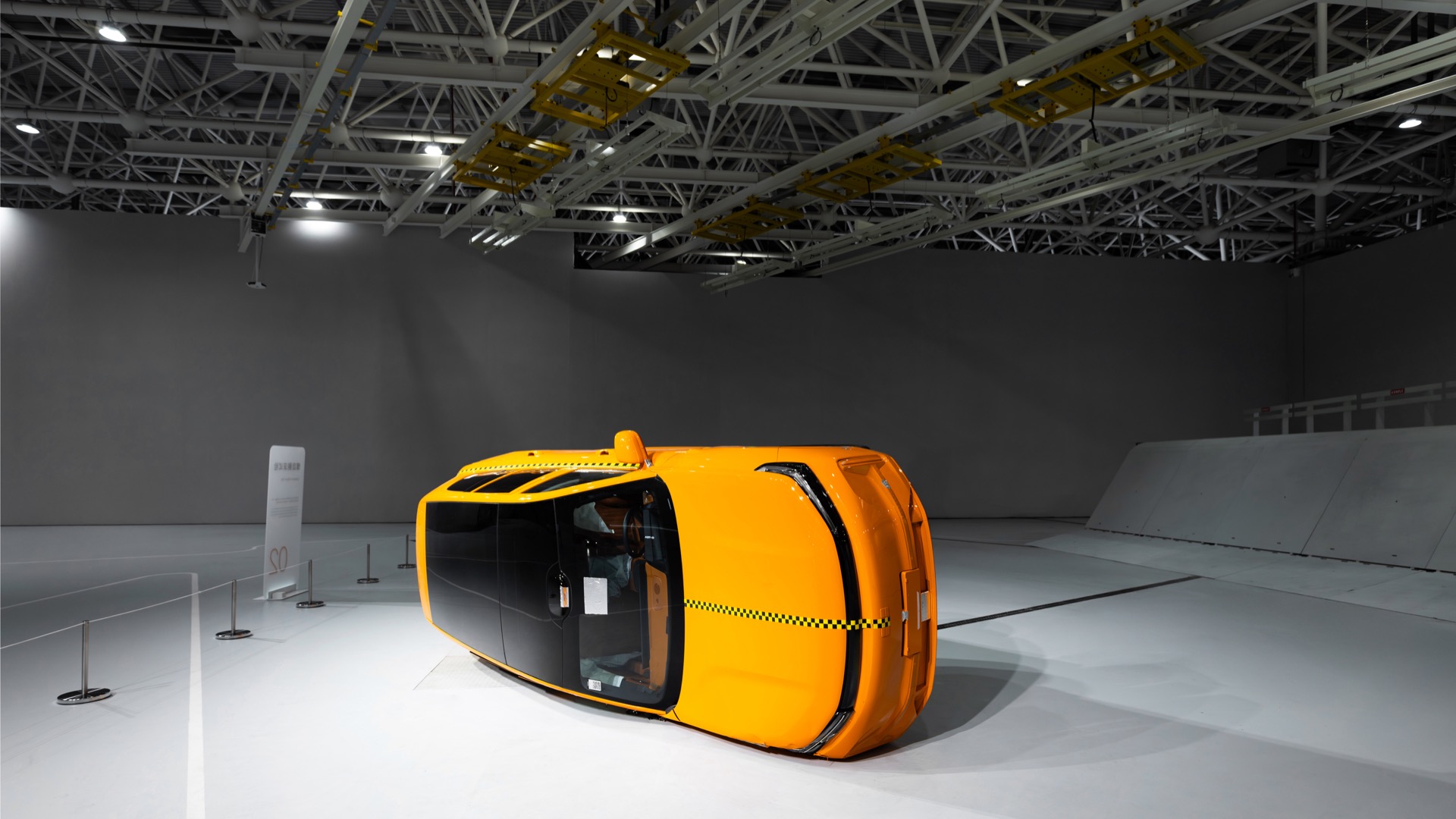
The Geely Global Safety Center adds five Guinness World Records and tests crashes, batteries, cybersecurity, ADAS and connected electric vehicles.
Not so long ago, when we talked about car safety, it all boiled down to one very specific image: a vehicle launched against a barrier, dummies inside and a final rating in the form of stars. Five, if everything went well. And, of course, these crash tests, which Chinese manufacturers once found so hard to pass with a good score, remain a fundamental part of developing any car.
But today’s car is no longer just a body, four wheels, an engine and a structure designed to absorb energy in an impact. Electric, plug-in hybrid and intelligent vehicles have completely changed the rules of the game. Now you also have to consider the battery, the software, the sensors, remote updates, connectivity, data protection… and even cybersecurity.
And that is where Geely wants to make its mark with its new Geely Global Safety Center, a facility located in Ningbo, China, which opened at the end of 2025 with a forceful calling card: five Guinness world records related to its size, its testing capacity and the number of tests it can carry out.
The five Guinness records of the Geely Global Safety Center
The new Geely Global Safety Center is not simply a crash laboratory bigger than usual; it is a infrastructure designed to validate the car as a complete system. And that, in the middle of the transition towards the electric, intelligent and connected vehicle, makes far more sense than it might seem at first glance. Because checking how a body behaves in a frontal, side or rear impact is one thing. Analysing what happens to a high-voltage battery after a knock, how driver-assistance systems react in low-visibility conditions, whether an OTA update could affect a critical system or whether the car’s electronics are protected against possible attacks is quite another.
In other words: Geely wants safety to be measured not only at the moment of impact, but before, during and after. Also in everything that cannot be seen from the outside. And the scale of its safety centre is clear when you review the five Guinness records the facility has achieved.
- The first is that of the largest car safety laboratory in the world, with a total area of 81,930.745 square metres. Now that the comparison is so fashionable, that is almost 12 football pitches, with facilities dedicated to testing, measuring, repeating and validating situations a car may encounter during its service life.
- The second record corresponds to the longest indoor crash test track, at 293.39 metres. This distance allows high-speed tests and the reproduction of more complex impacts than those needed merely to meet minimum homologation requirements.
- The third is one of the most interesting for those who think safety depends only on the structure of the car. Geely has the largest climate- and altitude-adjustable wind tunnel for vehicle testing, covering 28,536.224 square metres. It can simulate snow, rain, solar radiation and winds of up to 250 km/h.
- The fourth record corresponds to the largest arbitrary-angle impact test zone, covering 12,709.293 square metres and capable of tests between 0 and 180 degrees. This makes it possible to analyse collisions much closer to those that occur in real life, where cars rarely crash in a perfectly frontal and orderly way.
- And the fifth record has to do with variety: the centre can carry out 27 types of safety tests, the largest number available in a car manufacturer’s safety laboratory.
Why this matters in an electric or plug-in hybrid car
The logical question is: what does the driver gain from all this? Because, in the end, a laboratory can be enormous, hold Guinness records and boast a lot of technology, but what matters is how that translates into the cars that reach the dealership.
The answer lies in the growing complexity of the automobile. In an electric car, safety no longer depends only on the structure protecting the occupants well. It also matters how the battery is integrated, how its temperature is managed, what happens if it takes an impact, how high-voltage systems are disconnected or how the vehicle communicates with the outside.
And something similar happens in a connected car. Sensors, cameras, radars, chips, control units and driver-assistance systems work constantly with data. If everything works well, the driver hardly notices it. But for it to work well it must be tested beforehand under controlled conditions: rain, fog, snow, changes in light, traffic signs, low grip or emergency braking.
This is where a centre like this makes sense. It is not just about passing a test. It is about anticipating real-world scenarios before the car reaches the customer’s hands. Geely has taken this very seriously, as shown by the extreme test to which they subjected the Starray EM-i, which goes beyond the standard crash test of Euro NCAP.
Physical safety, digital security and data protection
One of the most relevant aspects of the Geely Global Safety Center is that it includes specific laboratories to analyse the cybersecurity of vehicles. And this, although it may sound less spectacular than launching a car against a barrier, is going to become increasingly important. Today’s cars receive remote updates, connect to mobile apps, store data, manage functions through software and depend on an increasingly complex electronic architecture. That opens up enormous possibilities, but it also requires the system to be better protected.
Geely speaks of tests on multiple attack vectors, chips, firmware, data transmission, OTA updates and the vehicle’s electronic systems. Put simply: the goal is for the car to be safe even when it is not crashing into anything. Because the safety of the future will not only consist of walking away unharmed from an accident. It will also mean that the car does not fail, does not become vulnerable and does not compromise the user’s information.
From China to the car you can buy in Spain
The safety centre is part of a broader industrial ecosystem that Geely has in Ningbo, where the Zeekr Smart Factory is also integrated. This smart plant uses technologies such as 5G, artificial intelligence, the Internet of Things and digital management systems to better control production processes and traceability.
Here another important point emerges: developing very advanced technology is of little use if it cannot then be manufactured with precision and in a repeatable way. Safety is also built on the production line, in the quality of the welds, in the control of components, in the integration of the battery and in the final verification of every vehicle. That is why Geely insists on connecting three worlds that until a few years ago seemed more separate: development, validation and manufacturing. The laboratory tests. The factory executes. And the data allows corrections, improvements and revalidation.
The launch of this centre also carries a strategic reading. Geely no longer wants to be seen only as a Chinese brand arriving in Europe with cars that are competitive on price, technology or efficiency. It wants to present itself as a global manufacturer capable of developing its own standards in safety, electrification and intelligent vehicles.
https://www.youtube.com/watch?v=6d8vBPQq0Zs
This is not an isolated move. The group has spent years growing with brands such as Geely, Lynk & Co and Zeekr, and has invested more than 31.5 billion euros in R&D over the last decade. In addition, the new centre is designed for international collaboration, with institutions such as CATARC and Tsinghua University involved in developing new safety standards for intelligent vehicles.
And this connects directly with the models Geely is beginning to deploy in markets such as Spain: the Geely E5 and the Starray EM-i. Safety is no longer just a commercial label or a final score. It is a brand argument. And if Geely, as it appears to be doing, manages to carry over to all its new production cars what this new safety centre promises, its upcoming models will have a very powerful argument to compete in Europe. Not only on price, range or equipment, but also on something worth far more than any screen or any power or range figure: safety.
Questions about the Geely Global Safety Center
Where is the Geely Global Safety Center?
The Geely Global Safety Center is in Ningbo, China.
How many Guinness records has Geely’s new safety centre achieved?
The centre has achieved five Guinness records related to its size, its test facilities and the number of safety tests it can carry out.
What kinds of tests are carried out at the Geely Global Safety Center?
It allows crash tests, angled impacts, pedestrian protection, battery safety, driver-assistance systems, climate tests, cybersecurity, software and connectivity to be carried out.
Why is this centre important for electric cars?
Because in an electric car safety does not depend only on the bodywork. The battery, high-voltage systems, electronics, software, remote updates and connectivity must also be validated.
Global Safety Center – Image gallery


 Kia offers an electric range of 10 models, 50 versions and 400 possible combinations
 The seven finalists for the 2027 European Car of the Year (COTY) are exclusively electric
 Peugeot E-208 GTi: a battery-powered toy that revives the spirit of the 1980s sports cars
Deja un comentario