SEAL 6 Sedans Hybrid Cars ECO Family Tests
It uses less fuel than a diesel, covers 1,500 km without refuelling, carries a zero-emission label... and it's not an SUV!: behind the wheel of the BYD SEAL 6 DM-i
 Antonio Roncero @roncero_antonio
22 September 2025
12 min.
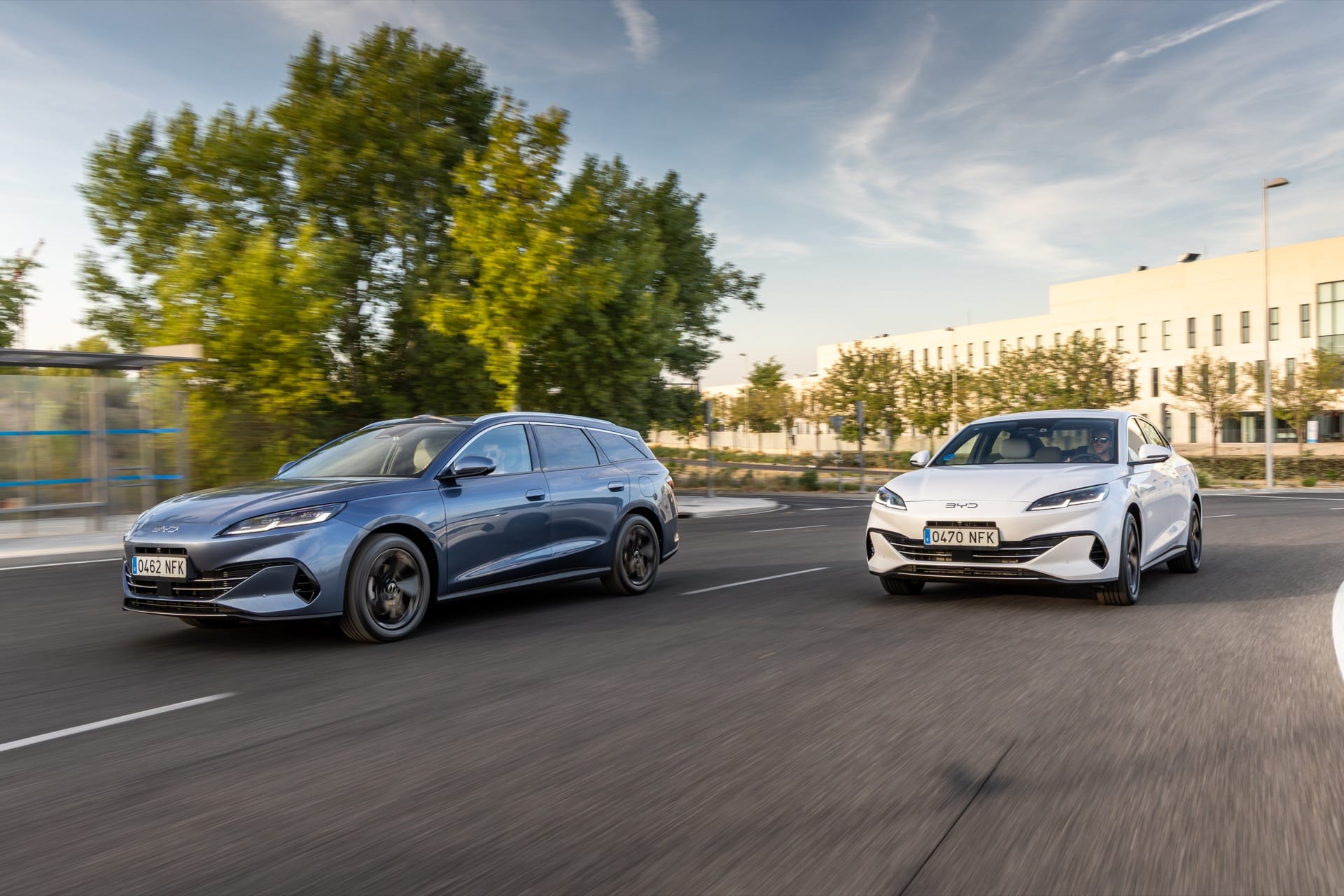
Plug-in hybrid PHEVs are gaining ground, and it’s no surprise. Buyers want cars with diesel-like consumption, but no longer dare to opt for this kind of powertrain, which has fallen out of favour, and the homologated consumption figures of PHEVs -real-world consumption is another matter in many cases, but that’s a whole different story- are a perfect draw. On the other hand, drivers also want to benefit from the advantages of the DGT zero-emission label, which today remain numerous -we’ll see what happens once cars carrying this label outnumber those that don’t-, but without making the leap to fully electric propulsion and having to depend on a plug when travelling.
If we add to this that the offer of PHEVs is growing all the time, and that these vehicles have evolved by increasing the size of their batteries, going from offering between 30 and 50 km in electric mode in the first generations to comfortably exceeding 100 km today, it is logical that they keep gaining prominence. In fact, there are already brands such as BYD that offer two PHEV variants to choose from in their plug-in hybrid models, with a smaller battery or with greater range. This was the case with the Seal U DM-i, the first plug-in hybrid from BYD to reach our market. And it is so again with the new SEAL 6 DM-i, which is set to repeat and continue the success the SUV is enjoying.
Incidentally, BYD has spotted the opportunity and will keep expanding its PHEV range in Europe: the next to arrive, before the end of the year, will be the plug-in hybrid version of the ATTO 2. But let’s focus on today’s protagonist, the SEAL 6 DM-i.
A car to “escape” diesels and the SUV craze
As I mentioned in the headline, the BYD SEAL 6 DM-i is a perfect car for anyone looking for a vehicle with the low consumption and long range that characterise diesels… and who doesn’t need or want an SUV body. It is available in two body styles, saloon and Touring, both measuring 4.84 metres in length and 1.87 metres in width (2.10 metres with mirrors). The height is 1.49 metres for the saloon and barely a centimetre more for the Touring, and the wheelbase reaches 2.79 metres in both versions.
There are two powertrain configurations, which, as is the norm for the brand, are tied to the trim level. Both feature a naturally aspirated 1.5-litre petrol engine producing 98 CV operating on the Atkinson cycle, plus a 197 CV electric motor, but the total system output differs, as does the battery they use. For the Boost versions the maximum system power is 135 kW (184 CV) and battery capacity is 10.1 kWh, allowing an electric-mode range of up to 55 km for the saloon and 50 km for the estate. Thanks to a 65-litre fuel tank and very low consumption, total range reaches 1,505 km or 1,350 km, respectively.
In the Comfort Lite and Comfort trims, system output rises to 156 kW (212 CV). But the most relevant aspect of these versions is that the battery here goes up to 19 kWh, allowing a WLTP-homologated electric-mode range of almost double: 100 km for the Touring and 105 km for the saloon. Total ranges, adding the kilometres covered in electric mode and on petrol, reach up to 1,455 km for the saloon in this case, and the same 1,350 km for the saloon as in the small-battery Boost versions. One difference to bear in mind is that the Boost versions charge at a maximum of 3.3 kW on AC, while the Comfort can do so at 6.6 kW, and they also accept DC fast charging, here up to 26 kW. All of them feature the V2L function, which allows you to “plug” electrical devices into the car and supply power directly from the battery.
Unlike most plug-in hybrids, BYD’s DM-i (Dual Mode Intelligent) powertrain is characterised by the fact that when the vehicle operates in hybrid mode, it is still the electric motor that takes the lead in driving the wheels, while the petrol engine is responsible for generating electricity to recharge the battery. Only in specific cases, such as when maximum acceleration is demanded, is the power of both motors combined.
A look inside the BYD SEAL 6 DM-i
BYD has managed to make its cars recognisable both for their exterior design and for their pleasant, welcoming interior, with a layout in the SEAL 6 that differs only in a few details from other models in the range, such as the gear selector, which is now located on the steering column. Otherwise, it’s the usual formula: clean, elegant lines, an almost total absence of buttons apart from those on the steering wheel, extremely comfortable sporty-looking seats, an 8.8-inch instrument display and the distinctive rotating multimedia screen, which can be 12.8 or 15.6 inches, depending on the version. Not to mention the good impression given by the materials used, all of them soft-touch and with almost no hard plastics, with a perceived quality and fit that deserve, at the very least, a good grade.
As for interior space, considering we’re talking about a car exceeding 4.8 metres in length, a spacious cabin is to be expected. And the SEAL 6 DM-i’s is. It doesn’t reach the dimensions of a Skoda Superb, but there is no lack of legroom in the rear seats, and headroom is ample too. Even width is good, and the completely flat floor makes the rear centre seat usable. However, if I had to choose a car to travel as a rear passenger I would sooner pick a SEAL U DM-i, and I’ll explain why: unlike other PHEVs that place the battery in the boot or under the seats, in the SEAL 6 DM-i it sits under the floor, which makes the seating position a little high relative to the seat base and doesn’t allow feet to be tucked under the front seats. This slightly compromises posture, forcing your knees to be higher than normal.
On the plus side, boot capacity is very good in both versions, with 491 litres in the saloon, expandable to 1,370 litres with the rear seats folded, figures that rise to 500 and 1,535 litres respectively for the Touring. If you load up to the roof rather than up to the parcel shelf, the Touring reaches 675 litres of capacity. In both cases the shapes are regular and very practical, and there is a false floor. On the Touring, the tailgate is electrically operated.
Behind the wheel of the BYD SEAL 6 DM-i: efficiency and comfort above all
The brief test drive I was able to do in a SEAL 6 DM-i Touring Comfort -the most powerful and with the largest-capacity battery- was enough to confirm several things. First, the SEAL 6 stands out for what BYD has already accustomed us to: superb ride comfort, achieved through the smoothness of everything it does, good sound insulation and generous equipment. Second, the 100 km of electric range announced for the Comfort versions is perfectly achievable as long as you drive with efficiency in mind. And third, the SEAL 6 DM-i really uses very little fuel, with real-world averages below 6 l/100 km. Whether or not it’s feasible to cover more than 1,500 km on one tank is beside the point; probably yes, but only on very favourable terrain and at sustained cruising speeds of 80 or 90 km/h. Commercially it may be a good draw, but in a PHEV I think it’s more important to have a good electric range than such a high total range figure.
Dynamically, the SEAL 6 responds much more quickly than a SEAL U on winding roads, but it doesn’t feel as agile and precise as other PHEV saloons of this size or even larger, such as a Volkswagen Passat or an Audi A5. Using the same powertrain as the SEAL U DM-i, I also found it works more smoothly and refined than the SUV’s… and that when you put your foot down the response isn’t as punchy as you’d expect from a car with over 200 CV. Undoubtedly the 1,800 kg kerb weight is noticeable, but so is the slight “lag” when only the electric motor is working and the combustion engine has to step in to provide assistance. Top speed across all versions is 180 km/h, while 0 to 100 km/h takes 8.5 seconds for the Comfort with the large battery and more powerful motor, and 8.9 seconds for the Boost versions with the small battery.
Important considerations regarding the price of the BYD SEAL 6 DM-i
As is practically the case across the whole BYD range, the SEAL 6 DM-i also stands out for its very competitive price, especially when you compare it with the cars it competes against. And here, the SEAL 6 sits somewhere in between. By size it is closer to D-segment models such as the Volkswagen Passat or the Skoda Superb, which are also offered as saloons and estates and with plug-in hybrid powertrains, but they are much more expensive than the BYD. However, on price its alternatives are smaller cars, such as a Seat León ST eHybrid or an Opel Astra Sports Tourer, which have no saloon version but do come as estates, and are also available in PHEV variants. A model that, by size, would be a direct rival to the SEAL 6 is the Skoda Octavia, available in saloon and Combi versions; but the Czech model does not offer a plug-in hybrid variant.
That said, it’s clear that the price of the BYD SEAL 6 is one of its selling points. List prices start from 37,000 euros for the Boost version (remember, with the small battery) and from 42,000 euros for the Comfort Lite in the saloon’s case. With the MOVES Plan (scrapping an old car) and the brand’s campaigns, this price drops to 30,790 euros for the Boost, and 33,790 euros for the Comfort Lite, respectively. And applying, in addition to MOVES and the campaigns, the financing promotion, the final prices stand as follows:
- SEAL 6 DM-i Boost: 27,990 euros
- SEAL 6 DM-i Comfort Lite: 30,990 euros
- SEAL 6 DM-i Comfort: 31,990 euros
There are several important points to make about these prices. The first is that for the same trim level, the Touring body adds an extra outlay of 1,500 euros, which is within what is usual. Second, it’s worth noting that between a Boost SEAL 6 with the small battery and a Comfort with the large battery, the difference in list price is 5,000 euros, but this drops to 3,000 euros once the MOVES Plan comes into play and you scrap an old car, since the Comfort versions, exceeding 90 km of electric range, benefit from the “full” MOVES, as with a 100% electric vehicle.
Another obligatory reference, in this case within the range itself, is the SEAL U DM-i. And here, it is rather curious that the SUV’s price with campaigns and the MOVES Plan is the same as the saloon’s when comparing the entry-level Boost versions, while the SEAL 6 DM-i Touring costs 1,500 euros more than the SUV. It also seems worth noting that the SEAL, the 100% electric saloon from BYD, which sits a step above the SEAL 6 in quality, refinement and driving feel, is 2,000 euros cheaper than the SEAL 6 DM-i with the larger-capacity battery.
Which version of the SEAL 6 DM-i to choose?
Well, I’m clear on this: the Touring body is my favourite. I’d also try to make the effort to step up to the Comfort Lite, since besides the larger battery with greater electric range for everyday use, it also has a more powerful on-board AC charger and, compared with the Boost variant, adds a heated steering wheel, 18-inch wheels instead of 17, tinted rear glass, ambient lighting, an interior mirror with auto-dimming, wireless phone charging, a panoramic sunroof and a higher-quality sound system. Incidentally, the difference between the Comfort Lite and the Comfort affects only the screen size.
On the Comfort Lite it is the same as on the Boost, 12.8 inches, while on the Comfort it becomes 15.6 inches. If you’re happy with the “smaller” screen, for 33,500 euros -2,500 euros less if you scrap an old car- you get the SEAL 6 DM-i saloon in Comfort Lite trim with the large battery, while the Touring with the same trim and under the same conditions comes to 35,000 euros. There is no other plug-in hybrid on the market right now that offers so much for that price.
BYD SEAL 6 DM-i Sedan and Touring – Image gallery
Technical specifications of this car

 Kia offers an electric range of 10 models, 50 versions and 400 possible combinations
 The seven finalists for the 2027 European Car of the Year (COTY) are exclusively electric
 Peugeot E-208 GTi: a battery-powered toy that revives the spirit of the 1980s sports cars
Deja un comentario