Ken Block receives an aluminum intake manifold made with 3D printing by Ford Performance
 Javier López @jlopezbryan96
1 February 2019
2 min.
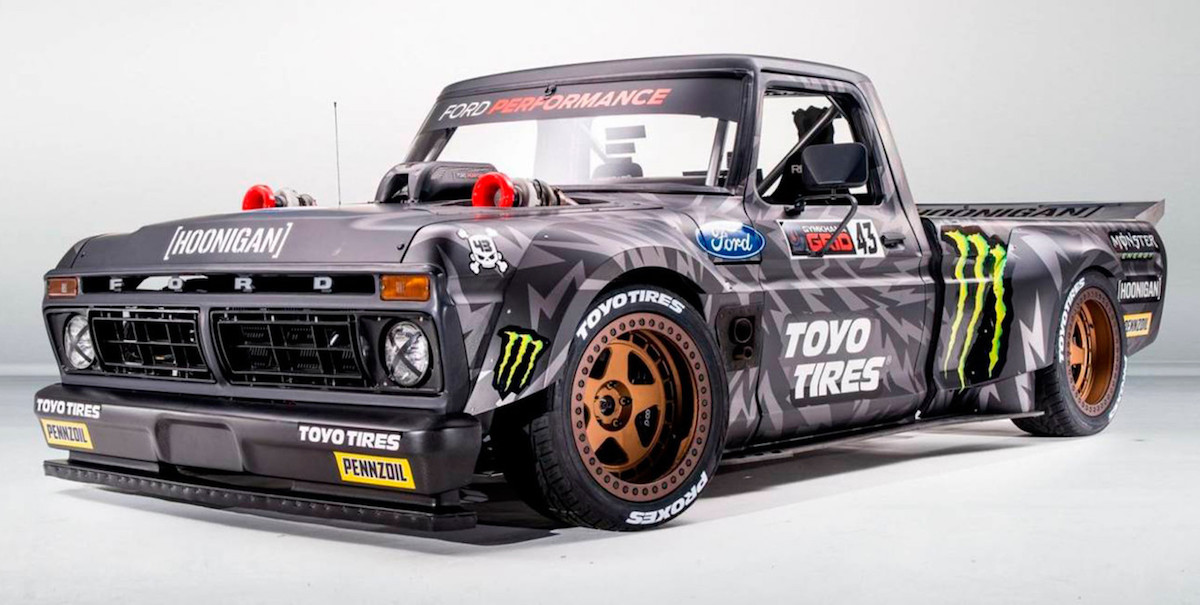
3D printing technology is here to stay, as Ford and Ken Block have shown by bringing an intake manifold to life using this system.
Today’s motorsport world is represented by a roster of illustrious drivers who are attracting strong attention, among whom we must highlight Ken Block. This charismatic figure stands out not only for his driving skills, but also for his constant need to slide his cars sourced from Ford. Block’s latest acquisition is a 1977 F-150 that has received a series of modifications to turn it into a true drift machine but, even so, the American needed a part that was supplied by the engineers at the oval brand, an aluminum intake manifold.
The Gymkhana TEN star has named his favorite son Hoonitruck, a nickname that does justice to its status more fitting for a supercar than a 1970s pickup. Now, thanks to innovative 3D printing, Ken Block’s faithful companion is complete, allowing the driver to enjoy it like never before and make the rear of his F-150 slide from side to side without hesitation.
The engineers at Ford needed five days to complete the part, a development that hides the hard work of the team behind it. The American company turned to its European headquarters to speed up the process and deliver an even more effective result. In collaboration with the Institute of Digital Additive Production at RWTH Aachen, in Germany, the oval brand managed to conceive this aluminum intake manifold.
This part is responsible for delivering air from the turbochargers to the engine cylinders, which requires high-performance components. This is because Block’s Ford F-150 does not hide an engine typical of the era in which it was built, but instead has a heart worthy of contemporary supercars.
To be more specific, the engineers at Ford installed the same 3.5-liter twin-turbo EcoBoost V6 that powers the latest generation of the Ford GT, a supercar that has generated great anticipation among today’s public. This is how this pickup finds itself capable of producing 914 CV and 951 Nm of torque, figures complemented by a hydraulic handbrake responsible for keeping the rear end constantly sliding.
https://youtu.be/6GsuRCGEZno
This is how Ford managed to install the largest 3D-printed metal part for a vehicle in operation in history. With this premise, we have witnessed the capability of this new technology, which continues to advance to deliver important innovations and many conveniences once it becomes more established.


 The seven finalists for the 2027 European Car of the Year (COTY) are exclusively electric
 Peugeot E-208 GTi: a battery-powered toy that revives the spirit of the 1980s sports cars
 New Lexus ES: luxury grows and goes electric
Deja un comentario