Ferrari LaFerrari Curiosities Supercars
New details about the Ferrari F70
 Chema
19 November 2012
2 min.
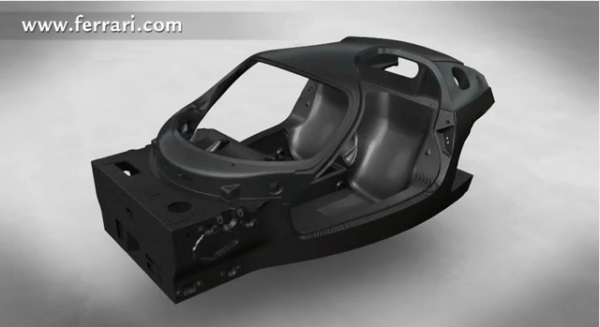
Some details about the successor to the Ferrari Enzo, the F70, have leaked. A hybrid powertrain with 850 CV, a kerb weight of 1,100 kg and custom-made seats are its biggest novelties so far.
Autocar has recently revealed new details about the successor to the Ferrari Enzo, the F70. This Italian thoroughbred is set to rival the McLaren P1 and the Porsche 918 Spyder and, like them, it will be a hybrid vehicle that is extremely light, fast and efficient within its capabilities. It will be unveiled to the public this spring.
The Ferrari F70, known inside the factory as the F150, is reportedly built around a carbon fibre monocoque weighing a total of 70 kg, 20% lighter than that of its predecessor, while also increasing the stiffness of the chassis by 27%. A honeycomb panel structure is used between each layer of fibre, while beneath the monocoque there would be another layer of Kevlar to protect certain components. In this way, the kerb weight has been reduced by more than 250 kg, bringing the total to 1,100 kg.
The powertrain of this vehicle would consist of two engines, one petrol and one electric, making it a hybrid, like its rivals. The first is a 6.3-litre naturally aspirated V12 with direct injection, capable of exceeding 750 CV of power, 10 CV more than the F12berlinetta with the same engine block. It will be paired with a seven-speed automatic dual-clutch gearbox.
To this is added a KERS system, very similar to those used in Formula 1, to electrically provide an additional 100 CV and a maximum torque of 270 Nm. The zero-emissions motor cannot operate on its own; the V12 must always be running. In exchange, however, it delivers a 40% reduction in fuel consumption on the road.
Performance figures are impossible to discuss for now. Rumour has it that it will exceed 400 km/h and that the 0-100 km/h sprint will undoubtedly drop below 3 seconds. The only thing we know for certain is that, thanks to the extra boost from the KERS system, the 0-200 km/h time is reduced by 10% compared with the car without it.
Finally, it has been learned that the driver’s seat will be fixed to the monocoque, with only the steering wheel and pedals adjustable. In addition, it will be made to measure for the driver.
Source | Autocar


 Peugeot E-208 GTi: a battery-powered toy that revives the spirit of the 1980s sports cars
 New Lexus ES: luxury grows and goes electric
 First contact with the Dacia Sandero Hybrid 155: power and efficiency from €19,890
Deja un comentario