Land Rover Range Rover Evoque Coupés Photos Tests SUV
Range Rover Evoque Coupé 2.2 SD4 4x4 with 190 CV, road test (Engine and performance)
 Diego G. Moreira
15 May 2012
6 min.
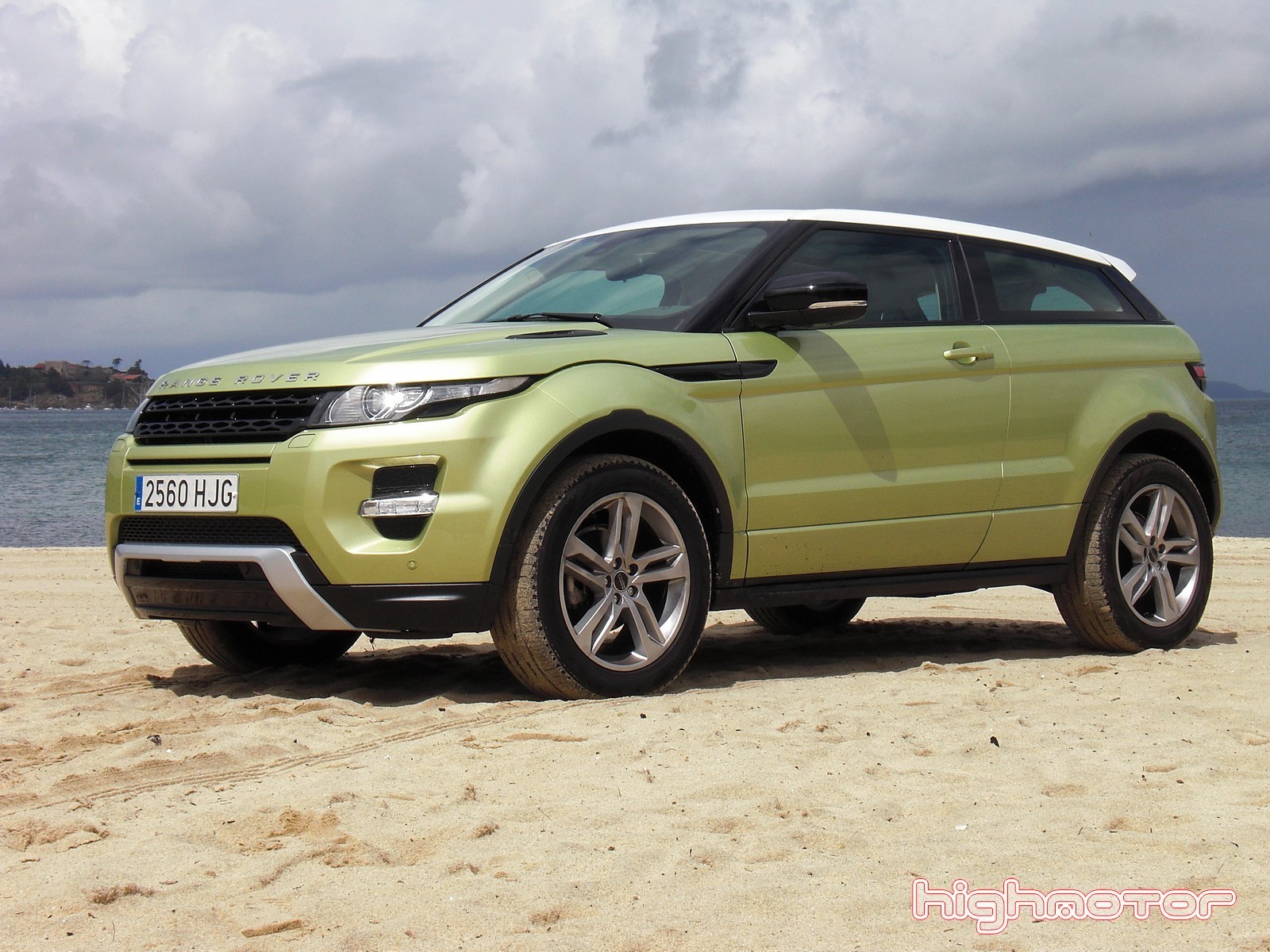
Road test of the Land Rover Range Rover Evoque with 190 CV diesel engine, 4×4 traction and six-speed automatic gearbox. In this first part we analyse the engine, handling, consumption and off-road capabilities.
A few days ago we previewed in the teaser the colour of the car and some other details about this peculiar model, and now we finally start the road test of the Range Rover Evoque Coupé. Under that long name that gives this article its title, we have an Evoque Coupé with a four-cylinder diesel engine, 190 CV, all-wheel drive and automatic gearbox (I could not put any more text in the post title).
That is, the most powerful and most expensive Evoque in its diesel version. But we will talk about all of this throughout the test, the test of a curious model, which is remarkably boosting Land Rover sales and which captivates with its exterior design, closer to a concept than to a street vehicle. But beyond design, it has other features that make it a very interesting SUV and which we will tell you about in this test across three parts, let’s go!
Engine and performance
The mechanical range of the Range Rover Evoque in diesel consists of just two variants, both based on the same 2.2-litre engine but with different power outputs, 150 and 190 CV. The engine is an old acquaintance of ours; we recently tested it in a Jaguar XF, but before that we tried it in a Citroën C5. It was developed by PSA-Ford and is used in several models from both manufacturers.
The most distinctive thing about this engine is its power delivery, it cannot be said to be a smooth powerplant, but when we press the accelerator the car responds forcefully and efficiently. Partly, this is thanks to a torque of 420 Nm available from just 1,750 rpm, pulling up to 3,500 rpm where it starts to run out of steam.
Therefore we are talking about an engine more than sufficient to move the Evoque, but perhaps the 150 CV variant would be more rational if we are not seeking a sporty response. The drawback we can point out is the noise: it sounds quite like a diesel engine and does not live up to a car with a premium finish level.
Associated with the powerplant, optionally, we have a six-speed automatic gearbox. It has nothing to do with the eight-speed ZF fitted to the Jaguar XF, and it shows. It is a more veteran gearbox that does not stand out for its speed. It incorporates paddles to shift from the steering wheel, but it is an extra we only recommend for those who want an automatic, because with the manual gearbox we save on an extra and can get more out of the engine.
Handling
In this section the Evoque surprised us, and it fully lives up to the sporty image projected by its exterior design. We are dealing with an elevated SUV but with a firm suspension setup that gives it great agility and stability on the road.
Thanks to this, it does not suffer the typical body roll of an off-roader of these dimensions, being very comfortable on long journeys and at the same time not becoming uncomfortable on uneven asphalt.
On roads with bends it has proven stable and agile; only the M+S tyres reduced its agility a little on winding routes and corners. It also has a good braking system, which stops the Evoque without problems and effectively.
In short, we have a tall vehicle but with stable and composed handling, which proves very effective on the road.
Consumption
When choosing an Evoque you have to think very carefully about what use you are going to make of the car, that is, whether or not we are going to need traction. I say this because the four-wheel drive system is permanent (in addition to having Terrain Response) and, of course, it affects consumption. Add to that 19-inch wheels, which are not the most fuel-efficient either.
With the above basis it is logical that consumption is not very low: on the road it hovered around 8 litres per 100 km, while on motorways the lowest we achieved was 7.3 litres per 100 km.
Where it shot up was in town, rising to 11 litres per 100 km. The consumption figures may seem very high, but it is a car with all-wheel drive, 190 CV and automatic gearbox. All of these elements weigh on consumption, so I recommend carefully considering whether or not to add traction and which engine to choose.
Off-Road Behaviour
Our test team is not the first to take the wheel of an SUV, but we have rarely ended up talking about genuine off-road behaviour. In the case of the Evoque, it must be said that it is a Land Rover, and with that you can get an idea.
Its urban appearance, far from the countryside and off-road trails, hides a vehicle with excellent off-road capabilities, atypical in the SUV segment, which rarely venture beyond forest tracks.
It features, in addition to traction, Terrain Response, with four programmes: Normal, Snow-Grass, Mud-Ruts and Sand. With the mountain and ruts programme it engages hill descent control to mimic the function of a low-range gearbox, a clever idea.
Our first off-asphalt test was in a wetland, with grass and water covering a third of the wheels. We were surprised that it did not even spin its wheels to leave the spot, but instead in the calmest and most effective way drove out of a place where some SUVs have had problems.
We also tried it on sand, to check the effectiveness of the traction system, and again we were surprised. Its effectiveness was closer to a Land Rover Discovery than to a Nissan Qashqai, and on top of that we have to add a generous ground clearance and the mixed tyres fitted as standard.
In short, the vast majority of Range Rover Evoques sold will never tread on mountain terrain or a truly difficult area, but it is interesting to know that, should you do so and have all-wheel drive, the car responds. That said, if we are not going to venture into difficult areas, it is better not to fit the traction system, for the logical savings in cost, maintenance and consumption.
In the second part of the test we will focus on the exterior design, finishes and interior space, as well as boot and storage.
Photos | David Taboada, Test team, Diego G. Moreira
Technical specifications of this car


 Peugeot E-208 GTi: a battery-powered toy that revives the spirit of the 1980s sports cars
 New Lexus ES: luxury grows and goes electric
 First contact with the Dacia Sandero Hybrid 155: power and efficiency from €19,890
2 comentarios
Deja un comentario
Buen Report! +10, en la segunda prueba haber si comentas sobre el equipo de sonido! xD
Saludos!
A mi tambien me ha está encantando la prueba, buen aporte de sensaciones que transmites con tu lectura. 😉 saludos.