SsangYong Korando, presentation and road test in Mallorca (part 1)
 Javi Vicente @javivicente
13 October 2010
5 min.
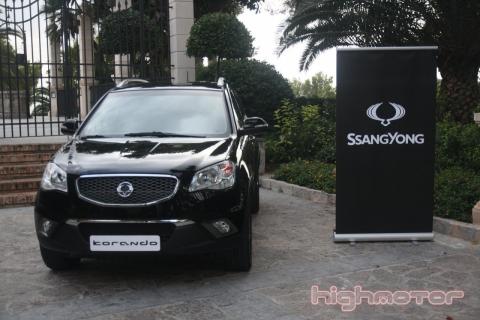
Something has changed for the brand; we don’t know whether it’s Mahindra, the current owner of the Korean brand with a 51% stake, or the demand for this type of vehicle in today’s market, or both, but SsangYong wanted to present its new project with a vehicle that has nothing to do with its previous models.
It inherits nothing, everything is new, from its monocoque chassis to the last detail on the instrument cluster. The new Korando comes on strong, with plenty of ambition, careful and modern design, ready to carve out a place in the world of SUVs or crossovers. And Mallorca was the ideal place to test it.
SsangYong Korando, the end of one era and the start of another
It had been some years since a new model was presented. The last was the Rexton, four years ago, and this new launch, after the crisis that began in 2009 with the suspension of payments, comes at just the right time to strengthen the brand.
It has been almost 2 years since the new product plan was presented, with 5 new launches in 5 years, and the first of them is the one we are looking at. The C200, the name it was known by as a concept and which we saw at the latest Barcelona Motor Show, has commercially revived an old name from a historic model whose last version dated from 1996. It has nothing to do with that one.
Carlos Olaso, the brand’s communications director, told us that the second launch, whose commercial name is still unknown and which is internally called D200, will be an SUV that shares a platform with the Korando, although larger.
Goodbye to the transfer case
The Korando abandons the ladder frame and crossmembers, which the current market does not much like, in pursuit of greater everyday comfort, naturally losing some off-road capability. With a monocoque chassis, the brand’s bet is very clear: it will offer much more stability on winding roads, mountain passes and motorways.
Although the low-range gearing is removed entirely, and the long and short gears too, full-time all-wheel drive can be kept in the 4×4 version. A button allows the centre differential to be locked with equal power to both axles, so drivers can still enjoy, albeit to a lesser extent, driving over slippery or sandy terrain.
One of the few brands that still incorporated a transfer case in its models, which helped it stand out and win market share in this way, has removed it. The vast majority will applaud, but a few will mourn its loss. After all, more than 90% of the market will be able to access the vehicle thanks to this decision.
Exterior and interior design
A much more rounded design, a more modern and robust look, and a clear resemblance to its rivals while keeping its own identity: that is how the new Korando can be quickly described.
Looking more closely, its dimensions are in line with the market: 4.41 metres long and 1.83 metres wide are more than sufficient for the SUV segment. The height of 1.675 metres is also average, so the approach is clear and above all safe: going after the market. It has nothing to do with its previous models; it is new, although at times, looking at the rear, some model from the brand comes to mind because of its large rear lights.
The front is what has changed the most, and for the better. Its aggressive grille gives it a very renewed, modern look adapted to today’s market. The foglamps are perhaps the only element that could be said to have been carried over, but overall it is a change for the better. The side profile also gains in modernity, rounding off the front and rear shapes and offering quite pronounced wheel arches. It has changed so much that, without seeing the logo, I wouldn’t be able to say it was a SsangYong.
Stepping into the cabin gives you a completely new set of sensations. It is also something different, something distinct, with a much better finish, and with plenty of plastics in some areas, as is the case with the window switches on the doors, but much improved compared with before. The dashboard colour is now uniform, unlike before when the centre panel was one colour because of the sat-nav and the instrument cluster was another. The steering wheel feel is much improved, although not very grippy and at times it can feel a little slippery, but that is a matter of getting used to. Quality materials for a rather tight price.
The leather seats in our version (Limited trim) are highly recommended. The cloth does not say much, either aesthetically or in terms of comfort, although if your budget is tight, the most sensible thing is to step down a version; the price difference of 2,000 euros may seem like a lot, but once you try one and the other, the difference is worth it.
I would go for the Limited without hesitation, but everyone should choose whichever suits their budget. Besides the seats, the difference lies in the air conditioning of the Premium and the climate control of the Limited, rear parking assist, 18-inch alloy wheels, a roof rack… among others. The automatic version also includes a sunroof.
If the interior and exterior design surprised you, the driving sensations are no less impressive. We will reveal them all tomorrow.


 Peugeot E-208 GTi: a battery-powered toy that revives the spirit of the 1980s sports cars
 New Lexus ES: luxury grows and goes electric
 First contact with the Dacia Sandero Hybrid 155: power and efficiency from €19,890
Deja un comentario