Tesla begins production of the Cybercab: its fully autonomous vehicle with no steering wheel or pedals
 Javier Cantagalli
18 February 2026
3 min.
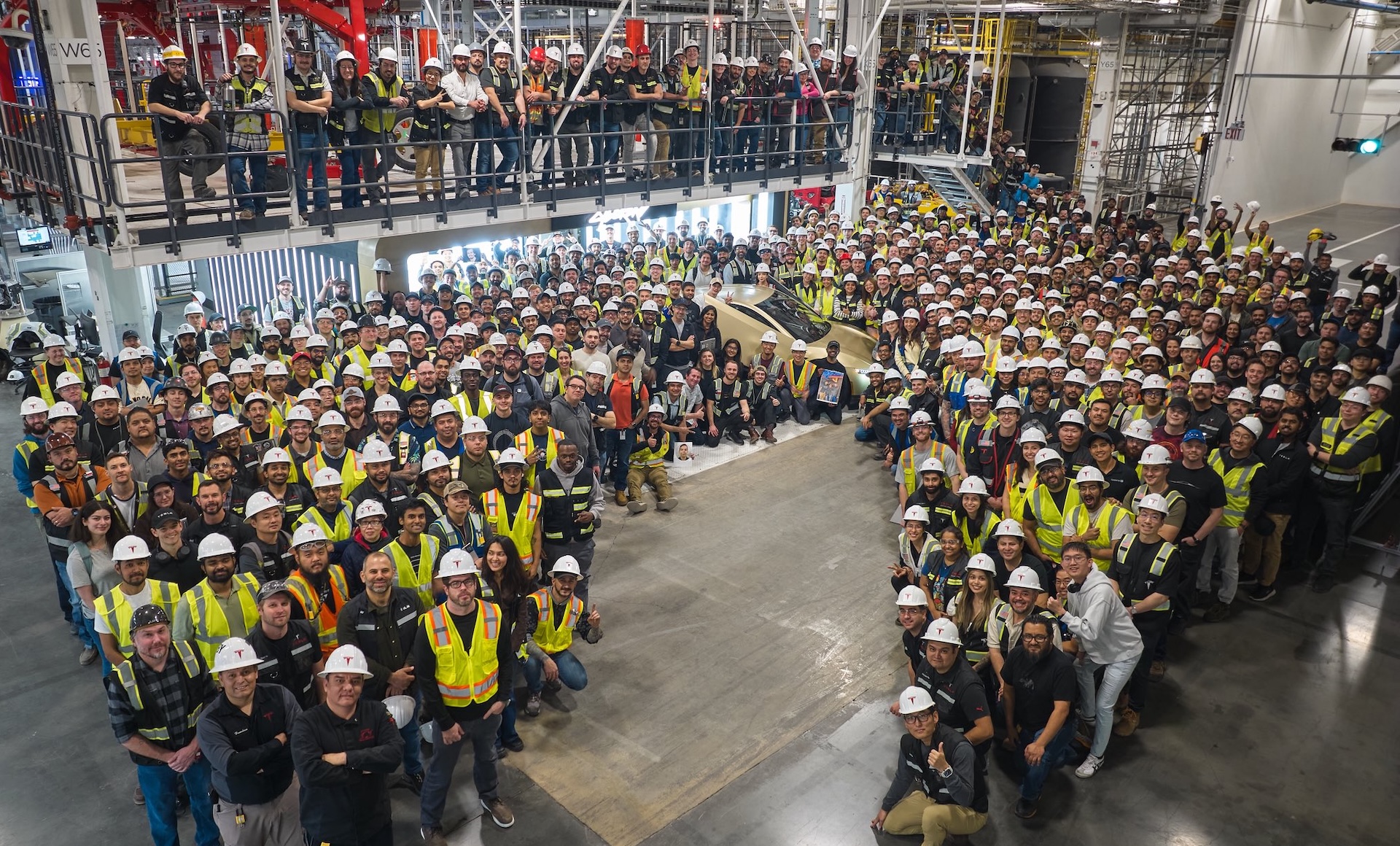
Following assembly of these first units, series production at the Giga Texas factory is scheduled to begin next April.
It seemed this day would never arrive, but it is now a reality. Tesla has just announced via a post on the social network X that the first unit of the Cybercab, its fully autonomous vehicle with no steering wheel or pedals, has already rolled off the production line at the Giga Texas factory. The news was accompanied by the image you can see at the top of this post, right here, showing the Tesla team that made this feat possible.
As you will likely recall, the Cybercab was unveiled in October 2024 during the “We Robot” event, where the company presented its distinctive vision of the future that awaits us. Tesla plans to deploy hundreds of thousands of units of this electric two-seater, whose operation depends entirely on the company’s Full Self Driving (FSD) software, as it has neither steering wheel nor pedals.
The American company is thus entering head-to-head competition in the robotaxi market with other industry players such as Waymo or Zoox, with the particularity that its vehicles rely entirely on the cameras surrounding the vehicle and artificial intelligence to analyse all the information these sensors provide, dispensing with others such as LiDAR or radar. This should allow a substantial reduction in the cost of each vehicle and, consequently, in the price charged per kilometre travelled.
The era of robotaxis is about to begin
As we have been telling you here at HighMotor over recent months, Tesla already has some Model Y vehicles adapted for use as robotaxis in several US cities, such as Austin in Texas, or San Francisco in California. Although many of these robotaxis are supervised by a company employee riding in the front right seat, some units are already completing journeys entirely alone, transporting passengers from one part of the city to another.
It should also be noted that, following this important step taken by Tesla, Elon Musk himself has announced that series production of the Cybercab will begin next April. The head of the company has additionally confirmed that, as promised, the Cybercab will also be available to private customers, who will be able to purchase a unit for less than 30 thousand dollars for personal use.
One of the key innovations that will make mass production of the Cybercab possible is its “Unboxed” production method, which consists of manufacturing independent sections of the vehicle in specific areas of the factory and then joining them together at the end. Tesla claims this approach reduces costs, takes up less space and speeds up the assembly rate. However, mastering this technique will be complex, and Elon Musk himself has already warned that at first this will be slow.
Unsupervised autonomous driving
Series production of the Cybercab is not, however, the only challenge Tesla faces if this project is to succeed. Although highly advanced, the Full Self Driving (FSD) software that is meant to enable fully autonomous driving of the vehicle is not yet finished, and completing it will be an enormous challenge, since, as we should remember, the Cybercab has neither pedals nor a steering wheel and therefore depends entirely on this software.
2026 is thus shaping up as a key year in the development of autonomous driving technology and the deployment of robotaxis dedicated to passenger transport. In the coming months we will see whether this ambitious project launched by Tesla ultimately moves towards success or runs into unexpected difficulties.


 Peugeot E-208 GTi: a battery-powered toy that revives the spirit of the 1980s sports cars
 New Lexus ES: luxury grows and goes electric
 First contact with the Dacia Sandero Hybrid 155: power and efficiency from €19,890
Deja un comentario