The 10 best super GTs of 2020
 Mónica Redondo @MonicaRedondoD
30 January 2020
14 min.
The ten best super GTs of 2020 are spread across some of the finest brands in the world. Do we know them?
The best Super GTs are a rare breed capable of being smooth and gentle one moment and ferocious the next, while enclosing their occupants in a luxurious environment. What are our top ten?
The modern ‘super-GT’ inherits a legacy forged and refined over more than a century of sports car manufacturing, through front-engined, rear-wheel-drive legends such as the pre-war Alfa Romeo 8C and similar to the Jaguar E-Type, the Aston Martin DB4, the Ferrari 250 and the Mercedes-Benz 300 SL Gullwing. No other part of the high-performance car market has a finer pedigree.
These are the cars destined for the idyllic high-speed continent-crossing missions of your waking dreams. They are ‘have your cake and eat it’ models, with excellent travelling manners and plenty of luggage space, often with a couple of occasional rear seats thrown in.
But the best combine all that with thoroughly first-rate speed, power, handling balance and driver engagement; or, alternatively, limousine-like luxury, as you prefer.
1. Aston Martin DBS Superleggera
If there’s one brand you’d expect to deliver the execution of a luxurious, powerful and beautiful super GT, it’s Aston Martin. And with the latest DBS Superleggera, that’s exactly what the iconic British marque has done.
This new flagship model (at least until the Valkyrie hypercars) is one of the few to have received a full five-star rating from our road test team in 2018. This is an impressively complete car. The 715 CV and 800 Nm produced by its 5.2-litre twin-turbo V12 allow the DBS to cover ground at an alarming rate of knots and yet, even with all that performance punch, the big Aston Martin never feels intimidating or nervous, something that can’t be said of the Ferrari 812 Superfast. Excellent handling and a ride that is deliberately firm but usefully supple add to its excellent grand touring credentials.
There are some (minor) flies in the ointment, however. It is not exactly light (despite what the Superleggera name might lead you to believe), and the eight-speed gearbox can be a little abrupt at low speeds. The cabin is also similar to that of the considerably cheaper DB11. But overall, this is a phenomenal car that represents a welcome return to form for a much-loved British manufacturer. It could hardly have been missing from the best super GTs of 2020.
2. Aston Martin DB11 AMR
The fact that Aston Martin has claimed the top two spots in this list is a testament to the success of Messrs Palmer and Co in turning the legendary British carmaker from a much-loved but dated brand into a genuine force to be reckoned with.
Think of the AMR as a DB11 2.0. Almost three years after the launch of the original DB11 V12 in 2016, it has been retired and replaced by the model seen here. Power from the 5.2-litre twin-turbo V12 is up by 30 CV over the previous model to 630 CV, while stiffer suspension bushes and recalibrated dampers mean it now handles even more competently than before, while four-wheel drive has also been improved. And while its handling is understandably firm, enough composure is on offer to ensure it remains a comfortable and effortless GT.
It’s one that isn’t quite as complete as the DBS Superleggera, but given that the flagship model is the better part of 50,000 euros more expensive, it’s to be hoped it doesn’t tread too heavily on the toes of its elder siblings among the best super GTs.
3. Bentley Continental GT
The sporting realignment of the Bentley Continental GT has got off to a good start with this new third-generation, twelve-cylinder launch-edition coupé. This is a car that retains all the tactile material luxury, first-class refinement and top-drawer finish we expect of its maker, but which probably halves the gap that existed between its predecessor and the better-handling cars in the ‘Super-GT’ niche in driver appeal.
The car’s high real-world performance and stability across all surfaces will be big draws for customers who use their cars daily, but they are coupled with far better body control and cornering balance than current GT owners have been used to. But for one or two quibbles, it’s hard to imagine how Crewe could have better met the particular dynamic brief of this car, which now caters to a wider range of customer preferences than any of its predecessors.
Admittedly, there are a couple of rival super grand tourers that achieve that all-important compromise of handling agility and involvement with GT comfort a little better. But given the weight of opulent luxury it has to carry, the Continental GT has come a remarkably long way as a driver’s car. We’ll be watching with interest to see how much further it can still go.
4. Rolls-Royce Wraith
Little in the motoring world is more wonderful than the most aristocratic of blue-blooded passenger vehicles dressed for weekend fun.
That’s what the Wraith represents. Rolls-Royce unveiled the two-door ‘grand touring’ version of its smaller Ghost saloon in 2013, and with it announced the
most driver-focused car in its history.
The two-door is only small by Rolls standards, of course; it’s large enough to accommodate adults in its beautifully appointed rear seats and has space in the boot for a heap of designer luggage.
Up front, it trades some of the extravagance and formality of its sister models’ interiors for a more informal, intimate and understated ambience. Yet again, though, Rolls’s idea of understated is still majestic enough to include soft leathers, gleaming bright work and large expanses of beautiful wood veneer panelling.
The Wraith’s handling has a more starched and crisp edge than the Ghost’s, making the car very happy to be hustled along at a test pace and able to reward an interested driver with its deliciously weighted steering and strong, balanced levels of grip.
The Wraith’s V12 engine has abundant power, typically aristocratic smoothness and greater responsiveness, although you can still monitor your business from a distance, via the idiosyncratic ‘Rolls-Royce energy reserve’ gauge rather than something as commonplace as a rev counter. This car is one of the best super GTs and simply delicious to drive, as well as being a sublime way to travel.
5. Ferrari 812 Superfast
An updated version of the front-engined V12 first unveiled as the F12 in 2012, the 812 Superfast builds on all the good things of its predecessor, and also incorporates much of what made the
special-edition F12tdf
such an incredible driver’s car. Which is not a bad start in life for any modern high-performance car.
With 801 CV from a naturally aspirated twelve-cylinder engine that could realistically be the best in its class, adorning a road car alongside sports handling that nothing else in the class of best Super GTs can truly approach, the 812 Superfast stands out above its nearest rivals for driver appeal.
The rapier-like handling agility of the F12tdf, caused mainly by its aggressive four-wheel steering system, has been toned down, but without dulling the dynamic alertness and balance that has distinguished this generation of Ferrari front-engined V12 since its introduction.
Some would argue that a super GT should be less taut, a more natural distance-eater capable of making the miles fly by the window in a less frazzled mode. But once you have sampled the incisive vigour and commitment with which the 812 Superfast drives, nothing else in the class will suffice.
6. McLaren 570GT
McLaren makes supercars, right? Correct. But it also makes the 570GT:
a further practical, slightly calmer and more cultured version of the
570S ‘sports series’ supercar.
And while that idea might sound a little ill-conceived, the car it gives rise to is anything but, combining 95% of the ‘core’ 570S’s remarkable pace and balance with more sober cruising manners, a more elegant silhouette and a useful increase in luggage space.
The 570GT is a strict two-seater, making it far less usable than many cars in this class, but it offers up to 370 litres of luggage space split between the front and rear boot compartments; it has a slightly softer suspension tune than a 570S, as well as slower and more relaxed steering; and it carries better interior insulation and refinement measures than its rangemate.
The 570GT drives with remarkable compliance and, being a McLaren, it offers much better panoramic visibility, far easier entry and exit, and a far more usable and longer-distance driving experience than you would ever believe a mid-engined sports car could. The car is so good, in fact, that you may wonder whether Woking should turn to the best super GTs more often in future.
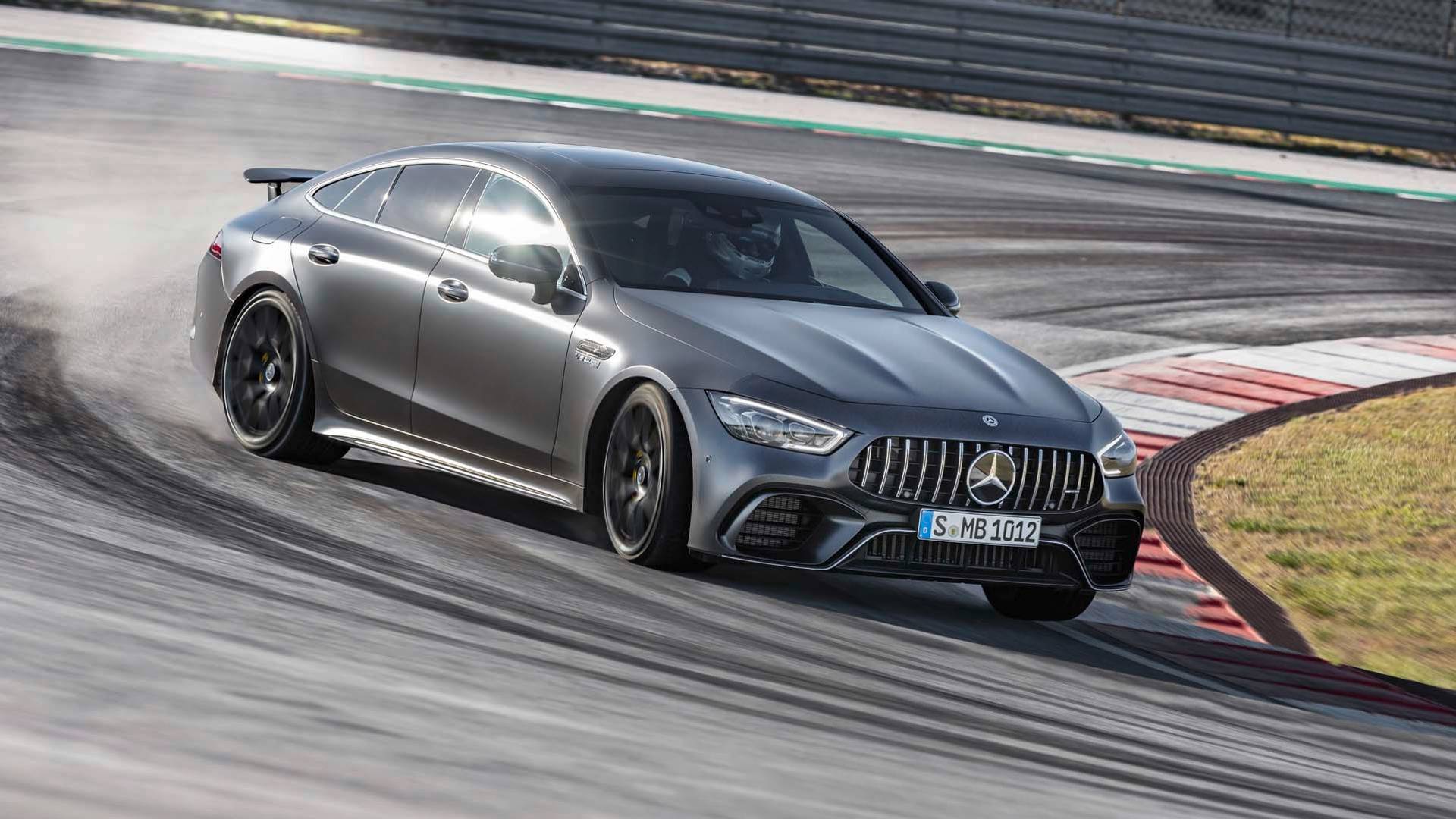
7. Mercedes-AMG GT 4-Door
The third in-house model from Mercedes-AMG is a completely different beast to its first two. Whereas the old SLS and the AMG GT
made much of their long bonnets, classic grand touring proportions and two-door (gullwing in the case of the SLS) designs, the 4-door AMG GT 63 does not. As its convoluted name suggests, this latest AMG has more in common with Mercedes-AMG’s faster saloons than the two-seaters that preceded it.
But don’t let its bloated proportions or 2.1-tonne kerb weight fool you into thinking
AMG has gone soft. An arsenal of drivetrain and chassis technology including everything from four-wheel steering, torque vectoring and an active-locking rear differential, to a range of selectable driving modes and traction and stability control programs endow the 4-Door GT with a physical challenge close to that of an out-and-out sports car in terms of agility, balance and incision on the road. Put it on a track and it will happily slide about all day.
That this athleticism does not come at the expense of driving refinement is what really makes the 4-Door GT stand out. Sure, the cabin quality could be better in places, as could the insulation, but none of these gripes are significant enough to detract from what is one of the genuinely impressive best super GTs.
8. Mercedes-AMG S63 Coupé
The Mercedes-Benz S-Class
includes the very latest and greatest in its maker’s drivetrain, suspension, safety and infotainment technology in an elegant two-door flagship. And when you’re an industry powerhouse the size of Daimler, you can include a great deal of technology, largely of the type that niche-level rivals in this class simply don’t have the budget or scale to offer.
The
Mercedes-AMG S63 Coupé, then, is a car with all of Mercedes’s semi-autonomous braking, speed-limit and lane-keep assistance systems, the latest on-board connectivity and digital concierge systems, and with Mercedes’s camera-based Magic Body Control active hydraulic suspension that scans the road surface and prepares the suspension specifically for the bumps it is about to encounter.
AMG’s 4.0-litre twin-turbo V8 provides the S63 with all the power and torque it needs, and the suspension strikes an intelligent compromise between isolation and driver engagement that does enough to keep you interested in the driving experience, but also makes the car feel magnificently refined and long-legged.
9. McLaren GT
The new McLaren GT really does seem to have put the ‘super’ back into the Super GT class. On paper, the GT seems to have more in common with a supercar than a stately grand tourer, with its carbon tub and strictly two-seater, mid-engined layout. But with the lines between vehicle classes increasingly blurred across the industry, it doesn’t seem entirely surprising that we now have a McLaren that supposedly can mix it with the tastes of Bentley and Aston Martin buyers.
Of course, McLaren pulled a similar trick with the excellent 570GT. But where that car was an adaptation of an existing model, the
GT is its own standalone model.
It therefore gets even more storage space, a more luxurious finish to the cabin and a slightly softer suspension tune. Its 4.0-litre engine is also less powerful than the 720S’s, but 622 CV and 600 Nm ensure the GT remains startlingly quick in a straight line.
It’s also a peach on challenging roads: incisive and agile with precise, pleasant steering. Indeed, if driving pleasure is at the top of your list of requirements, this could be one of the best super GTs for you.
There is a compromise, however. As comfortable as it is by McLaren’s standards (and those standards are really very high indeed), alongside the Aston Martin and Bentley that sit at the top of this class, the McLaren doesn’t compete for genuine long-legged grand touring ability.
A full road test will deliver the final verdict imminently, but based on our first preproduction examples, the McLaren GT is not quite as convincing as its cheaper sibling, the 570GT.
10. Aston Martin Rapide AMR
Let’s not beat about the bush here: the Aston Martin Rapide is now incredibly long in the tooth, having existed in one form or another since 2009.
This AMR version (which is the Aston Martin Racing) is effectively a swan song for the four-door model, marking the end of the line for Aston’s VH architecture and its phenomenal, ageing
6.0-litre naturally aspirated V12
.
It’s also a fitting send-off. Subtle chassis tweaks give its ride a little more firmness and help keep its body under control more effectively, but its wonderful rear-engined balance is as evident as ever. Its steering is precise and impressively pleasant, its V12 smooth, powerful and with a soundtrack to die for.
Of course, it feels its age against the newer, more advanced rivals in this class, particularly in terms of its cramped and restless-styled interior. But there’s a great deal of character on offer here, so much so that it will be hard not to be charmed by the old-school appeal of the four-door Rapide.


 Peugeot E-208 GTi: a battery-powered toy that revives the spirit of the 1980s sports cars
 New Lexus ES: luxury grows and goes electric
 First contact with the Dacia Sandero Hybrid 155: power and efficiency from €19,890
Comentarios cerrados