EBRO s400 s700 s800 s900 Electric Cars Hybrid Cars ECO SUV
The EBRO electrified range put to the test: these are the consumption figures for the S400, S700, S800 and S900 when driven with maximum efficiency
 Antonio Roncero @roncero_antonio
2 March 2026
8 min.
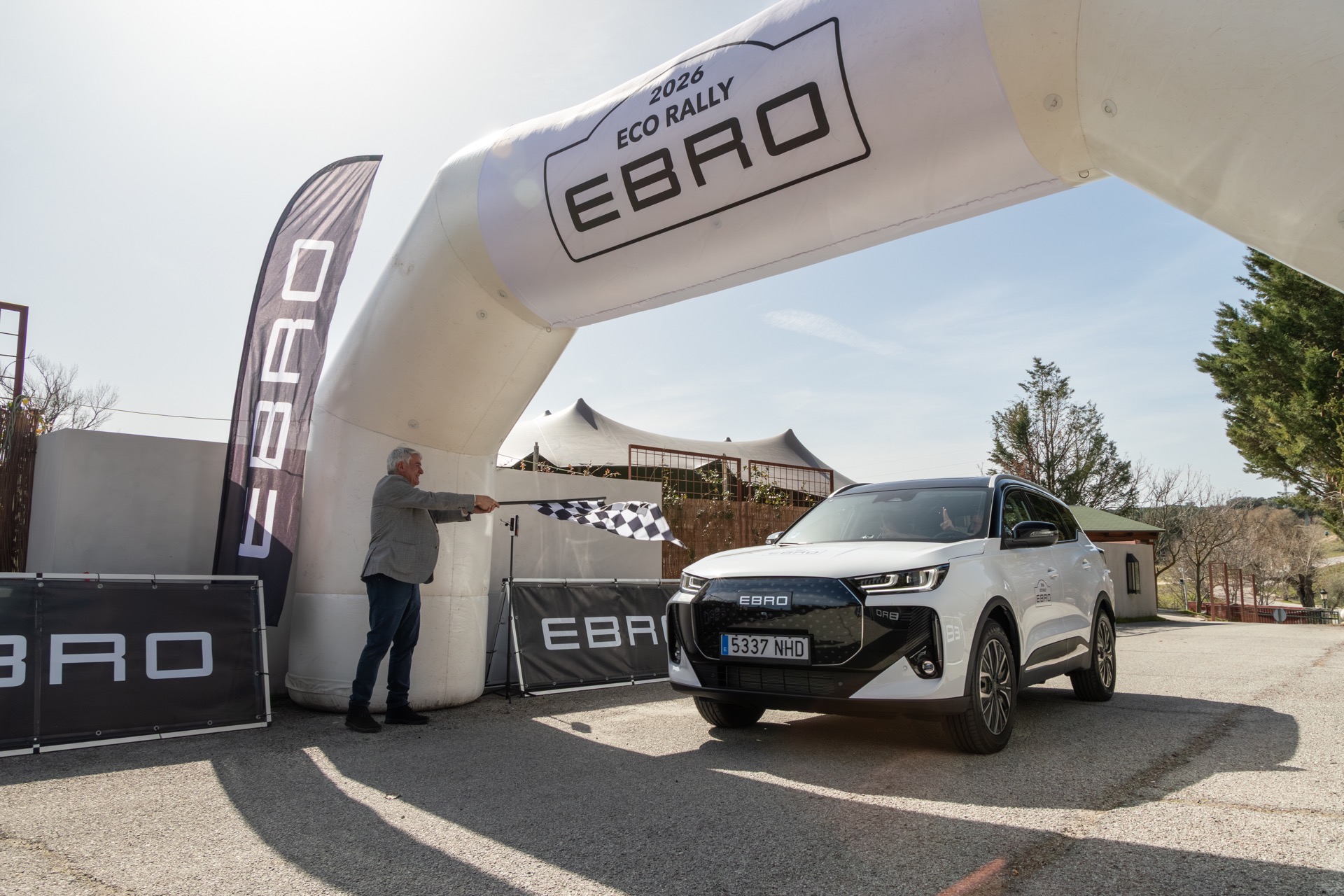
Beyond the homologated figures and the commercial rhetoric, electrification only makes sense when it is tested under real conditions. That was precisely the approach of the EBRO ECO Rally 2026: a 132-kilometre route, with regularity sections, imposed average speeds and strict control of times and consumption, designed to verify under real conditions the consumption of its entire electrified range: S400 HEV, S700 PHEV, S800 PHEV and S900 PHEV.
The approach was clear: full and sealed fuel tanks, charged batteries and efficient driving as the only valid strategy, with a pace imposed on timed sections, secret controls and penalties for leaving the route… or for missing the time checkpoints. The winner was not the fastest, but the most precise… and the one who consumed the least energy.
The event, held over two days, served as a dynamic laboratory to analyse how EBRO’s multi-energy strategy works in practice: self-charging hybrid for those who don’t want a plug, plug-in hybrids to maximise daily electric use and, in the case of the top-of-the-range model, high-performance electrification with all-wheel drive.
EBRO S400 HEV: hybridisation without a plug and surprising efficiency
The EBRO S400 HEV is the entry point to the brand’s electrification. It is a 4.32-metre compact SUV that opts for a self-charging hybrid solution, with no need for a plug, designed for mostly urban and suburban use. Its system combines a 1.5 DHE naturally aspirated engine with an electric motor, reaching a combined output of 211 CV. The electronic management allows driving in electric mode at low speed and alternating between series and parallel operation depending on demand. On paper, it declares a homologated consumption of 5.3 l/100 km.
In the ECO Rally, the best results of the two winning crews on each of the two days were 2.06 and 2.48 l/100 km. These figures were obtained under extremely optimised driving, but they demonstrate the system’s ability to make the most of regeneration and prioritise electric use when the environment allows it. Obviously we are talking about a regularity environment, with anticipatory driving and intensive use of regeneration, but the data shows something important: the hybrid system works with great efficiency when driven smoothly and with plenty of anticipation.
It is not a hybrid designed for pure performance, although it accelerates from 0 to 100 km/h in 8.7 seconds, but rather to reduce consumption without changing driving habits. In the city and suburban environments this model makes the most sense. It does not need a plug, prioritises electric mode at low speed and its transition between phases is smooth and progressive. Frictionless electrification, as the brand proposes. However, although its performance is very good, it would not be my choice if you have to travel frequently on motorways, because the operation of the hybrid system is uncomfortable due to the noise it produces when accelerating when you cannot maintain a constant speed.
EBRO S400 HEV key data
- Segment: small SUV
- System: self-charging hybrid (HEV)
- Combustion engine: 1.5 DHE naturally aspirated
- Combined output: 211 CV
- 0–100 km/h: 8.7 s
- Homologated consumption: 5.3 l/100 km
- Label: ECO
- Price from: 19,990 euros (with financing)
EBRO S700 PHEV: the balance between size, electric range and price
With the EBRO S700 PHEV we enter plug-in electrification, now with the CERO label. Here the priority is no longer just reducing consumption, but allowing the vehicle to run most of the time in electric mode. The system combines a 1.5 TGDI DHE of 143 CV with a 204 CV electric motor, for a combined output of 279 CV. The homologated electric range is up to 90 km, enough to cover daily journeys without resorting to petrol if recharged regularly. It supports DC fast charging of up to 40 kW (30–80% in 19 minutes), an unusual figure in its segment.
In the test, the best crews recorded 1.28 and 2.4 l/100 km. Here the key is the intelligent management of electric mode. On favourable stretches it is possible to drive without using petrol and, when the combustion engine kicks in, it does so under high-efficiency conditions. The possibility of DC fast charging (up to 40 kW) adds a practical bonus that is unusual in its segment. Be aware, as we always say, that this consumption is achievable by practising “Eco Rally” driving, somewhat removed from daily driving… and by making full use of the battery’s capacity. With the battery already depleted, a realistic average consumption maintaining the same efficient driving conditions would be around 6 l/100 km.
We are probably looking at the most balanced model in the range: contained size, good performance (0-100 km/h in 8.2 s), real capability for day-to-day driving in electric mode and an excellent value-for-money ratio between price and equipment.
EBRO S700 PHEV key data
- Segment: compact SUV
- System: plug-in hybrid (PHEV)
- Combustion engine: 1.5 TGDI DHE (143 CV)
- Combined output: 279 CV
- Electric range: up to 90 km
- 0–100 km/h: 8.2 s
- Total range: >1,200 km
- Label: CERO
- Price from: 29,990 euros (with financing and Plan Auto+)
EBRO S800 PHEV: family format, supermini consumption
With a length of 4.72 metres and the possibility of up to seven seats, the S800 PHEV brings the same plug-in hybrid architecture to a more family-oriented SUV. And this is where one of the surprises of the rally came.
It is a model designed for families who want to get around every day in electric mode without giving up comfortable long-distance travel and a total range of over 1,100 km. It shares its propulsion system with the S700 PHEV, but with a more touring and family-oriented approach. On paper, given its size and weight, one would expect higher consumption than the S700. However, in the ECO Rally it recorded 1.0 and 1.61 l/100 km, figures that are particularly striking for an SUV of this size. For an SUV of this size, the figures are especially striking. Much of the explanation lies in the priority electric-use strategy and very efficient management on connecting stretches. But also in the hybrid architecture itself, which alternates series and parallel operation depending on demand. Again, bear in mind that practically the entire route could be done in EV mode.
It is probably the model that best represents the idea of practical electrification for families: daily journeys in electric mode and long trips without range anxiety.
EBRO S800 PHEV key data
- Segment: 7-seat SUV
- System: plug-in hybrid (PHEV)
- Combined output: 279 CV
- Electric range: up to 90 km
- Total range: >1,100 km
- Label: CERO
- Price from: 32,990 euros (with financing and Plan Auto+)
EBRO S900 PHEV 4×4: 425 CV and minimum consumption thanks to a large battery
The EBRO S900 PHEV 4×4 is the technological peak of the range. A 4.81-metre SUV, also with up to seven seats, combining a 1.5 TGDI DHE with three electric motors and all-wheel drive. The combined output reaches 425 CV and 580 Nm, with 0–100 km/h in 5.8 seconds. The 34.46 kWh battery allows up to 140 km of electric range (177 km in urban cycle) and supports DC fast charging of up to 71 kW.
In the rally it achieved the best absolute results: 0.74 and 1.59 l/100 km. The large battery capacity was decisive. Over a 132-kilometre route, the S900 was able to drive practically the entire journey in electric mode, minimising use of the combustion engine. The result shows that size and weight are not necessarily enemies of efficiency when energy management is well resolved. And all this without forgetting that we are talking about an SUV capable of accelerating from 0 to 100 km/h in 5.8 seconds.
It is proof that electrification can also be performance-oriented without giving up efficiency.
EBRO S900 PHEV 4×4 key data
- Segment: large SUV
- System: PHEV with all-wheel drive
- Electric motors: 3
- Combined output: 425 CV
- Maximum torque: 580 Nm
- Battery: 34.46 kWh
- Electric range: up to 140 km
- 0–100 km/h: 5.8 s
- Label: CERO
- Price from: 44,490 euros (with financing and Plan Auto+)
Conclusion: electrification measured, not just promised
Beyond competition, the ECO Rally has served to validate EBRO’s approach: offering different electrified solutions according to the usage profile.
- HEV for those who don’t want to depend on a plug.
- PHEV for those who can maximise daily electric driving.
- Large-battery versions for those seeking real electric range without giving up performance.
The consumption figures obtained in the test are not directly extrapolable to every driver, but they do show that the promised efficiency has a solid technical basis. At a time when electrification raises doubts in part of the market, EBRO has opted for something unusual: putting its cars to the test under measurable and comparable conditions. And the numbers, at least in this first dynamic contact, support the message.
Technical specifications of the cars in this article

 Peugeot E-208 GTi: a battery-powered toy that revives the spirit of the 1980s sports cars
 New Lexus ES: luxury grows and goes electric
 First contact with the Dacia Sandero Hybrid 155: power and efficiency from €19,890
Deja un comentario