EX60 Volvo Electric Cars ECO SUV
Volvo EX60: the electric SUV that, with up to 810 km of range and superior comfort, doesn't need to ask permission to stand among the best
 Antonio Roncero @roncero_antonio
16 April 2026
13 min.
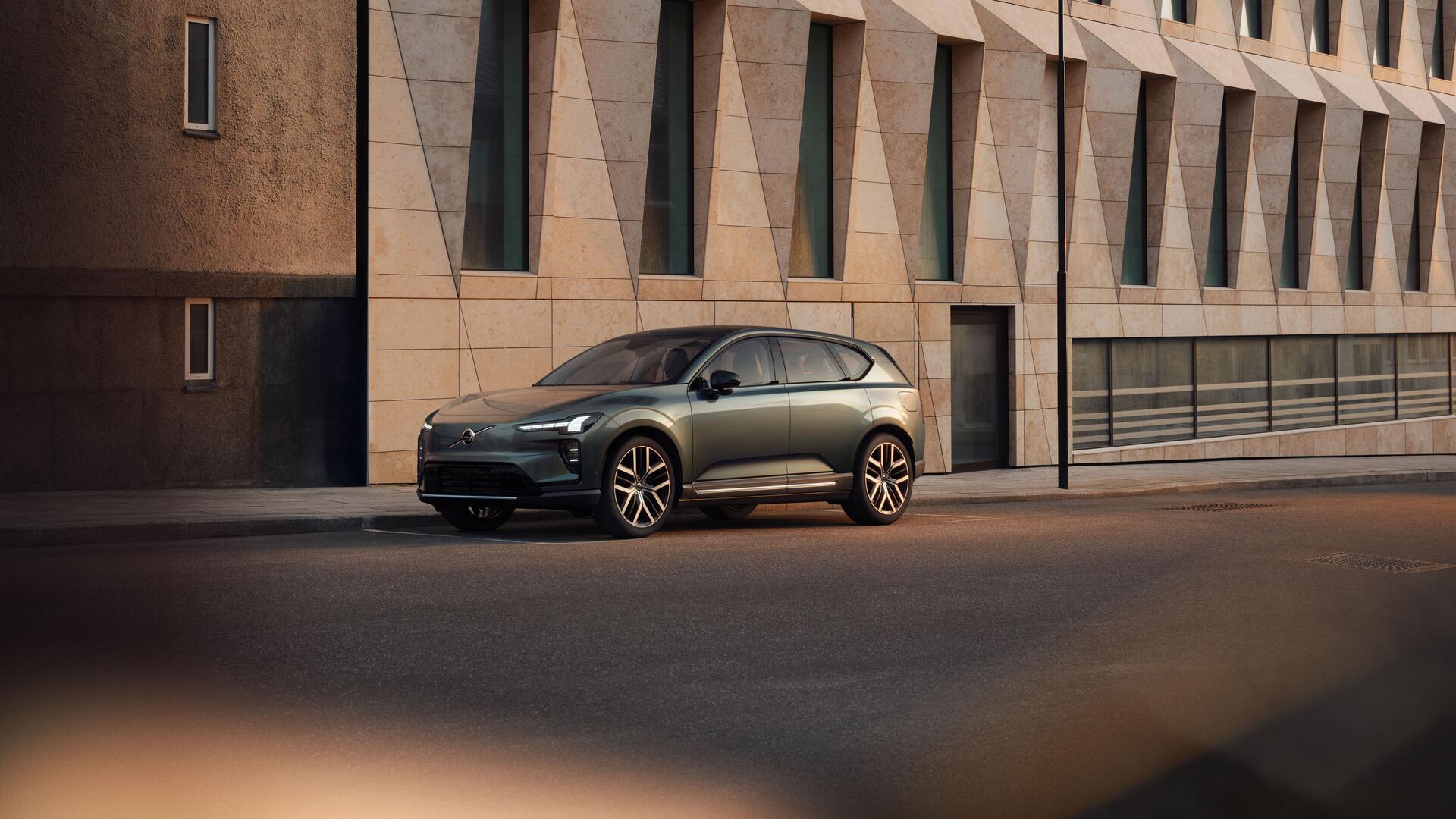
Some cars convince you before you’ve even driven a single kilometre in them, based on their technical specifications and what you already know about other models from the brand. And the Volvo EX60 is one of them. We have seen it, touched it, sat inside and explored every corner during the static presentation held in Madrid, still with the test drive of the Volvo ES90 very fresh. And the conclusion is as clear as it is uncomfortable for the competition, even if it may sound very “marketing-driven”: the EX60 is not just another Volvo, it is one of the most interesting electric cars of the moment for anyone who prioritises range and comfort.
And Volvo has touched a very sensitive nerve. More than 3,000 orders in Sweden alone in the first two months, enormous interest in Spain even before its official launch and availability for viewing at dealerships, and such overwhelming demand across Europe that the brand has had to announce a production increase at its Torslanda plant before the first customers have even received their cars. This is a sign that, at least from the outset, Volvo has hit the mark with the positioning of its new model.
Design and new SPA3 platform
Volvo is equally emphatic in its press materials. But to change the rules of the game you need plenty of arguments… or an ace up your sleeve and the skill to use it. The EX60 has them. To begin with, it is the first model from the brand based on the SPA3 architecture, a platform designed from scratch and exclusively for fully electric vehicles. It is not an adaptation of a hybrid platform; it is a purely electric architecture, and that has to show in everything: in energy management, in aerodynamics, in the integration of the battery into the chassis – with the safety and space-efficiency advantages that brings – and therefore in the overall efficiency of the whole.
The aerodynamic coefficient of 0.26 is no coincidence. The very low front end, the roofline with a gentle yet millimetre-calculated drop, the tucked flanks and even the new wing-type door handles (or “shark fin”, as the brand calls them), which do not interrupt the silhouette, all respond to the same obsession: making air slide over the car the way a bar of soap slips out of hands covered in oil. Because when we talk about an electric car capable of homologating a range of over 800 km, every tenth of the Cd counts, though it is not the only factor, as we will see later.
The dimensions also say a lot: 4,803 mm in length, with a wheelbase of 2,970 mm. A large car that stands eye to eye with the BMW iX3, another recently arrived premium electric SUV loaded with technology and arguments to convince even the most sceptical that you can forget the hose and switch to the plug; and indeed, judging by its sales, it is doing just that. Further proof that if you give customers what they want, which is the ability to forget entirely about what is called “range anxiety”, electric driving stops generating rejection.
A note, so as not to dwell too long on design. I have to say that the EX60 never looks like a 4.80-metre car. It is a fully-fledged Volvo, there is no doubt about that. And depending on the body colour and the wheels, which can go up to 22 inches, you will see it pass by in the street without drawing your attention… or you will know that what you have just seen is a very serious car.
Up to 810 km without recharging: range to end range anxiety
This figure, in the context of today’s electric market, is a bold move. With that homologated WLTP range, the EX60 P12 AWD Electric is the Volvo electric car with the greatest reach, and it surpasses rivals presented very recently in the segment, such as the BMW iX3 itself, which shook things up just a few months ago with its homologated 805 km. The EX90 is currently the electric car on sale in Spain with the greatest range. And that figure corresponds to the dual-motor version with all-wheel drive and the most powerful of the range.
How do they get there? With a sum of technologies that reinforce one another. The aforementioned SPA3 architecture incorporates cell-to-body technology, which integrates the battery cells directly into the vehicle’s structure, reducing total weight and gaining interior space. A huge battery that, in addition to improving energy density by 20% over the previous generation, reaches up to 117 kWh of capacity. The 800-volt electrical system, combined with in-house developed charge-management software and special algorithms that allow extraordinarily efficient energy transfer… Everything adds up. That with just 10 minutes connected to a 400 kW charger, the EX60 recovers up to 340 km of range is an appealing claim. Finding charging posts that deliver that power is another matter, since you could go even further and go from 10% to 80% of the battery in under 20 minutes. Increasingly true is the saying that with an electric car you can recharge in the time it takes to have a coffee…
The EX60’s three powertrain variants cover a broad spectrum of needs, with very interesting range figures even in the entry-level versions:
- P6 Electric: Rear-wheel drive, 275 kW/374 CV, 83 kWh battery. Up to 611 km of range. DC charging of up to 300 kW.
- P10 AWD Electric: All-wheel drive, 375 kW/510 CV, 95 kWh battery. Up to 660 km of range. DC charging of up to 400 kW.
- P12 AWD Electric All-wheel drive, 500 kW/680 CV, 117 kWh battery. Up to 810 km. DC charging of up to 400 kW.
The P6, with rear-wheel drive, deserves a special mention. Performance and range more than sufficient for any kind of use, from 64,900 euros in the Plus trim. The P10 is priced at 67,925 euros, which I don’t think is much of a difference for the extra power and range it offers; in fact, I think it is the most interesting option in the range. Mind you, we are already talking about a car capable of accelerating from 0 to 100 km/h in just 4.6 seconds, compared with the P6’s 5.9 seconds, which is not bad at all. For the P12 you will need to lay out 73,975 euros, roughly 6,000 euros more than the P10. Even so, it is a competitive price against its rivals from the German brands.
An interior that gives up nothing
This is where the EX60 scores many points. Because if the range argument convinces on paper, the interior convinces the moment you get behind the wheel. Natural, high-quality materials create a warm, refined atmosphere that can be as sophisticated as you like: advanced air purification, predefined ambient lighting themes, electrochromic panoramic roof that lets you adjust the glass transparency with a simple button… For those who travel a lot with music, the 28-speaker Bowers & Wilkins system is simply another level. Volvo has taken a step further by including speakers in the headrests of the four main seats, bringing the sound physically closer to each passenger. And the EX60 is the first Volvo with Apple Music with Dolby Atmos pre-installed, guaranteeing an immersive sound experience that turns every journey into a small private concert.
But the EX60 also has a family vocation, and it demonstrates it with figures. The space in the rear seats is genuinely generous, and being an SUV, unlike a saloon such as the ES90, for example, the seating position here is less forced, although the floor sits high relative to the seat. The boot is very capable: 523 litres with the seats in their normal position, to which another 63 litres under the floor must be added, also very usable, with a separate compartment where the charging cable can fit. A boot expandable to almost 1,000 litres by folding down the rear seats, measured up to the top of the front seat backrest. Not forgetting the “frunk”, the additional 58-litre space under the front bonnet. The interior also has well-designed dedicated compartments: a central glovebox under the dashboard, armrest with sliding cup holders and additional storage, slots for placing a phone… Every object has its place. And in a family car, that is a detail.
The smartest Volvo…
The technology platform on which the EX60 is built is the basis of all future Volvo electric cars. A long-term commitment that guarantees constant updates and continuous improvements through over-the-air updates. You know the saying: the car you buy today is better a year from now, without needing to visit the workshop… Unless within a year there is another revolution in batteries, charging technology and motors, leaving your shiny new electric car almost like a “paperweight”, something we have already seen more than once in recent years, although it is true that evolution seems to have reached a point where it can no longer be quite so frenetic.
At the heart of the system is the central processing system. Specifically, the NVIDIA DRIVE AGX Orin platform provides the computing power needed for the EX60 to learn from every kilometre… and from the collective experience of the Volvo fleet worldwide. It takes some getting used to. The Qualcomm 8255 CPU guarantees ultra-fast connectivity and four years of unlimited data included. The screens, for their part, respond with seamless fluidity. Their layout is as in the EX90, with one for the instrumentation which, in this case, is striking because it is not immediately behind the steering wheel but far away, practically at the base of the windscreen. And the 15-inch main multimedia screen which, once again, is positioned horizontally rather than vertically.
The EX60 is the first Volvo with Gemini, Google’s artificial intelligence assistant, integrated natively. Drivers can hold natural conversations, without specific commands and without any learning curve. Ask it to find your hotel’s address in your email, to calculate whether the suitcase you saw on Amazon fits in the boot, to propose a travel route… Whatever you can think of. Gemini does it, and does it well. Just as on your computer or smartphone. It remains to be seen how it works in real use, but the Gemini integration is undoubtedly one of the most interesting novelties. Another is the Navi Pilot Assist system: on motorways and at speeds of up to 130 km/h, it takes control of the steering and assists with lane changes.
… and also the safest Volvo
Volvo has been saying for decades that safety is not optional, and it has done rather well out of it. The brand has earned a reputation in this respect, and the EX60 is the most emphatic demonstration of that commitment. It lacks nothing: it has all the active and passive safety systems and every assistant you can imagine. And advanced systems that work as they should. For example, the driver status monitoring system detects fatigue and distraction, responding by issuing alerts and increasing assistance and, if the situation requires it, can bring the vehicle to a safe stop. Or the occupant detection system throughout the cabin, which can pick up movements as subtle as a baby’s breathing, to ensure no one is left inside unintentionally.
But Volvo keeps innovating. It already did so when it patented the three-point seatbelt, and now it surprises again with a multi-adaptive seatbelt, an innovation that adapts the belt and how it works to the height, build and posture of each front-seat occupant, and uses the vehicle’s external sensors to anticipate the intensity and direction of a collision before it happens. In other words, a seatbelt that does not react; it anticipates.
EX60 Cross Country: for those who want more adventure
And an SUV from Volvo could not be without the EX60 Cross Country version, with a more rugged orientation. Its body is about 20 mm taller, and its ground clearance, thanks to the standard air suspension, can reach up to 234 mm, compared with the 182 mm of the EX90 with coil springs. The same suspension also lowers the vehicle on the motorway to improve aerodynamics and maximise range. Towing capacity is up to 2,400 kg, as in the rest of the EX90 AWD range (2,000 kg for the single-motor, rear-wheel-drive EX90).
Aesthetically, the Cross Country goes further with wider wheel arches, black upper door mouldings, a stainless-steel D-pillar trim with the Cross Country inscription engraved, and a striking polished stainless-steel underbody guard. The exclusive Frost Green colour, inspired by Scandinavian nature, completes a set with a very defined personality. As for engines, the EX60 Cross Country is initially offered with the P10 AWD Electric variant with 375 kW (510 CV) and a 95 kWh battery. It promises a range of up to 640 km, and has a starting price for the Spanish market from 70,950 euros, about 3,000 euros more than the P10 AWD. It is worth thinking about even if you are not going to venture off the tarmac very often, since the air suspension almost justifies it on its own.
The verdict before driving a single metre
The Volvo EX60 arrives on the market at the most opportune moment. German competition has spent years setting the standard, but the Swedes respond with record ranges, first-class technology, an interior that apologises to no one and a price starting from 64,900 euros. Demand speaks for itself, and what the EX90 is achieving is not something a mediocre car would manage. Of course, without driving it; but after seeing and analysing it in detail, we are looking at a very “top” electric SUV.
Orders are already open, and deliveries of the EX60 P6 and P10 are expected to begin this very summer. For the P12, with those 810 km of range that have everyone talking, you will have to wait until next March. By then it will probably no longer be the electric car with the greatest range on sale in the Spanish market. But at Volvo they may well say what is known as “I couldn’t care less”.
Volvo EX60 – Image gallery
Technical specifications of this car

 Kia offers an electric range of 10 models, 50 versions and 400 possible combinations
 The seven finalists for the 2027 European Car of the Year (COTY) are exclusively electric
 Peugeot E-208 GTi: a battery-powered toy that revives the spirit of the 1980s sports cars
Deja un comentario