EX60 Volvo Electric Cars Historia
Volvo has done it again: the seatbelt that "thinks for you" and could change safety forever debuts in the new EX60
 Óscar Sanz
24 March 2026
3 min.
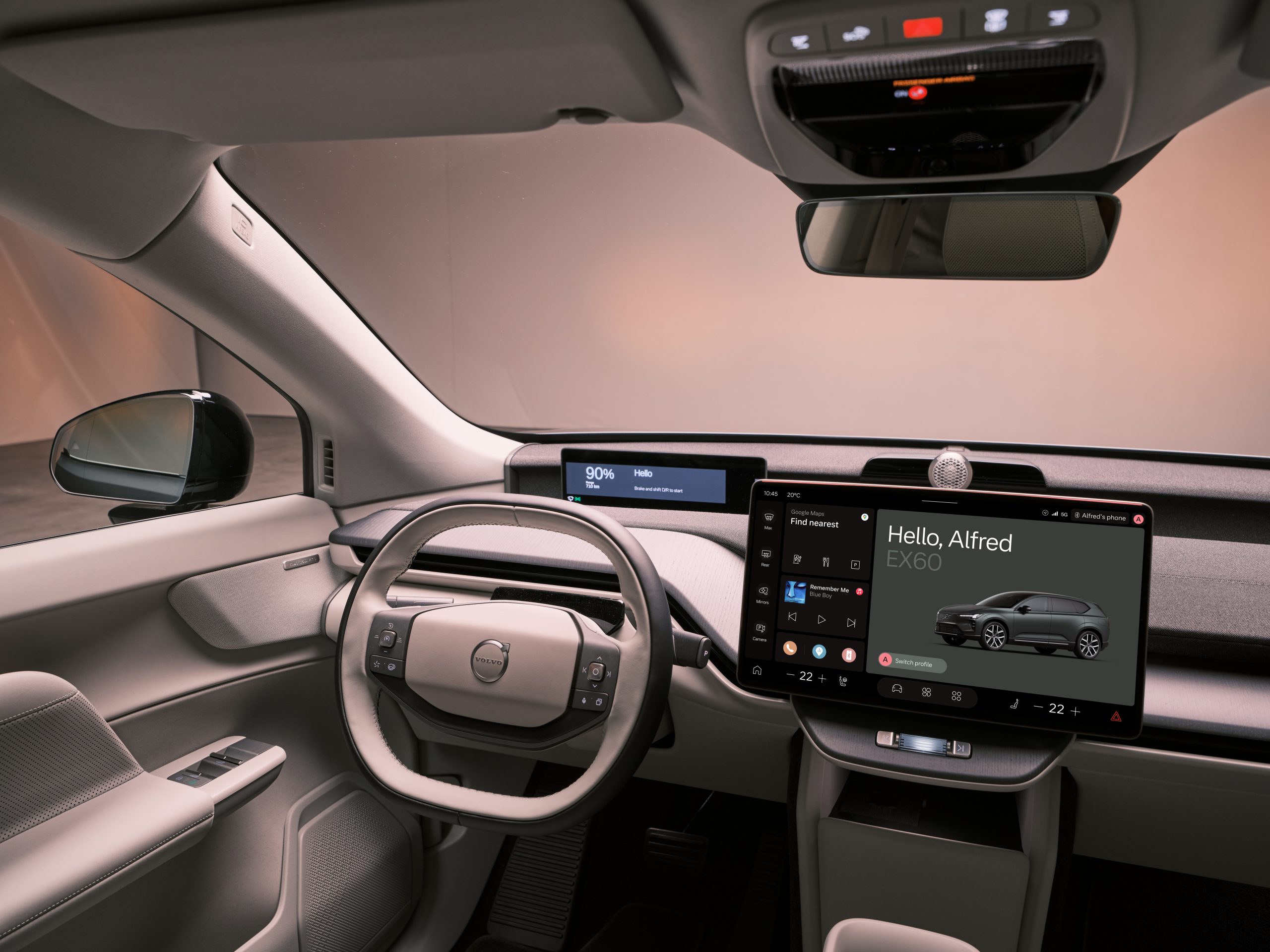
A story that begins in 1959 and — for now — ends in an electric SUV that adjusts your seatbelt in thousandths of a second
It was a cold morning in Gothenburg when Nils Bohlin, an engineer at Volvo, sketched on paper what would end up saving more than a million lives: the three-point seatbelt. More than six decades have passed since that seemingly simple gesture. And now, in 2026, Volvo is once again shaking the foundations of safety with an idea that, once more, seems simple… yet changes everything.
The protagonist already has a name: multi-adaptive seatbelt. And the setting for its debut is no coincidence: the new electric Volvo EX60.
The key to this new technology is not in holding better, but in knowing when, how and how much to do so.
The multi-adaptive seatbelt in the Volvo EX60 uses real-time data from multiple vehicle sensors. It analyses variables such as:
- The intensity of the impact
- The direction of the collision
- The occupant’s position
With this information, the system adjusts the belt load in thousandths of a second, increasing restraint in serious accidents or reducing it in minor impacts to minimise injuries.
In practice, this means that the same seatbelt acts differently depending on who you are and what is happening.
Not all bodies react the same way: Volvo takes this into account
One of the most significant advances is the expansion of performance profiles. The system adapts its behaviour based on:
- Height
- Weight
- Build
- Occupant posture
For example:
- For a larger-built occupant in a severe impact, the belt applies greater load to reduce the risk of head injuries.
- For a lighter person in a minor accident, it reduces tension to avoid rib fractures.
This is not an incremental evolution. It is a paradigm shift: safety stops being universal and becomes personalised.
From historic innovation to connected intelligence
Volvo does not merely introduce a new device; it redefines its evolution. This seatbelt:
- Continuously improves through over-the-air (OTA) updates
- Learns from new data collected by Volvo Cars
- Refines its responses to new real-world situations
In essence, it is a living system.
The EX60: the laboratory where everything makes sense
The Volvo EX60 not only debuts this technology, it also integrates it into a broader safety ecosystem where:
- Airbags
- Occupant detection systems
- Driver assistance systems
work together in a coordinated way to optimise protection.
All of this in an electric SUV that, according to the brand itself, offers ranges of between 620 and 810 kilometres and the ability to recover up to 340 kilometres in 10 minutes at 400 kW chargers.
International recognition even before its launch
The multi-adaptive seatbelt has already been named by TIME magazine as one of the best inventions of 2025, anticipating its impact on the industry.
From the two-point belt in 1956 to the release of the three-point belt patent in 1959 — an unprecedented decision to accelerate global safety — Volvo has built its identity around a clear principle: protecting lives above all else.
Today, that principle takes shape in a technology that not only protects, but interprets, decides and acts in real time.
The seatbelt, as we knew it, has just stopped being the same.
And if history is any guide, what Volvo has just introduced in the EX60 will not take long to become the new industry standard.
Technical specifications of this car

 Peugeot E-208 GTi: a battery-powered toy that revives the spirit of the 1980s sports cars
 New Lexus ES: luxury grows and goes electric
 First contact with the Dacia Sandero Hybrid 155: power and efficiency from €19,890
Deja un comentario