What is torque vectoring and how does it work?
 Antonio Roncero @roncero_antonio
7 December 2021
5 min.
Manufacturers increasingly boast about how well their new cars handle corners, especially the sportier ones, thanks to torque vectoring technology. We explain what it is and how it works.
Whether we’re talking about a €75,000 sports car like a Audi RS 3, a half-million-euro car like a Ferrari SF90 Stradale, or hypercars like a McLaren P1… Each in its own way, all of them rely on Torque Vectoring to improve dynamic behaviour. A technology that began to gain popularity Mitsubishi with its world rally championship victories, and which it applied to successive generations of its legendary road-going Lancer Evo, although back then it was called something different: active yaw control. But, what is Torque Vectoring and how does it work?
A matter of grip
Basically, torque vectoring, or selective torque vectoring, allows the engine torque delivered to each wheel of an axle to be modified in a controlled way, something that cannot be achieved with an open differential, which splits torque 50/50, without resorting to additional control systems.
And why do we need torque vectoring? Because when taking a corner, the outer wheels have more capacity to transmit power to the road than the inner ones, which are more unloaded. Thanks to the selective distribution of torque across the wheels, the car’s change of direction can be encouraged, complementing the turning provided by the steering.
As a result, the car achieves better dynamic behaviour, especially in sporty driving. In other words: with torque vectoring, a car can take corners faster, since the technology can reduce understeer (when the car goes straight through corners and the steering wheel must be turned further, limiting the tyres’ ability to transmit power to the road)… or increase oversteer, even to the point of making the car slide.
Selective torque vectoring systems
Although most torque vectoring systems are used in cars with all-wheel drive, they can also be found in vehicles with drive on a single axle, whether front-wheel or rear-wheel drive. The goal is the same: to send more torque to the wheel with greater capacity to transmit power to the road, that is, the outer wheel in a corner. How much? As much as it can manage, depending on the grip available.
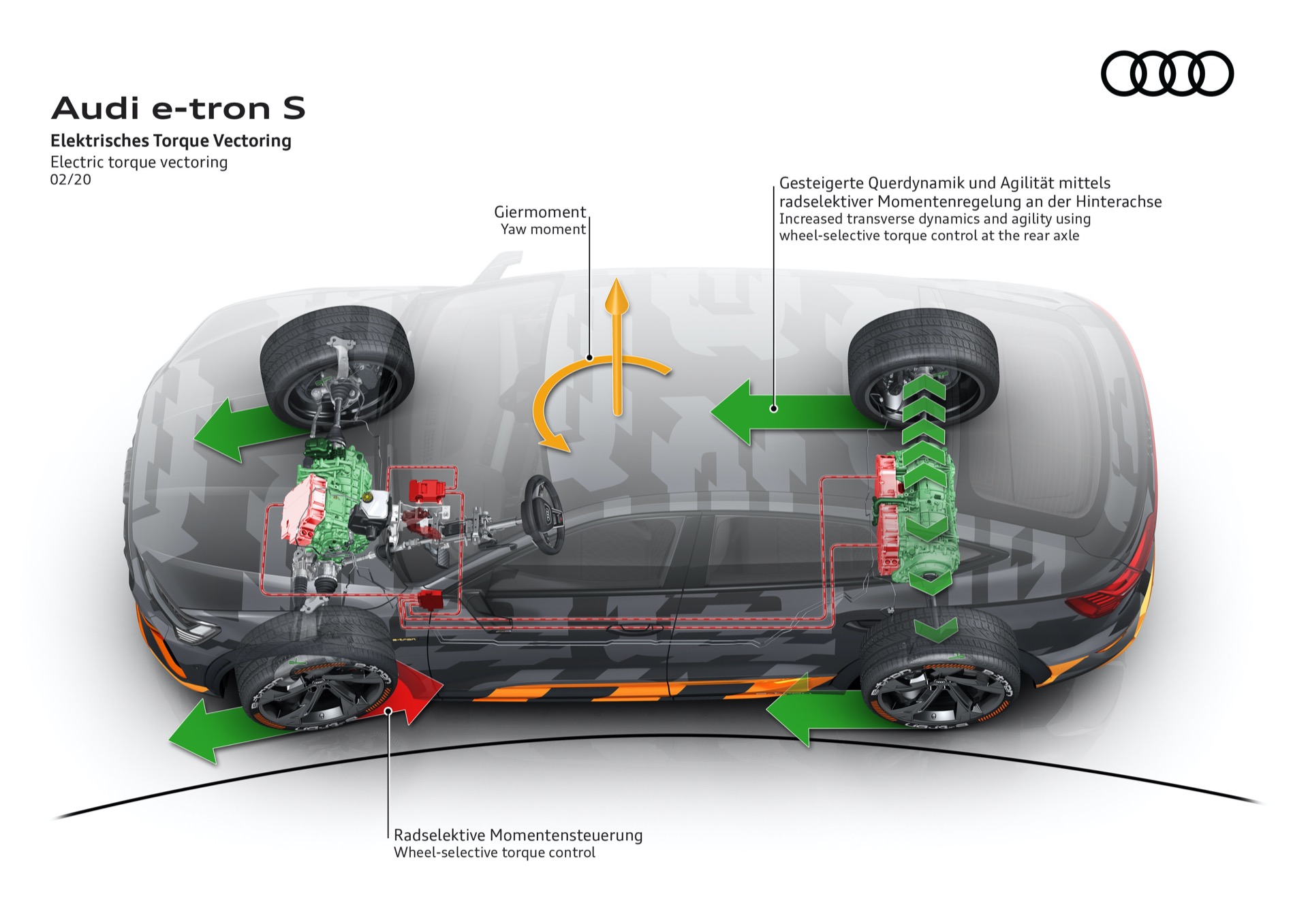
To achieve this, manufacturers use different systems. The simplest is selective braking of the wheels, through ABS and the ESP stability control. By braking the inner wheel when it begins to have trouble transmitting power to the road, a self-locking effect is achieved that allows the torque distribution to be controlled. In a way, the operating principle of stability control has much in common with this, although with a completely different aim: in this case, the brakes are applied selectively to generate a yaw moment of the vehicle (movement around its vertical axis) opposite to the one that tends to take the car off its path, improving safety.
What a torque vectoring system allows, to understand it better, is to delay the moment when ESP would have to intervene, making it possible to make much better use of the engine’s power and the tyres’ grip. ESP can completely cut off understeer or oversteer behaviour to avoid losing the car’s path, while a torque vectoring system has the capacity to make the car more understeering or more oversteering, depending on what we need, to get through corners faster.
Other selective torque vectoring systems use electronically controlled limited-slip differentials or electrohydraulic clutches at the output of the differential. Audi, for example, offers the sport differential as an option on its quattro models, which allows this variable torque distribution between the rear axle wheels. And on the new Audi RS 3, the previous multi-plate clutch with a conventional central differential has been replaced by the new RS Torque Splitter rear differential, which distributes torque variably and actively between the two wheels of this axle based on longitudinal and lateral acceleration, throttle position, selected gear, wheel rotation speed… It even has a mode that allows controlled drifts!
Now, torque vectoring takes on a new dimension with the arrival of the new generation of electric cars. With a motor on each axle, controlling torque between the wheels is much simpler. And that’s not to mention cars with two motors on the same axle, such as the Audi e-tron S, where each rear electric motor can send torque directly to its corresponding wheel without using a mechanical differential. Not only can very high traction torques be managed, but it can be done in just a few milliseconds.
As you can imagine, the ultimate in torque vectoring is found in electric cars with a motor on each axle, where the possibilities for individually managing torque for each wheel are endless. Only in this way can cars like the Rimac Nevera, with almost 2,000 CV, manage the delivery of power to the tarmac.


 Peugeot E-208 GTi: a battery-powered toy that revives the spirit of the 1980s sports cars
 New Lexus ES: luxury grows and goes electric
 First contact with the Dacia Sandero Hybrid 155: power and efficiency from €19,890
Deja un comentario