Audi continues to lead the development of synthetic fuels and is now going one step further
 David Lopez @espacionblanco
21 November 2017
3 min.
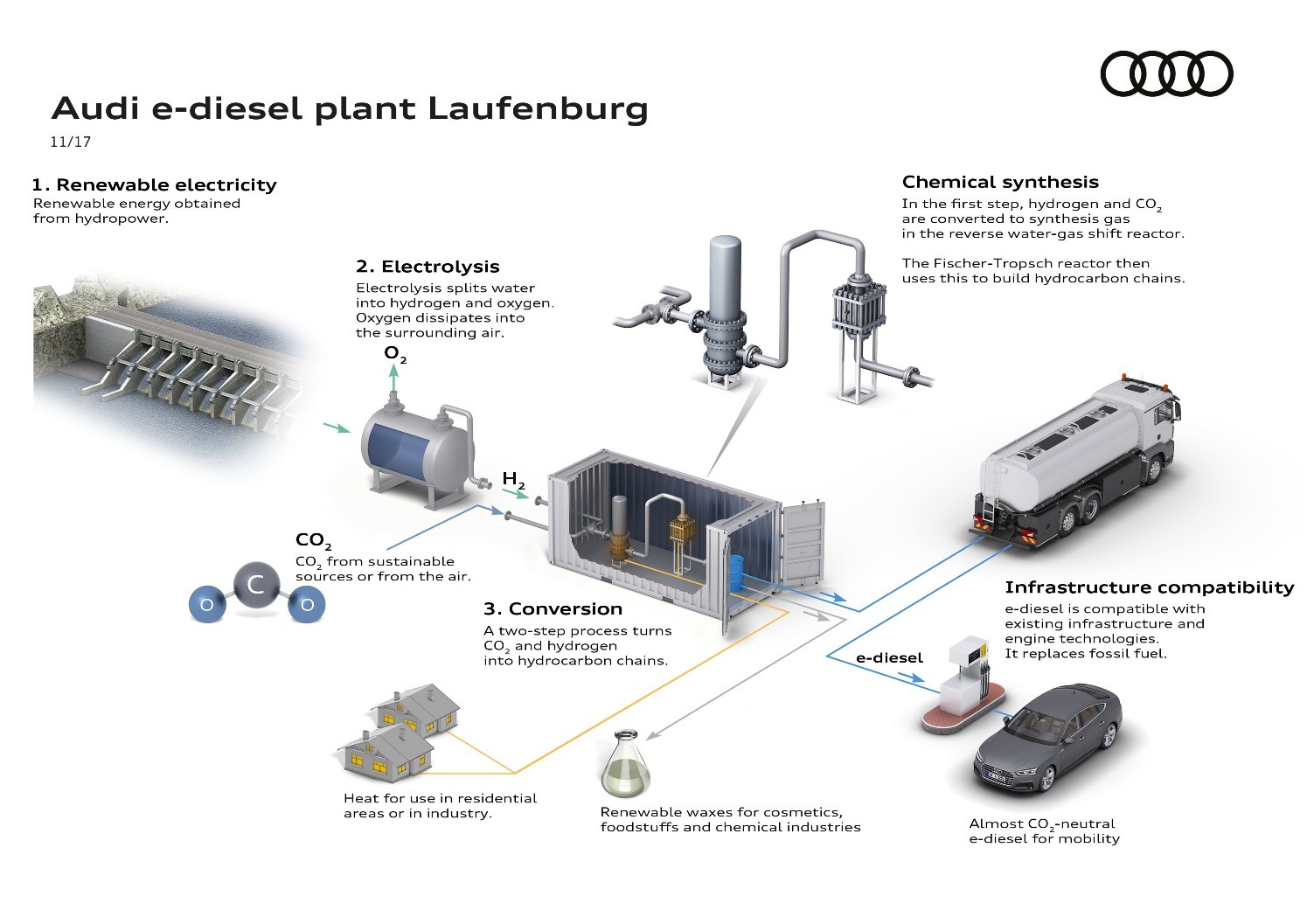
Audi has not forgotten the development of synthetic fuels and will build a new plant for e-diesel with a production process powered by renewable energy
It is clear that, in the short and perhaps also the medium term, mobility will inevitably move towards the adoption of electric motors, whether hybrid or fully electric, including hydrogen motors within the latter group. As you well know, this will mean a genuine revolution and investment that will transform everything from a simple moped to something as complex as an aircraft.
But perhaps there is one more alternative on the road to clean energy. This alternative involves Audi and the work it has been carrying out for several years on synthetic fuels, fuels that will allow conventional combustion engines to keep running, with the key advantage that they would have an almost neutral CO2 footprint. In this regard, Audi has fairly advanced research into fuels it has named e-petrol, e-diesel and e-gas.
All three products are equally important to Audi’s development, but the one attracting the most attention is perhaps e-diesel. In order to achieve mass production of this product, Audi has decided to go a step further and has approved the project in Laufenburg, in the Swiss canton of Aargau, to produce e-diesel using energy from a renewable hydroelectric source.
This plant will operate using the electrolysis process, converting surplus hydroelectric energy into synthetic fuel. In the first phase, the energy generated at the hydroelectric station produces hydrogen and oxygen, while in the next phase the hydrogen reacts with CO2 obtained from the atmosphere or from biological waste gases, using a very innovative and compact micro-process technology. In the final stage a long chain of hydrocarbon compounds is formed, which are separated to obtain finished products such as e-diesel or waxes, which will be used in other areas of industry.
Audi plans for the first quantities of e-diesel to leave the Laufenburg plant early next year. In fact, in the coming weeks Audi and its project partners, Ineratec and Energiedienst AG, will submit the planning application for the facilities, with construction work beginning as soon as 2018 starts.
This will mean that Audi embarks on its second pilot plant project under the power-to-liquid principle, the first being the Dresden plant, where they have been working since 2014, which is run by the technology corporation Sunfire to produce e-diesel, following the same process but involving different technologies. Nor should we forget the Werlte plant in Germany, where the e-gas needed for the g-tron variants of the A3 Sportback, A4 Avant and A5 Sportback is produced, in addition to the manufacture of e-petrol.


 Kia offers an electric range of 10 models, 50 versions and 400 possible combinations
 The seven finalists for the 2027 European Car of the Year (COTY) are exclusively electric
 Peugeot E-208 GTi: a battery-powered toy that revives the spirit of the 1980s sports cars
Deja un comentario