Volvo Electric Cars Comerciales
Can you drive from Zurich to Valencia in an electric truck? We tell you
 Victor Alós Yus @sepelaci
11 February 2023
3 min.
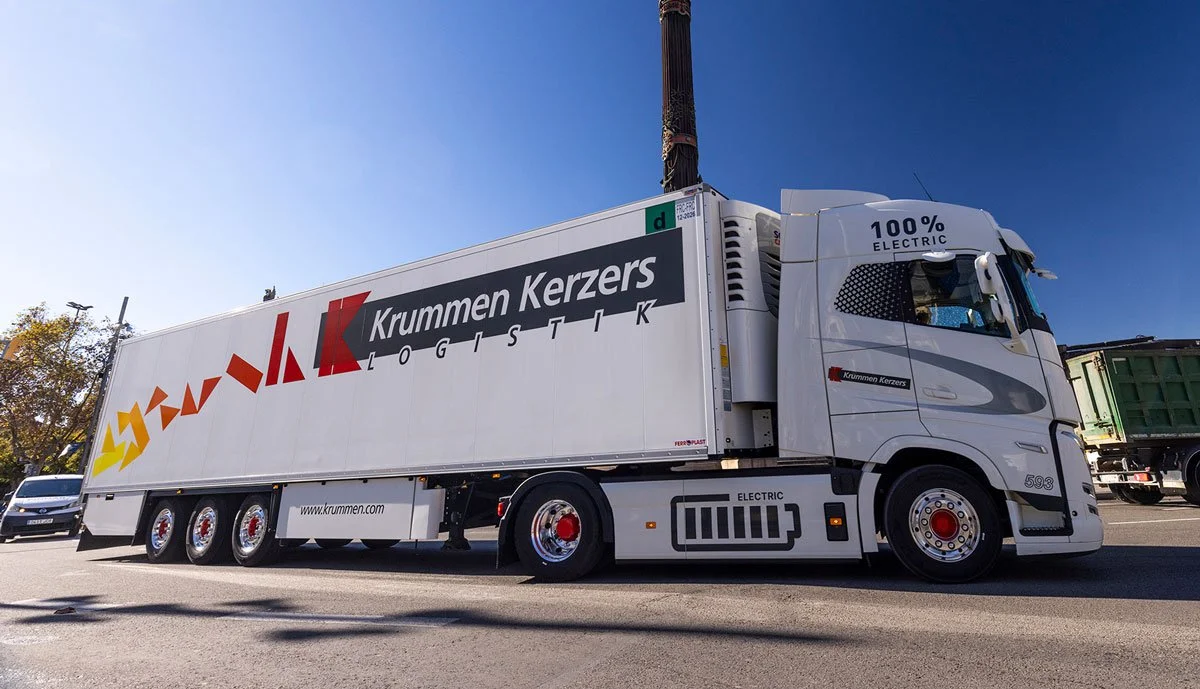
A Swiss transport company has dared to make the journey between Zurich and Valencia with an electric semi-tractor unit, covering 3,000 km.
Road freight transport seems to be resisting the adoption of electric-powered vehicles. But little by little, heavy-tonnage trucks are appearing that dare to undertake road journeys. Admittedly, these vehicles are normally limited to short routes. The characteristics of their battery pack and energy consumption are holding back their development.
But there are companies that want to get the most out of their electric trucks and have sent them on long journeys to fulfil their service. This is the case of the company Krummen Kerzers, a logistics firm based in Switzerland, which has several electric trucks in its fleet. One of them is a Volvo FH Electric, which has completed a route between Zurich and Valencia and returned to its base.
The route covers a distance of 3,000 kilometres, so the truck had to be recharged several times. Even so, the truck successfully passed this test. Admittedly, there are several drawbacks that call into question the efficiency of this transport system with electric trucks, at least when it comes to long journeys.
Range and problems during the journey
Problems kept arising along the way, and although they could be resolved, they were far from simple. This is nothing new, since diesel trucks also suffer their own unforeseen events. In this case, the main problem is the range of the Volvo FH Electric.
This is put at 300 kilometres, so it has required many recharges during the journey. It is a 40-tonne truck, so it struggles to cover many kilometres on a single charge. To complete the route, they had to plan the route carefully to find charging points. Another added problem is the size of the vehicle. Not all charging points can accommodate a truck for charging.
Once the route was set, they found that not all charging posts work properly. So the charging stops had to be scheduled so that they could move on if they needed to reach another charging point. The stops were timed to coincide with rest periods, and were adjusted to suit the conditions of the journey as closely as possible.
As an interesting fact, it was upon arrival in Spain that the difficulties in charging the battery increased. The shortage of charging points on Spanish roads is an additional problem, although more charging points are being prepared. In the end, the journey time was one day longer than a diesel truck would have taken, but it is a test that validates the possibility of making long journeys with a 40-tonne electric truck.
To avoid greater problems, throughout the whole journey a diesel-engined tractor unit was kept on hand to replace the electric one if necessary. But it was not needed, and this is important for the immediate future of road transport with electric trucks.


 Kia offers an electric range of 10 models, 50 versions and 400 possible combinations
 The seven finalists for the 2027 European Car of the Year (COTY) are exclusively electric
 Peugeot E-208 GTi: a battery-powered toy that revives the spirit of the 1980s sports cars
Deja un comentario