China bets on diesel for truck range extenders
 Victor Alós Yus @sepelaci
3 February 2026
3 min.
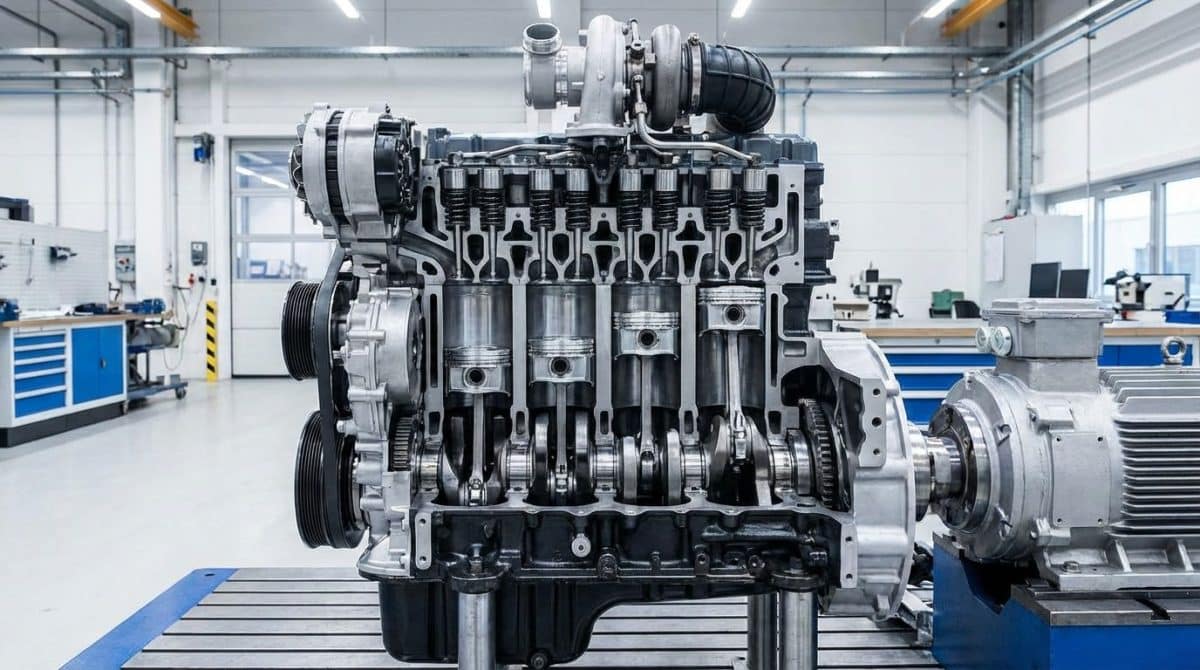
A Chinese company proposes a range extender powered by diesel that would allow a 50% lower fuel consumption in trucks.
The road freight transport is one of the markets that most resists electrification. It is too complex, since large batteries are needed to store the energy required to power heavy commercial vehicles. In addition, an infrastructure capable of charging those batteries in a short time is required. And that is very difficult to achieve, although tests are being carried out to solve it.
From China comes a possible solution to this problem, which could prove very practical. It is a diesel-powered engine that will not be used to drive the truck, but to charge the battery of the electric traction system. This engine has been developed by the company Yuchai, which specialises in engines.
An ambitious bet
The company’s intentions are to reduce diesel consumption by 50% and achieve an efficiency of 4.8 kWh per litre. The power range it will cover goes from 15 kW to 600 kW. So if all these figures are confirmed, this could revolutionise the heavy road transport market.
The range extender developed by Yuchai is somewhat different from other similar systems. It stores mechanical energy through a high-speed flywheel, which is connected to the crankshaft. When needed, this energy is released and converted into electricity by a generator. This design reduces the number of components, simplifies the transmission and allows optimised operating cycles. This makes it more practical for intermittent power applications and for managing the demand peaks that commercial vehicles and industrial equipment usually require.
To shape this project, the company has a division of Rolls Royce and contracts with Chinese multinationals such as Dongfeng and BAIC. The goal is to equip light trucks and industrial vehicles with this system, but it could also be applied to off-road vehicles. With this proposal, China is not only focused on full electrification, but also on parallel development to reach that final goal.
Problems for its application
The reality is that this system, although very efficient and promising, still requires many tests. High-speed flywheels need very complex containment systems to guarantee safety and advanced calculations on rotating masses and gyroscopic effects. Many tests are needed to validate its use in practice, with real fleet trials and under normal operating conditions.
To be approved in Europe, it will need to pass NOx and particulate emission tests and meet standards that are stricter than those applied in China. So there is still a long way to go before this system can be used without problems. That said, its application may be simpler than building the infrastructure needed to power electric truck batteries.

 Peugeot E-208 GTi: a battery-powered toy that revives the spirit of the 1980s sports cars
 New Lexus ES: luxury grows and goes electric
 First contact with the Dacia Sandero Hybrid 155: power and efficiency from €19,890
Deja un comentario