Dacia takes a qualitative leap with the new Duster, which offers Eco stickers across the entire range
 Rafa Guitart @GuitartRafa
3 May 2024
11 min.
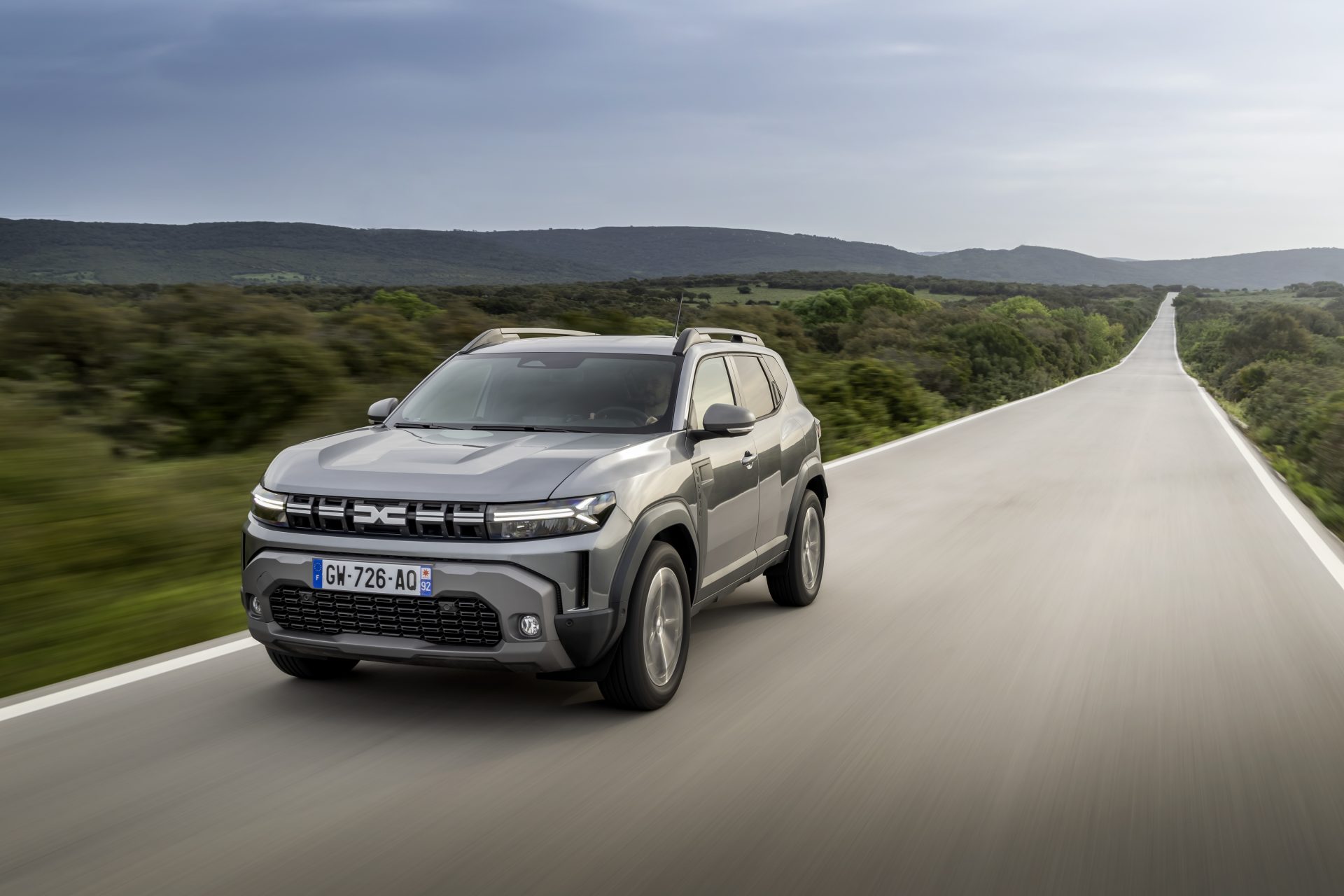
The third generation of the Dacia Duster, available from 19,200 euros, is a significant improvement over previous editions and embraces hybrid powertrains across the entire range.
The Duster, launched in 2010 and first facelifted in 2017, has established itself as one of the most interesting affordable SUVs on the market. Its figures speak clearly for it: over its 13 years on sale, more than 2.4 million units have been produced, and it was the best-selling SUV in Europe in 2022 in the private buyers market across all segments.
The new version keeps very similar dimensions, with a length of 4.34 metres, a width of 1.81 m and a height of 1.66 m; that is, it is slightly wider (+1 cm) and a little lower (-3 cm), which gives it a more dynamic and robust appearance. It has been developed on the CMF-B platform, also adopted by the latest Sandero and Logan, and later by the Jogger, which has made it possible to introduce electrified engines, generous interior space and a notable boot volume (474 litres). It also promises greater width for front-seat passengers and more legroom in the rear seats (+30 mm).
Another aspect that improves significantly in the new Duster is rigidity, with new firmer suspension and a higher level of dynamic behaviour. The damping adjustments, the tuning of the power steering and the fitting of specific “all season” tyres on the all-wheel-drive versions all help on the road and off it. Dacia claims it has improved acoustics by an average of two decibels.
Modern and robust design
The design work on the new Duster is simple yet very striking: simplicity of shapes and volumes with a very upright front end, wheel arches with clean, bevelled cuts, a large tailgate and a wide glazed area.
It features side underbody protection that emphasises the model’s off-road character, using tinted elements without paint, made from recycled material, which promise great durability.
Inside, too, a simple and durable look has been pursued, with a dashboard set in a high position, with air vents inspired by the design of the wheel arches. It has a 10.1-inch central screen angled 10° towards the driver, a flat-topped and flat-bottomed steering wheel and easily recognisable controls.
The 10.1-inch screen is available with both multimedia offers, Media Display and Media Nav Live: the first, standard on Expression and Extreme, offers wireless Apple CarPlay and Android Auto connectivity. Media Nav Live, standard on Journey and optional on Extreme and Expression, offers connected navigation with real-time traffic information and a map updated for 8 years.
The Duster debuts a customisable 7-inch colour digital instrument cluster – standard from the Expression trim – which displays the most useful information. A phone holder is available on all trim levels, and versions equipped with Media Display and Media Nav Live include 2 USB-C ports at the front and 2 at the rear. On the Journey, a wireless smartphone charger in the centre console is added as standard, and it is optional on the Extreme.
To cope with hard use, rubber floor mats for the front and rear seats are fitted, containing 20% recycled material. They are easy to clean, but somewhat uncomfortable, as the foot tends to slide off the pedals easily.
More equipment
The new Duster offers the Sleep Pack, similar to that of the Jogger, which was the first Dacia to feature it. It includes three functions: a double bed (1.90 m long and up to 1.30 m wide) that one person can set up in under two minutes, a tray and a storage space. A new roof rack is also available, allowing up to 80 kg of load to be carried. It attaches to the modular roof rails in a transverse position or to the transverse roof bars available from the aftermarket for Dacia.
A digital instrument cluster: the new Duster debuts a customisable 7-inch colour digital instrument cluster that displays the information the driver considers most useful. This digital cluster is standard on the new Duster from the Expression trim. On the Journey (standard) and Extreme (optional) trims, an automatic parking brake and electrically adjustable and folding exterior mirrors are available.
An ingenious YouClip is also offered, a simple system that allows accessories to be fixed in specific places in the cabin, with 4 fixing points on the Essential trim, or 6 factory fixing points (one on the dashboard, one on the side of the console on the passenger side, one at the rear of the centre console, two in the boot on the left and right sides, and one inside the tailgate). Later, 2 more points can be added thanks to the accessory bracket on the headrest.
These points allow a tablet holder, a storage bag, a smartphone holder with or without an induction charger, or an ingenious device combining a cup holder, a bag hook and a portable lamp (standard on the Extreme) to be anchored.
The Duster range is structured in three levels: Essential, Expression and Extreme, plus the Journey. The first of these, Essential, has Media Control, fixed roof rails, manual air conditioning, 6 airbags and rear parking assist, while the Expression adds 17-inch alloy wheels, a 7-inch digital instrument cluster, a 10.1-inch touchscreen with the Media Display multimedia system and wireless Apple CarPlay and Android Auto mirroring, and a rear-view camera.
The Extreme trim adds roof rails, washable upholstery, rubber mats, automatic air conditioning, the YouClip system and interior and exterior decorative elements. The equipment on the Journey trim is that of the Expression, with 18-inch alloy wheels, automatic air conditioning, automatic parking brake, a wireless smartphone charger, the Media Nav Live multimedia system with connected navigation and an Arkamys audio system.
Driving aids
It has not only received a new design and interesting engines; it has also been equipped with a host of driving aids and safety systems, such as the speed regulator/limiter now standard from the Essential trim, automatic headlight activation, or automatic switching between dipped and main beam on the Extreme and Journey.
There are also features such as autonomous emergency braking with vehicle detection, pedestrian, cyclist and motorcycle detection, traffic sign recognition with speeding alerts, rear parking assist, an emergency stop signal, lane change alert, lane keeping assist, driver attention monitoring and the eCall emergency call system. An interesting button called “My Safety Switch” provides access to the selected configuration of driving aids.
Hybrid engines
The diesel engine disappears, but in exchange the ECO G100 petrol and LPG engine is retained, and an interesting TCe 130 with mild hybridisation is added to the range, with a 48 V, 0.8 kWh battery, as well as a Hybrid 140 based on the 1.6 combustion engine and two electric motors. The all-wheel-drive version, which has greater ground clearance, shorter gear ratios and specific tyres all season.
The Duster 100 ECO-G features a petrol and LPG combustion system with an ECO sticker. Running on LPG, it is claimed to average 10% less CO2 emissions compared with an equivalent petrol engine and a range of almost 1,400 km thanks to its two tanks with a combined capacity of around 100 litres: 50 litres of petrol and 50 litres of LPG. Switching from one fuel to the other is instantaneous and imperceptible, thanks to a switch on the instrument cluster.
The middle engine option, and perhaps the most interesting for road driving, is the TCe 130. It combines a 1.2 three-cylinder turbo petrol engine based on the Miller cycle, with a mild hybrid system using a 48V, 0.8 kWh battery, capable of assisting the combustion engine during starting and acceleration phases, so that it can reduce consumption and CO2 emissions by approximately 10%. It is available only with a six-speed manual gearbox for the front-wheel-drive or all-wheel-drive versions.
The most powerful, the Hybrid 140, features a 1.6 four-cylinder petrol engine producing 94 CV, together with two electric motors (one of 49 CV and a high-voltage starter/generator) linked to an electrified automatic gearbox. This has 4 gears for the combustion unit and 2 further gears for the electric motor, with no clutch. Thanks to regenerative braking, the high energy recovery capacity of the 1.2 kWh battery (200 V) and the efficiency of the automatic gearbox, it promises up to 80% of city driving time in electric mode, a 20% consumption saving in the combined cycle and up to 40% in the urban cycle, with starting in 100% electric mode.
Light and efficient 4×4
The variant with 4×4 transmission and Terrain Control system is sold only with the 130 CV engine and features 5 driving modes: Auto, in which the system automatically distributes torque between the front and rear axles depending on grip and speed; Snow, which can vary the ESC and Extended Grip settings; Mud/Sand, specific to muddy tracks or sand; Off-Road, which distributes torque between the front and rear wheels depending on traction conditions; and Eco, to optimise consumption.
This variant has a ground clearance of 217 mm; an approach angle of 31°, a departure angle of 36° and a breakover angle of 24°. It also incorporates a slightly shorter gear ratio, a hill descent control system from 0 to 30 km/h that works in all gears including reverse, all season tyres and a camera to make off-road driving easier.
Good handling
One of the aspects that has clearly improved in the new model is the soundproofing, which is markedly better than in the previous version. The comfort is also improved, as the seats are a little firmer, offer better support and there is more interior space for passengers and storage.
We had the opportunity to drive the 140 CV Hybrid and the 130 CV mild-hybrid. It is true that the more powerful variant becomes an ally for those seeking more urban use, as it has an automatic gearbox, achieves a fair amount of electric-mode driving in town and offers greater quietness. On the road, however, it feels somewhat “loose” and requires frequent use of the brake pedal, as the “B” mode on the gear selector is not especially comfortable and does not hold back very much. For its part, the steering has a great deal of assistance and provides excellent comfort when manoeuvring, but it gives less feedback about what is happening beneath the front wheels.
In terms of performance, the 140 CV offered by this variant is more than sufficient, as the engine allows lively speeds with reasonably controlled consumption. At low speeds it provides a lot of electric assistance, which translates into smooth, quiet operation or extra torque.
The 130 CV mild-hybrid version is very pleasant on the road and, although it is only available with a manual gearbox, it has very dynamic behaviour, is easy to drive and achieves a good level of performance. In this case too, we noticed excessive steering assistance.
On a short off-road route we had the chance to test the off-road abilities of the all-wheel-drive version. With a little more ground clearance, a shorter gear ratio and specific all season tyres, this variant copes with extreme ease in difficult terrain, thanks to its lightness, suspension and torque delivery with electric assistance, as barely any throttle is needed to clear obstacles at low speed. It can cross adverse terrain with great ease, such as steep slopes, crossing bridges, side slopes or surfaces with low grip.
Without doubt, it is an economical, practical and interesting alternative to conventional off-road vehicles, as it proves capable of tackling difficult terrain with competence, with the advantage of also handling road journeys with ease, speed and low fuel consumption.
Technical specifications of this car


 Peugeot E-208 GTi: a battery-powered toy that revives the spirit of the 1980s sports cars
 New Lexus ES: luxury grows and goes electric
 First contact with the Dacia Sandero Hybrid 155: power and efficiency from €19,890
Deja un comentario