Ford BlueCruise: hands off the wheel, eyes always on the road
 Antonio Roncero @roncero_antonio
23 June 2026
9 min.
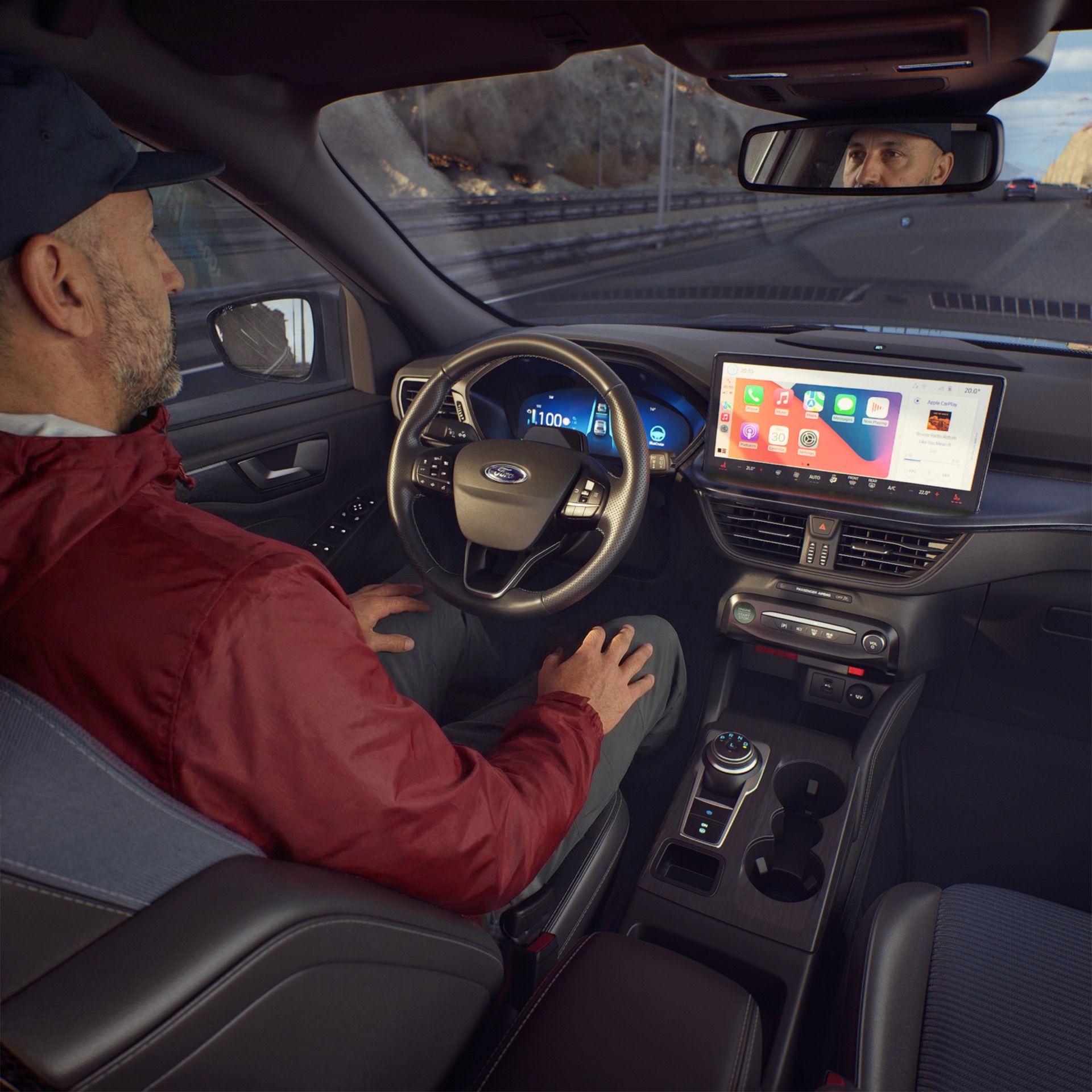
Ford BlueCruise allows hands-free driving on compatible motorways and dual carriageways, but not attention-free driving: the driver remains responsible and must always keep their eyes on the road.
Travelling with hardly any need to put your hands on the steering wheel or touch the pedals? I admit that the first time you try Ford BlueCruise there is a small moment of mistrust. Activating the system, watching the car maintain speed, distance from the vehicle ahead and its path within the lane… and, on top of that, taking your hands off the wheel legally, without the system asking you to put them back, is not something you do every day.
But it is also worth explaining it properly, because BlueCruise does not turn the car into an autonomous vehicle nor allow you to switch off from driving. On the contrary: the driver remains responsible at all times. The key is that Ford has taken a step beyond conventional assistance systems to offer “hands-free” driving, but always with eyes on the road.
What exactly is BlueCruise?
Put simply, Ford BlueCruise is an evolution of adaptive cruise control with lane centring which you can already find even in many city cars. In practical terms the car does what we already know these systems do: it accelerates, brakes, maintains a safe distance from the vehicle in front and keeps the car centred in its lane.
The important difference lies in how the system interacts with the driver. In a conventional adaptive cruise control with lane assist, the car constantly asks you to keep your hands on the wheel. Even if you are looking ahead and perfectly alert, if it does not detect pressure or movement on the steering wheel rim, it issues a warning. And if you ignore it, the system deactivates.
BlueCruise changes that logic. Instead of checking whether you have your hands on the wheel, BlueCruise checks whether you are still paying attention to the road. To do this it uses a driver-facing camera that monitors gaze and head position. If you are looking ahead, the system understands that you remain engaged in driving and allows you to travel without your hands on the wheel.
That is why the correct definition is not “autonomous driving”, but Level 2 assisted driving with hands free: the car helps, but you are still really driving… even though you don’t need to keep your hands on the wheel or touch the pedals in one very specific situation, such as driving on motorways or dual carriageways.
Hands off, but not attention off
During the test, what stands out most is precisely that naturalness. On a compatible motorway – basically it needs a central reservation – the system is activated just by pressing a button on the steering wheel, and the instrument cluster shows a blue interface indicating you are within an area authorised for BlueCruise. From then on you can take your hands off the wheel and stop worrying about the pedals, provided you keep your attention on the road.
The car takes care of steering, acceleration and braking. It maintains distance, follows the lane and adapts speed within the system’s operating limits, which can work in coordination with the traffic sign recognition system and adjust speed to the road up to 130 km/h. The feeling, once you get past the initial psychological moment of letting go of the wheel, is very similar to a good intelligent adaptive cruise control, but with one clear difference: you no longer have to “trick” the system with small steering corrections to prove you are still there.
Now, BlueCruise does not let you fully “disconnect” from driving. If you take your eyes off the road, the system detects it. After about 7 or 8 seconds without looking ahead the first visual and audible warnings arrive. If you react, and no steering contact is needed, simply paying attention to the road again brings everything back to normal. If you don’t, the system moves to a second phase: it warns you more intensely and may even progressively reduce speed and bring the vehicle to a stop if necessary.
This nuance matters compared with other systems: freedom of hands does not mean freedom from attention. Ford sums it up well with its philosophy: “hands free, eyes on the road”.
Where can it be used?
BlueCruise does not work on any road. It can only be activated in what Ford calls Blue Zones, previously mapped and authorised stretches of motorway and dual carriageway. These are roads with suitable conditions, physical separation between directions and specific mapping so the system knows it can operate safely.
In Spain, Ford announces around 28,500 compatible kilometres, which is roughly 90% of the national motorway and dual carriageway network. In Europe, coverage exceeds 133,000 kilometres. Maps are updated remotely, so coverage may evolve over time.
This is important: BlueCruise is not activated on a secondary road, in town or on any stretch with painted lines. The system only allows hands-free driving when the right conditions are met and the vehicle is within a Blue Zone. During our test, from Madrid to Villacastín and back on the motorway, it was only deactivated when passing through tunnels. What BlueCruise does not do – and some other adaptive cruise assistants not approved for hands-free use, such as Ford’s technology, do – is automatically perform a lane change to overtake a slower vehicle when you activate the indicator.
BlueCruise arrives on the Kuga, Puma and Puma Gen-E
Until now, BlueCruise was mainly associated with the Mustang Mach-E. The news is that Ford is extending this technology to high-volume models such as the Kuga, the Puma and the Puma Gen-E, always in versions equipped with automatic transmission. Its arrival on the Ranger PHEV is also planned.
The Kuga has special relevance in addition: as it is manufactured in Almussafes, it becomes the first car produced in Spain approved for hands-free driving on compatible motorways and dual carriageways.
BlueCruise Tech Pack: worth it
It is worth clarifying another important point: BlueCruise is part of a broader technology package. It is not just a matter of paying for a software feature, because the car needs specific equipment fitted at the factory. If the vehicle is not equipped from new, it cannot be added later.
The BlueCruise Tech Pack includes the hardware and systems needed to activate BlueCruise, but also adds other assistants and safety features. These include the collision mitigation system, adaptive speed control, advanced speed sign recognition, BLIS blind spot detection, reverse braking assist, intelligent speed assist, lane centring assist compatible with BlueCruise, the 360-degree camera and front parking assist.
The BlueCruise Tech Pack prices are 1,000 euros on the Ford Kuga, 1,500 euros on the Ford Puma and 1,450 euros on the Puma Gen-E.
Monthly, annual or permanent subscription
Ford offers several ways to enjoy BlueCruise. If the car has the BlueCruise Tech Pack, the customer gets a free 90-day trial, which can be activated during the first year through FordApp. Afterwards, it can be continued with a monthly or annual subscription.
The monthly subscription costs 24.99 euros a month. The annual one costs 280 euros. There is also the option of purchasing the permanent subscription as a one-off payment, with no subsequent fees.
This last option is especially interesting for anyone who will use the car a lot on motorways. For a driver who frequently makes long trips, BlueCruise is not just a technological gadget: it can reduce fatigue, make driving more comfortable and provide an additional layer of supervision, precisely because the car monitors not only the road but also the driver’s attention.
BlueCruise Edition: everything included from the start
The other formula is to choose a BlueCruise Edition version directly. In this case, the car already includes the BlueCruise Tech Pack and the permanent BlueCruise subscription as standard, so there are no monthly or annual fees afterwards.
Furthermore, these special editions add their own equipment and styling details. The Kuga BlueCruise Edition includes BlueCruise with permanent subscription, the BlueCruise Tech Pack, permanent connected navigation, Steam Blue bodywork paint, black roof, mirrors and 19-inch wheels, and matrix LED headlights.
The Ford Puma and Puma Gen-E BlueCruise Edition equipment includes the BlueCruise Tech Pack, permanent subscription as standard, connected navigation and black details for the roof, mirrors and 18-inch wheels.
As for promotional prices with the Tech Pack included, the Kuga BlueCruise Edition starts at 36,200 euros for the automatic 2.5 FHEV and at 38,950 euros for the automatic 2.5 PHEV. The Puma BlueCruise Edition starts at 29,700 euros with the automatic 125 CV 1.0 mHEV and at 30,200 euros with the automatic 155 CV 1.0 mHEV. The Puma Gen-E BlueCruise Edition is offered from 33,500 euros.
For reference, Ford announces BlueCruise availability from 31,800 euros on the Kuga, from 26,500 euros on the Puma and from 29,900 euros on the Puma Gen-E.
A real aid, not a promise of an autonomous car
After testing it, I think the best way to understand BlueCruise is to make clear that we are not dealing with an autonomous driving system. It does not allow you to read your phone, eat while driving or stop paying attention to the road, which is in any case prohibited even if you have this technology. And if you try, the car warns you.
But it does represent a very interesting evolution of current assistants. Compared with the classic system that requires you to touch the wheel every few seconds, BlueCruise better understands what matters: that the driver is attentive. If they are, it allows you to free your hands. If they are not, it intervenes. That is the great difference. It is not about removing the driver from the equation, but about making the technology work more intelligently alongside them.
On long motorway journeys, especially on monotonous stretches, BlueCruise brings comfort, reduces tension and turns assisted driving into a much more natural experience. And now that it reaches models such as the Kuga, Puma and Puma Gen-E, it stops being a technology reserved for very specific cars and becomes a much more accessible option within the Ford range.

 Peugeot E-208 GTi: a battery-powered toy that revives the spirit of the 1980s sports cars
 New Lexus ES: luxury grows and goes electric
 First contact with the Dacia Sandero Hybrid 155: power and efficiency from €19,890
Deja un comentario