Focus Ford Compact Photos Tests
Ford Focus 1.0 EcoBoost 125 CV, road test (Engine and performance)
 David Taboada
14 January 2013
6 min.
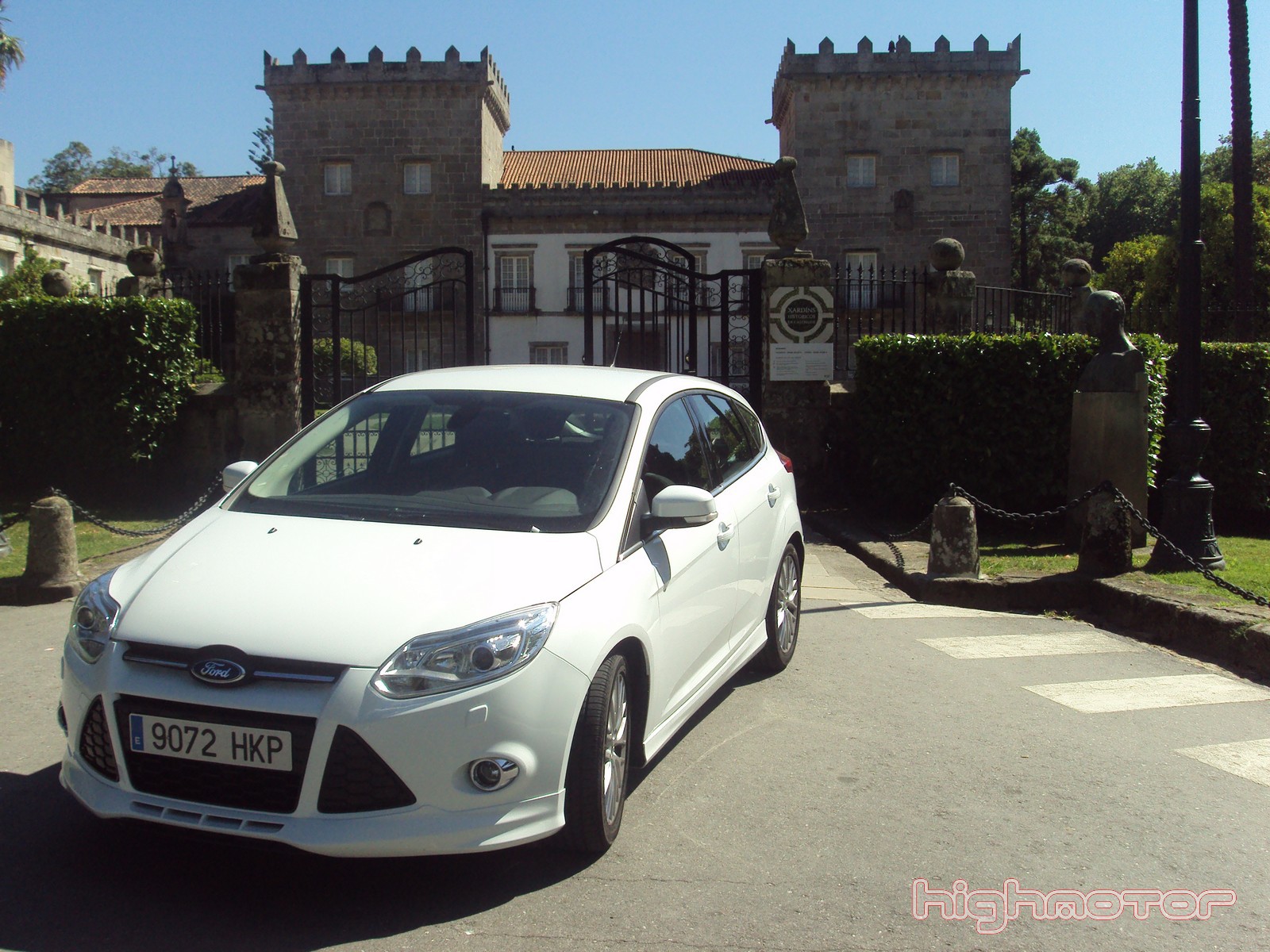
A little over a year ago at Highmotor we brought you the test of the Ford Focus with the innovative 1.6 EcoBoost that reaches 180 CV. Today we return to this same model from the oval brand, but we reduce the power and settle for the 1.0 Ecoboost of 125 CV.
In this first part of the test we will focus on the 1.0 EcoBoost engine, which has three cylinders and, as we will see, stands out for its smoothness and moderate consumption. We will also analyse its performance, comparing it with the rest of the alternatives within the range.
Engine and performance
The Focus was the first model of Ford to debut this 1.0 EcoBoost engine, which was presented at the latest edition of the Frankfurt Motor Show and which stands out for its high technological content. The block is made of aluminium and features direct injection, a variable-flow oil pump and a low-inertia turbocharger, all of which allow maximum smoothness with reduced consumption levels.
This three-cylinder 1.0 engine is available in two power outputs, 100 and 125 CV, with a 5-speed gearbox in the first case and a 6-speed in the second. Besides the innovative engine, Ford has added the ECOnetic Technology pack, which includes a series of systems and improvements aimed at reducing consumption and increasing efficiency. Among these systems the well-known start-stop and energy recovery stand out, but it also adds another that opens or closes the grille depending on the driving.
On starting the engine we notice the first surprise this powertrain holds, as the low engine noise and the correct soundproofing of the cabin make you forget you are dealing with a three-cylinder. During the first kilometres the thrust at low revs is surprising, as it delivers a maximum torque of 200 Nm between 1,400 and 4,500 rpm. Therefore one of its defining characteristics is the smoothness typical of a four-cylinder but with a power delivery and, overall, a behaviour closer to a diesel.
As for its top speed, which stands at 193 km/h, with 0 to 100 km/h taking about 11.3 seconds. This is a difference of 0.4 seconds if we compare the petrol engine with the similarly powered diesel version, the 1.6 TDCi 115 CV, which takes 10.9 seconds for the same acceleration. These performance figures make this Ford Focus an alternative for drivers looking for a petrol engine with smoothness and lower consumption than the usual powertrains.
As we saw earlier, the gearbox associated with this engine is a six-speed manual with a correct feel and precise gear changes. This makes it easy to get the most out of the engine, since its torque allows overtaking or any similar manoeuvre without any additional danger.
To conclude this section, we complete the range of engines available in the Focus line-up. Thus, for petrol engines we find, besides the 1.0 EcoBoost with 100 and 125 CV, the 1.6 EcoBoost with 150 and 180 CV, the 2.0 EcoBoost with 250 CV and the 1.6 Ti-VCT of 125 CV. For diesel we find two engines: the 1.6 TDCi 95 and 115 CV and the 2.0 TDCi 163.
Handling
The handling of the Ford Focus is determined by the suspension setup, designed to minimise as much as possible the imperfections found on the road surface. This allows it to adapt perfectly to city or country roads.
However, this is no burden to driving, since its cornering behaviour is quite correct, with a body and steering that give the driver a sense of control at all times. As we saw earlier, another attribute of this Focus is its smooth ride thanks to the progressive engine that responds at low revs.
On country roads or motorways we notice how easy it is to cruise with it: on flat roads or with a slight downhill gradient it lets you maintain speed without having to keep pressing the accelerator all the time, which positively affects average consumption. This is explained by the grille that opens or closes to improve the aerodynamics of the Focus.
If we now head into the city, we have the start-stop system that reduces consumption levels. When we pull away we notice how power is transmitted quickly to the wheels, making the most of all the torque’s potential.
Consumption
We now come to one of the most important sections of this Ford Focus, since the EcoBoost engine was born with the clear intention of offering good performance without having to give up moderate consumption.
We start with motorway consumption, where it homologates a consumption of 5 litres per 100 km. However, on our usual route the figure rose to 5.6 litres. Although higher than the official figure, this is an acceptable number for the dimensions and weight of the Focus.
On country roads the figure rises to six litres, but it is true that if you drive economically and get the most out of the gearbox, this figure can be reduced by a few tenths , which adds up over time. Finally, there is the city, where it homologates 6.3, but in our test it rises to 6.9, provided you are careful with your right foot.
Therefore Ford offers with this 1.0 EcoBoost engine decent performance but above all is marked by very smooth driving and gear changes. Furthermore, consumption is low compared with engines of similar characteristics, and it is presented as a good alternative for the average driver who seeks economical driving without giving up the enjoyment of driving.
In the second part of the test we will review the exterior and interior design of our tested unit and focus on the equipment options currently available for the Ford Focus. Finally we will bring you the price list for this engine and the rest of the range.
Photos | David
Technical specifications of this car


 Kia offers an electric range of 10 models, 50 versions and 400 possible combinations
 The seven finalists for the 2027 European Car of the Year (COTY) are exclusively electric
 Peugeot E-208 GTi: a battery-powered toy that revives the spirit of the 1980s sports cars
un comentario
Deja un comentario
gracias…buenas explicaciones y lo del consumo impresionante.saludos.