Hyundai unveils the new IONIQ 3 exclusively for the European market
 Javier Cantagalli
22 April 2026
4 min.
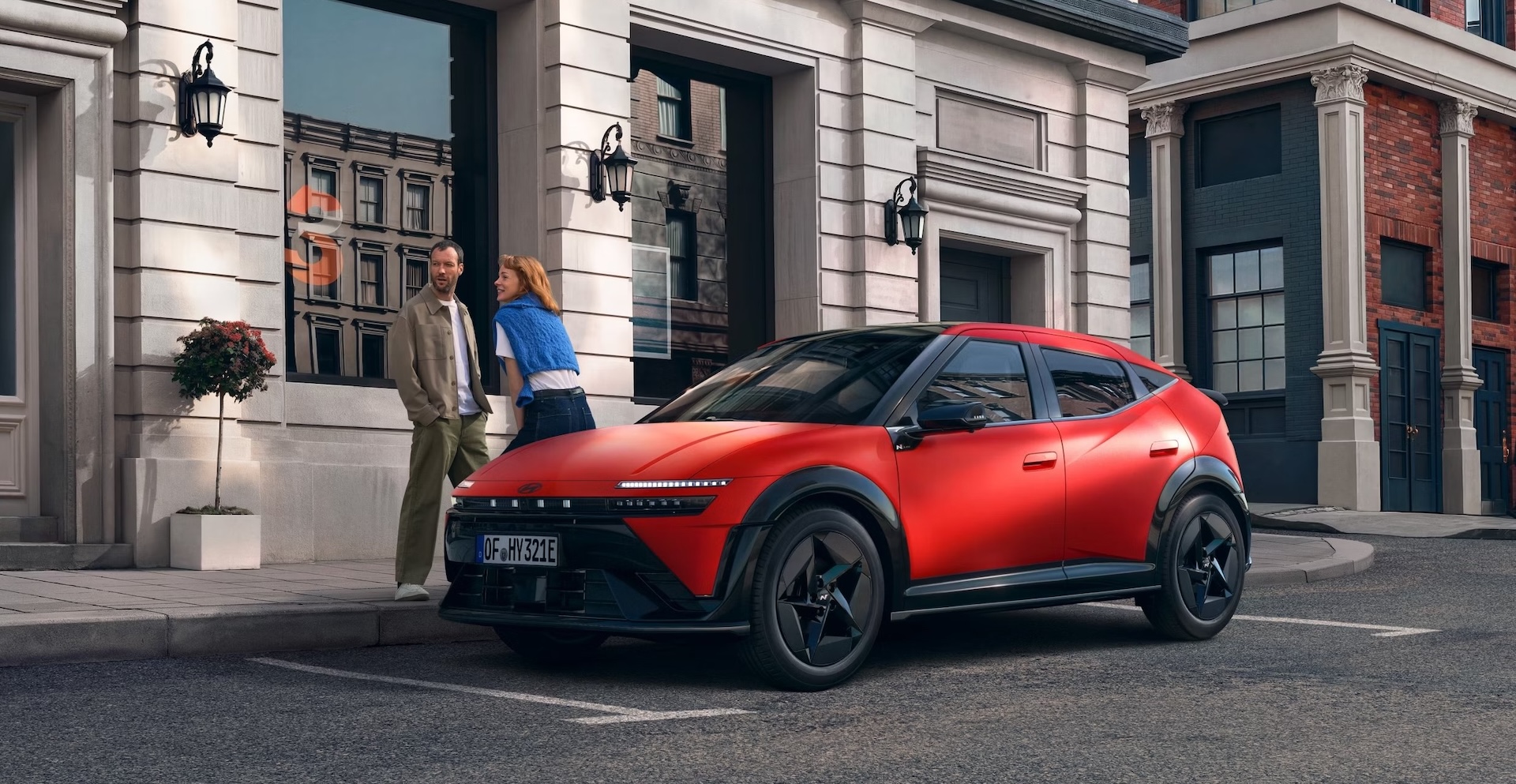
The new Hyundai IONIQ 3 redefines compact electric mobility in 2026, simultaneously blending retro and futuristic styling.
Hyundai Motor Company has just unveiled the new IONIQ 3, its new fully electric compact model based on the E-GMP platform and aimed exclusively at the European market. As expected, the new IONIQ 3 has a lot in common with the Kia EV2, although it improves on the latter in energy efficiency and aerodynamic drag coefficient thanks, among other reasons, to the Aero Hatch design language implemented by the South Korean manufacturer.
Unlike the more angular design and steeply raked rear glass of the Kia EV2, the IONIQ 3 opts for a fluid, continuous line. The low, aerodynamic front gives way to a roof that stays virtually flat over the front and rear seats, then descends smoothly towards the spoiler. This configuration maximises interior space and offers greater headroom for rear passengers, noticeably improving their comfort.
According to Hyundai itself, the IONIQ 3 has been developed on the basis of the Art of Steel design language, which simplifies surfaces into well-defined volumes to create a precise, modern look inspired by the natural properties of metal. Особенно заметна its pixelated lighting, characteristic of the brand, where the recurring use of four pixels represents the letter “H” in Morse code, creatively replacing the traditional Hyundai logo.
Created in Europe for Europe
Developed mainly at Hyundai’s R&D centre in Rüsselsheim (Germany), the IONIQ 3 will be produced at the company’s Izmit plant in Turkey, exclusively for the European market. As expected, it is based on the 400-volt variant of the Hyundai E-GMP platform, the same one used by the Kia EV2, with which it shares many technical elements.
The IONIQ 3 will be available with a choice of two battery packs, the standard 42.2 kWh and an extended-range 61 kWh option. In this regard, the South Korean manufacturer’s decision to pair the smaller battery pack with the more powerful 108 kW motor, while the larger battery pack is associated with a 99.5 kW motor, is particularly notable. The IONIQ 3’s lower drag coefficient allows it to offer a significant improvement in total WLTP range over the Kia EV2, with 344 km or 496 km depending on the battery pack chosen.
Charging times, on the other hand, are identical to those offered by the Kia EV2, with a peak output of 110 kW and about 30 minutes to go from 10 to 80 percent state of charge. For AC charging, Hyundai offers an optional 22 kW onboard charger.
In terms of dimensions, this new electric compact from Hyundai is slightly larger than the Kia EV2, measuring 4.15 metres long – about 10 cm longer than the EV2 – and the same 1.80 metres wide; it is also 7 cm lower, standing at 1.50 metres. The wheelbase, on the other hand, is 9 cm longer, reaching 2.68 metres.
When it comes to travelling with the new IONIQ 3, Hyundai quotes 441 litres of boot space, although the main usable capacity is 322 litres. Beneath the floor there is a practical additional compartment of 119 litres, which can hold, for example, a cabin suitcase, splitting the space across two levels.
You’ll feel right at home
The interior also marks a significant change compared with the EV2. Instead of conventional screens, it features a large floating touchscreen of 12.9 or 14.6 inches depending on the version. Driving information (speed, limits and assistance) appears on the left side of the screen, centred in the style of Tesla. However, Hyundai retains a second screen behind the steering wheel for added visual safety.
The new IONIQ 3 has also had the honour of debuting the Pleos Connect system based on Android Automotive OS. On the technology front, the vehicle features Hyundai Digital Key 2, supports Plug&Charge and bidirectional charging Vehicle-to-load V2L. As part of the vehicle’s equipment, rear-seat passengers have USB-C ports and a magnetic MagSafe holder.
Finally, it should be noted that the vehicle integrates a good number of driver assistance systems, such as Highway Assistant 2.0 or the remote parking assistant with memory. It also has a 360º camera and blind-spot monitor. There are also ventilated seats, the well-known Relaxation Seats that recline fully, and a Bose sound system.
Availability and price
Hyundai has not yet announced official prices for the IONIQ 3, but they should not be very different from those of the equivalent versions of the Kia EV2. In this regard, it’s worth remembering that the Kia EV2 is available in Spain from 26,600 euros.


 Peugeot E-208 GTi: a battery-powered toy that revives the spirit of the 1980s sports cars
 New Lexus ES: luxury grows and goes electric
 First contact with the Dacia Sandero Hybrid 155: power and efficiency from €19,890
Deja un comentario