Beetle Volkswagen Coches clásicos Curiosities
Ivan Hirst: the British officer who saved Volkswagen
 Fernando Alvarez
13 May 2012
4 min.
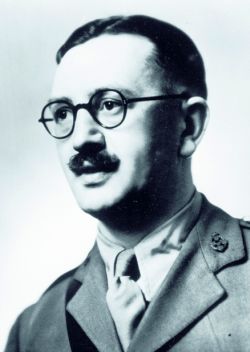
In 1945, at the end of the Second World War, when British, Russian and American forces divided up what remained of defeated Germany, Volkswagen was a still-nascent company, with facilities that had been almost completely destroyed by Allied bombing. One of the main tasks of the Allies was to restart German industry, for which they appointed administrators for each of the factories, which were initially used to repair damaged military vehicles.
Ivan Hirst, a Major in the Royal Electrical and Mechanical Engineers, was placed in charge of Volkswagen, which at that moment was beginning its reconstruction work, using labour from prisoners of war and captured Nazis. Hirst’s appointment at the head of Volkswagen marked the beginning of one of the most curious chapters in automotive history.
Hirst’s mission was to try to get Volkswagen up and running again, although from the very first day his mission took a humanitarian turn towards the German people and former employees of the brand who were out of work and possibly without homes. Long queues of people looking for work gathered at the gates of the reborn Wolfsburg plant, but there were no orders and no vehicles to build, and even if there had been, there were no customers willing to buy a car in post-war Germany.
To address this, Hirst turned to his British compatriots for help. In those days the tasks of the occupying armies were reduced to mere administrative duties, so they needed transport to get around; somehow Hirst’s collaborators managed to find a pre-war Volkswagen Beetle, painted it green and presented the gleaming car at British headquarters, where it was offered as a cheap and reliable transport for the army.
Hirst’s idea produced the expected result. The British Army reasoned that ordering cars from Volkswagen would cost its government nothing, since it would be considered war reparations. Less than six months after the war had ended, Volkswagen already had an order for 20,000 Beetles (Type 51) for the British Army, to which orders from the French, Americans and Russians were later added.
However, not everything was easy for Hirst and his reborn Volkswagen. According to the British, the Beetle proved weak and not robust enough for army tasks. As the factory was under British control, they considered offering it to the Americans and entered into negotiations with Ford; when Ford rejected it, the idea arose of handing it to the French and relocating it to France, which was rejected by French car makers. Fortunately.
Volkswagen had to be German, and so in 1947 Ivan Hirst entrusted the management of Volkswagen to Heinrich Nordhoff, who already had experience running Opel under American control. Two years later, Volkswagen was handed over to the new German federal government with 50,000 Beetles already built and with the foundations laid to begin exporting the Beetle, Hirst’s last project at the head of the brand. The Major of engineers who became CEO of Volkswagen returned to his native England, where he remained until the end of his days, in the year 2000.
Neither Volkswagen nor the Germans forgot the work of Ivan Hirst; he not only prevented the disappearance of Volkswagen, but also gave work to thousands of Germans in those post-war days, in addition to making it possible for the Volkswagen Beetle to come back to life. To this day, the brand awards the Ivan Hirst Prize to young talents in the field of automotive engineering, and there is even a section dedicated to him in the Volkswagen museum in Wolfsburg, alongside one of the first post-war Beetles painted in military green.
Source | Wikipedia, Ivan Hirst website

 The seven finalists for the 2027 European Car of the Year (COTY) are exclusively electric
 Peugeot E-208 GTi: a battery-powered toy that revives the spirit of the 1980s sports cars
 New Lexus ES: luxury grows and goes electric
Deja un comentario