SEAT Ateca 2.0 TDI 150 CV DSG-7 "Marathon" test drive: an Ateca built to get lost in the desert
 Ramiro Mansanet @RamiroMansanet
10 October 2024
8 min.
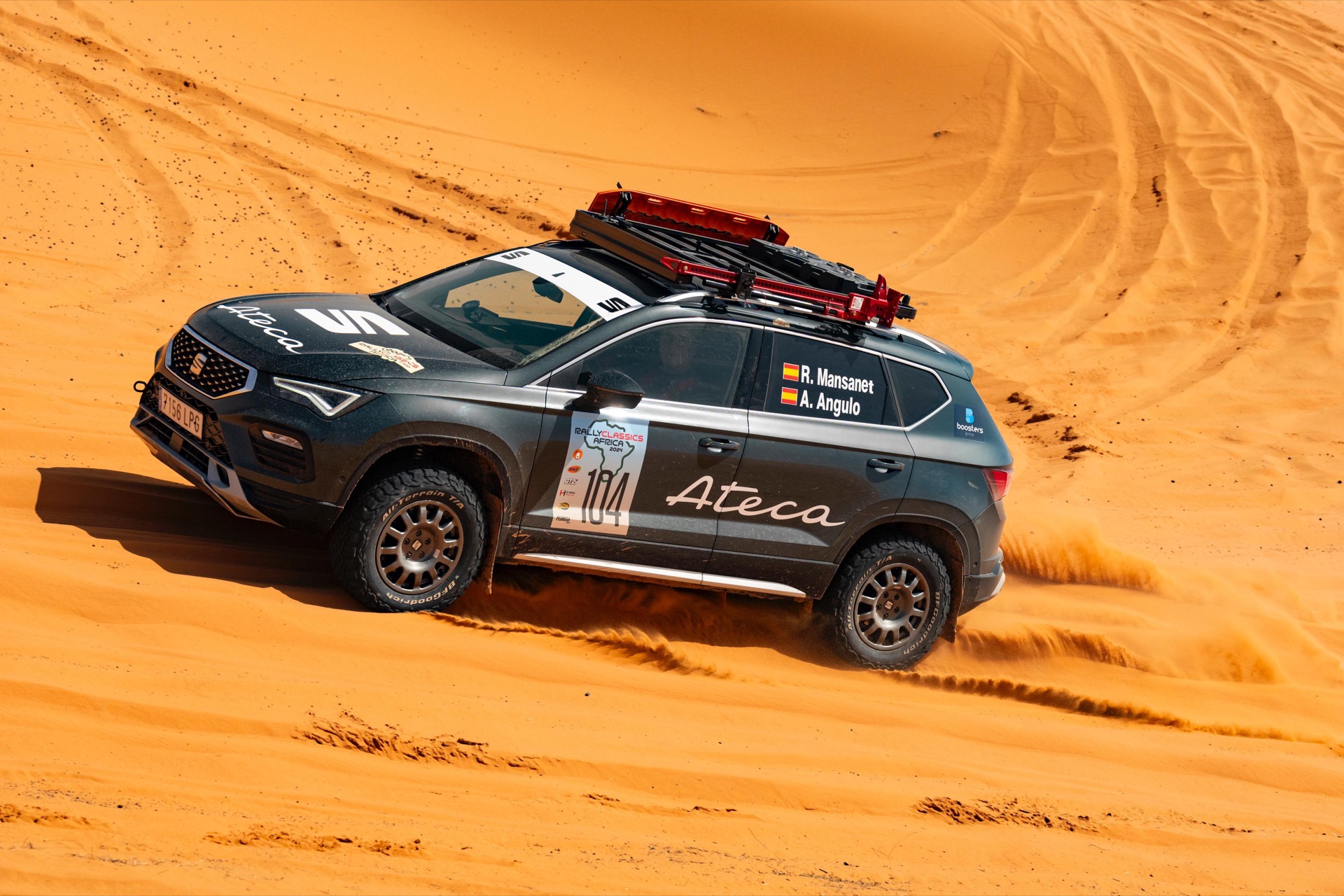
It is a production car, but don’t expect to find the Marathon name on the price list of the SEAT Ateca. After driving it for more than a week over the worst tracks in the Moroccan desert, including the endless dunes starting at Merzouga, I would buy it without hesitation. I never thought an SUV designed to take the kids to school or to enjoy a comfortable weekend road trip could be so incredibly effective against very considerable obstacles.
The “Marathon” name is simply a distinguishing element compared with the ATECA X-Perience and FR models it derives from. A legendary name at SEAT, because it identifies the imposing SEAT Toledo that was designed to compete in major international raids. The SEAT Toledo Marathon was an off-road prototype built on a multitubular structure with a brutal 330 CV engine and four-wheel drive with a lockable central differential and self-locking differentials on both axles. Furthermore, its suspension was revolutionary for its time, with double superimposed wishbones and thirty centimetres of travel. Nothing to do with our production Ateca.
SEAT’s first SUV and a sales benchmark
But let’s return to the Ateca, the model with which SEAT began building its enormous SUV range back in 2016, a car that is a sales benchmark with a cumulative total of more than half a million units sold worldwide and that remains one of the best-selling at this time. A car that, for the average user, has great virtues such as a spacious cabin, versatility of use, an attractive design and, of course, agile, comfortable and also fun dynamic behaviour.
Well, none of that is what we are going to highlight in this test; now we analyse how a car slightly modified by the wizards of SEAT Históricos becomes an almost infallible machine for beating the RallyClassic África, crossing the dunes and conquering the worst tracks of the arid Moroccan desert, with a total of five intense stages and more than a thousand kilometres of navigation between Merzouga and Erfoud, overcoming frightening landscapes such as the dune ridges of the Erg Chebbi and terrain typical of a genuine Rally Dakar.
A legendary Ateca
The SEAT Ateca Marathon is nothing other than a SEAT Ateca TDI 150 CV DSG that anyone can buy at their dealership. The engine is the well-known 150 CV TDI with a DSG dual-clutch automatic gearbox combined with the “4” all-wheel drive, a perfect and genuinely surprising combination given how well it performs in the desert or anywhere else.
Perhaps the most striking thing from the outside is the roof rack designed to carry the sand ladders, an imposing hydraulic jack, the toolbox, a shovel and a few other off-road gadgets. Over the aforementioned thousand kilometres of desert we had to pull the ladders and use the shovel a few times, but that is part of the adventure. Everything else, we didn’t touch. Continuing with the off-road “preparation”, the bodywork has been raised a bit more, 40 mm in total, which rises slightly more due to the profile of the chosen tyres. The springs have been replaced with stiffer ones than the originals and the dampers have been swapped out. Instead of the standard hydraulic dampers, which can show fatigue from overheating after hundreds of kilometres of constant abuse, and to avoid bigger problems, gas dampers with adjustable settings and an expansion reservoir have been fitted, which resolves the matter more than adequately.
Alongside the greater ride height and dampers, a robust sump guard and underbody protection is essential. It wasn’t fully undertray-enclosed, but the engine area was well protected with a large duralumin plate, and there were also some fibreglass skirt-type panels to shield the suspension from stones on the track. The choice of wheels is decisive and greatly helps everything the Ateca Marathon is later capable of doing on the terrain.
The aluminium wheels are spectacular: 16-inch Braid Dakar rims fitted with imposing BF Goodrich All Terrain tyres in Baja specification, 225 mm tread width with a 70 profile, which gains a couple of centimetres of height compared with the original tyre fitment. We carried two spare wheels in the car and, given the demands we placed on the tyres, especially on the stony tracks more than on the dunes, it was easy to imagine we would need to change wheels from time to time, but no. After more than a thousand kilometres under the harshest demands, we saw that the tyres had suffered, they even had a good number of cuts; let’s say they were no longer at their best, but they had more than fulfilled their role, delivering flawless performance throughout, without having to change a wheel during the entire test.
In the dune section the wheels were equally an essential ally. Before starting to cross the sand you had to stop and lower the pressure to one kilo, or 1.1 bar; this way the tyre bulges on contact with the ground and you can climb the dunes more easily, but afterwards, when leaving, the pressure had to be raised again because the risk of puncturing with the stones is very high. The tyres play a fundamental role in an expedition like this.
The Ateca Marathon is an almost infallible machine for beating the RallyClassic África
Inside the cabin everything is also standard, although some interesting changes have been made. The seats have been taken from the sister brand and are comfortable bucket seats, almost like competition ones for their excellent support, and more comfortable than racing seats, which are well padded. The ultra-sporty design allows the fitting of harness-type competition seatbelts, which greatly helps interior comfort, makes you feel safer and is especially good for the co-driver, who can stay well strapped in while reading the roadbook so that jumps or suspension bottoming don’t hurt them if they arrive while they are looking at the notebook or operating the navigation devices.
There is one important thing to bear in mind: the instrument panel has many warning lights lit… this is perhaps the most complex part of the preparation. The electronics that today govern every function of the car have been disabled here. No front or side airbags, which would deploy on one of the landings after the dunes. No traction or stability control, which in the dunes would not let you slide progressively. Needless to say, ADAS and everything else is a hindrance in these circumstances. Only the ABS was kept, and to be honest it was barely noticeable; it worked like a competition ABS.
The Marathon name is a build carried out by SEAT Históricos
A sensational diesel engine: if you could choose another hundred horsepower it would be great, but those 150 CV of pure breeding are enough. The automatic gearbox is for relaxing, and it is the perfect ally both for driving comfort and for how much it helps when overcoming obstacles. It makes the car do better than 90 percent of drivers would. And then there are the paddle shifters, which are not necessary except when crossing the dune crests. There you cannot afford to fail, hesitate or delay applying the throttle, because you could get stuck.
With the paddles, skilfully managing the first three gears, there is always power under the pedal. And then there is the all-wheel drive, which uses a Haldex-type clutch that sends drive to the rear axle depending on the slip of the front axle. The traction capacity is spectacular. The 4Drive all-wheel drive system uses a set of multi-plate clutches located on the rear axle, acting as a self-locking differential. The basis is excellent for the needs of any user, to tackle excursions on tracks and even off them with good assurance; those guarantees are what the mechanics of SEAT Históricos have achieved to complete a genuine Ateca “Marathon”, the Ateca of the desert.
Seat ATECA Marathon – Image gallery
Technical specifications of this car
 Peugeot E-208 GTi: a battery-powered toy that revives the spirit of the 1980s sports cars
 New Lexus ES: luxury grows and goes electric
 First contact with the Dacia Sandero Hybrid 155: power and efficiency from €19,890
Deja un comentario