Ford Mustang Mach-E Electric Cars Tests SUV
Test drive: Ford Mustang Mach-E: 294, 351 or 487 hp? We analyze which is the best option
 Diego G. Moreira
5 September 2024
7 min.
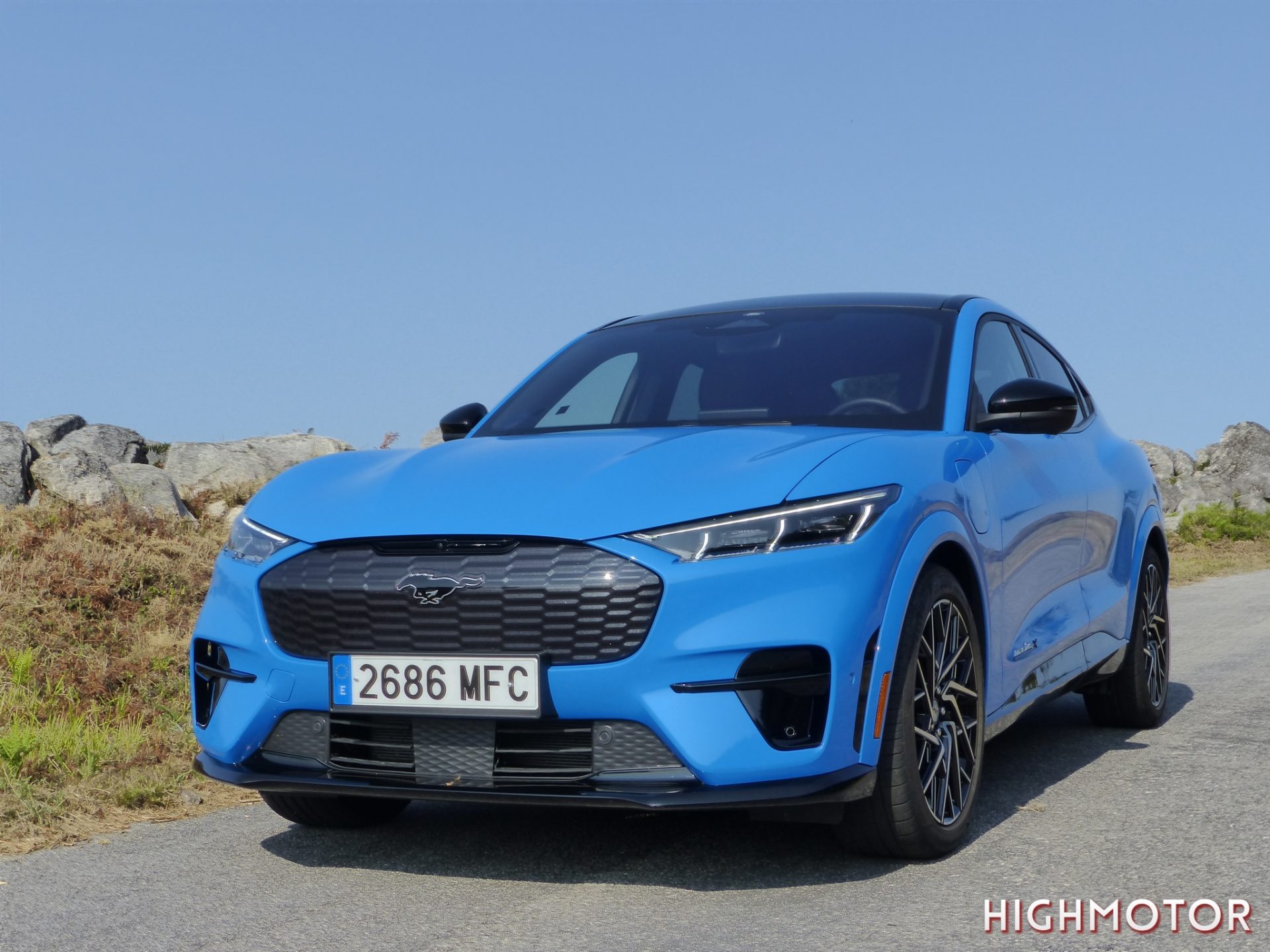
In this test of the Ford Mustang Mach-E, we get behind the wheel and analyze in detail all the versions, including the Mach-E GT with 487 hp
At Highmotor we continue analyzing electric vehicles, from the perspective of whether they are useful for travelling or at least covering a reasonable number of kilometres on motorways. From that perspective, the Ford Mustang Mach-E with its 99 kWh battery that is homologated for almost 600 km of range on the WLTP cycle has seemed very interesting to us.
Given that there are several power and drivetrain versions, we decided to analyze in detail what each Mustang Mach-E offers: 294 hp (rear-wheel drive), 351 hp (all-wheel drive) or the radical Mach-E GT 487 hp (all-wheel drive).
Design: Mustang essence in SUV format
Externally, the Mustang Mach-E wants to evoke the legendary sports car, but from a very different point of view. Its bodywork is eminently SUV, although the design does have nods to the rearing horse. The front end is imposing, with pronounced features, standing out for its fully enclosed grille (typical of electric vehicles).
The side profile is where the SUV touch is most evident, and what especially caught our attention is the absence of handles or door levers, replaced by a button that, when pressed, electrically opens the door (however, opening from the inside is mechanical, using an unusual lever). It is also striking that the front doors have a kind of grab handle to hold the door while the rear ones do not.
The rear uses high lines, again with an SUV feel, and headlights that follow the design of the sports car. The tailgate features electric operation.
When we moved on to the interior, technology is once again the protagonist, particularly through the huge screen (in the style of Tesla) that centralizes all the vehicle’s controls (from the climate control to the multimedia system, including the on-board computer, among others). A second, smaller screen serves as the instrument cluster, though much more minimalist and with little information.
The interior feels spacious, both in the front and rear seats. The driving position is correct, not very high, with comfortable seats with a soft padding that doesn’t show the passing of kilometres, although they don’t offer much lateral support. The front seat adjustment is electric, with a heating function.
The rear seats are wide, with space for feet and head; the only drawback is that they are slightly lower than the front ones. It has air vents and charging sockets for devices.
The build quality is adequate, there are areas on the dashboard made of hard plastic, but the finish of the centre console or the doors is good.
Engine and performance: rear-wheel drive 294 hp or all-wheel drive 351 hp
The Mustang Mach-E is available with several power outputs, with rear-wheel or all-wheel drive. All of this will configure the final range, and I can already tell you that the most balanced version is the one with all-wheel drive and 351 hp.
But let’s start at the beginning: any of the Mach-Es has more than enough power to move this car with ease, and in any configuration it will provide fun behind the wheel. Although it’s true that the all-wheel drive 351 hp version offers the most, at the cost of a slightly higher consumption.
It’s an electric car, American-style, as soon as you press the accelerator pedal, the power is felt and the response is immediate, making it very quick, performing overtaking manoeuvres nimbly, even when loaded.
Handling: raw, fast, but not precise
Both the 294 hp and 351 hp versions have very similar handling, except for the all-wheel drive. It is a fast car, but not a sports car, nor does it aim to be precise in corners, with its inertia, weight and huge tyre profiles being noticeable.
On top of this, there is an ESP that allows a certain play, being rather non-interventionist (a curious detail I have seen in few electric cars), and to which we must get accustomed if we decide to drive in a more dynamic or sporty manner.
The steering feel doesn’t help precision either, being rather artificial, returning to that sensation of having a lot of power but precision limited by dimensions, weight and so on.
Even so, the sporty touch is noticeable, and the all-wheel drive version, in corners, offers an extra dose of traction and immediacy, but also with higher consumption.
Battery, consumption and electric range
When deciding on a Mustang Mach-E, my recommendation is to choose the extended-range 99 kWh battery (gross) since it will offer higher ranges, because consumption is not particularly efficient.
The 294 hp variant is homologated for a range of 600 km, with a consumption of 17 kWh per 100 km, a figure that can be achieved but only in urban settings, since on the road the usual figure is 18–19 kWh per 100 km.
Meanwhile, the all-wheel drive 351 hp variant loses slightly in range, with its homologated consumption rising to 18 kWh per 100 km. On our test route, on the road the figure was closer to 20 kWh per 100 km, although by being careful with the pedal and driving more efficiently it could reach the official figures.
On motorways, on our usual route between Madrid > Vigo > Madrid, the average consumption was 22 kWh for the 294 hp version and 24 kWh for the all-wheel drive 351 hp version.
The average range on motorways exceeds 350 km, while on urban or country roads it can easily exceed 500 km.
As for charging speed, it can charge at up to 150 kW but not beyond 30% of the battery. It is especially slow when charging between 80% and 100%, below 20 kW. Meanwhile, the charging speed approaches 80–100 kW in all other scenarios.
The equipment is very complete as standard. There are three trim levels depending on the version, starting with the basic level linked to the version with the shortest range. The next level is “Premium”, which comes with the versions with greater range or all-wheel drive (and includes everything we could need), and finally there is the GT trim (more focused on sporty aspects, but with comprehensive equipment).
In the intermediate “Premium” trim we tested, the driver assistance systems stand out, with the well-known BlueCruise (under subscription, free for 90 days), which allows driving on motorways with steering assistance without having to keep your hands on the wheel.
The optional items include electric leather seats, the nine-speaker B&O sound system, and the glass panoramic roof.
Ford Mustang Mach-E GT: irrational, brutal, senseless but addictive
I have saved a dedicated section for our test of the Mustang Mach-E GT, because its figures are dizzying. We are talking about an electric car with all-wheel drive, a power output of 487 hp and a torque of 860 Nm that makes it fly from 0 to 100 km/h in just 4.4 seconds.
Is it a rational car? No, without a doubt it is not a rational purchase, it makes no sense at all. Is it recommendable? After our week of testing, I didn’t want to say goodbye to this untameable American.
In short, it is a special car, a cult car, American-style. It is aimed at buyers who want something different from the rest, electric but very radical, one that requires considerable skill behind the wheel, because it is not an easy car: if you decide to squeeze out all its horses, with an ESP that seems asleep until the situation becomes truly uncontrollable, but with acceleration worthy of a beast.
Much of what has already been mentioned about its dynamics applies equally to this Mach-E GT; the main differences lie in its higher consumption, with motorway figures around 28–30 kWh per 100 km if we have to run the air conditioning or if the motorway is not as flat as it should be. Off the motorway, road consumption is around 22–24 kWh per 100 km, which can be adjusted if we are careful with the accelerator pedal.
Photos | Test team
Technical specifications of this car

 The seven finalists for the 2027 European Car of the Year (COTY) are exclusively electric
 Peugeot E-208 GTi: a battery-powered toy that revives the spirit of the 1980s sports cars
 New Lexus ES: luxury grows and goes electric
Deja un comentario