Test drive of the Volkswagen Tiguan 4Motion 2.0 TDI 150 CV DSG Sport, fearless about going off the asphalt
 Diego G. Moreira
2 January 2018
10 min.
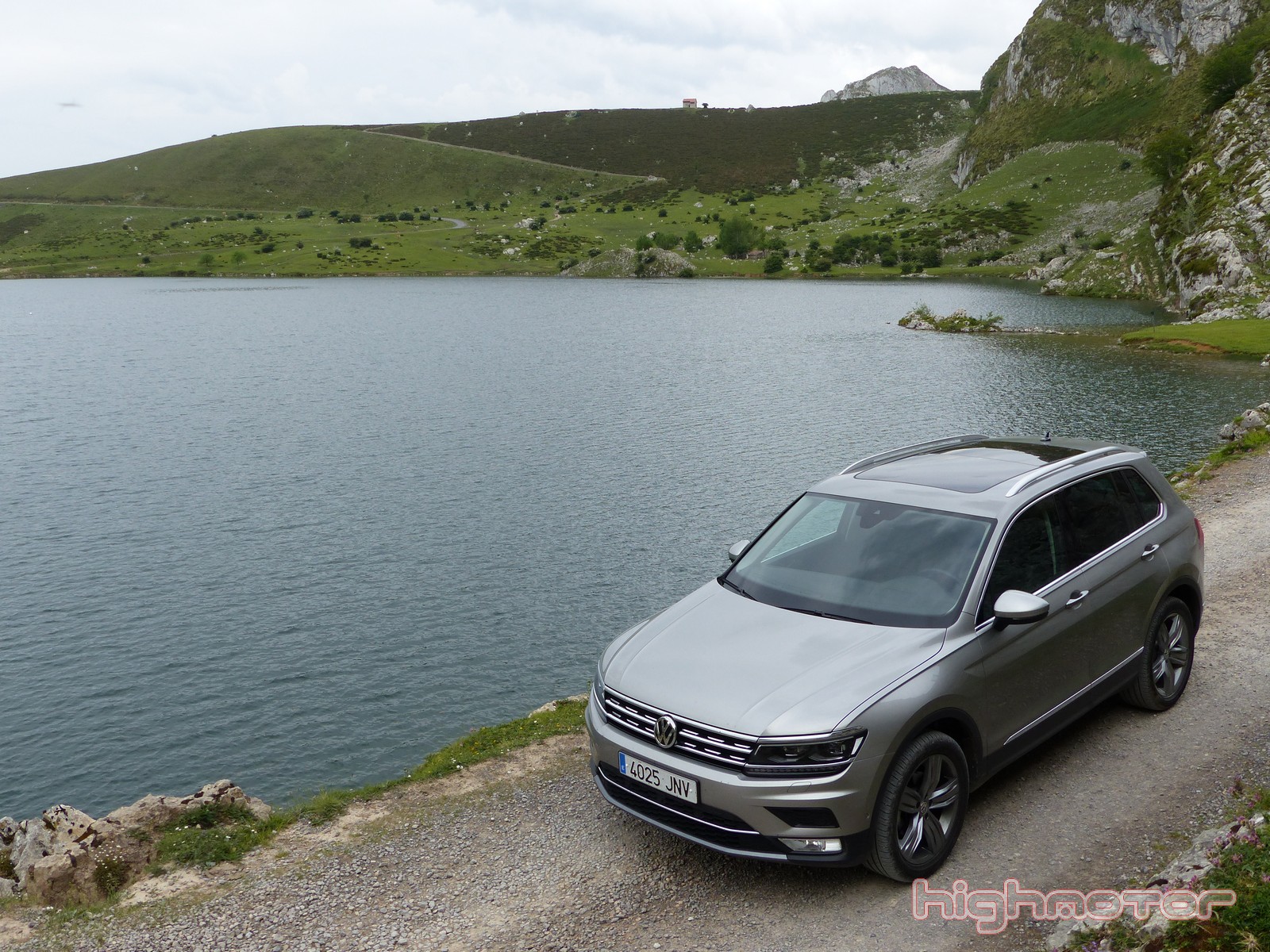
We put the Volkswagen Tiguan with 4Motion all-wheel drive to the test. This is our opinion of this German model equipped with a 2.0 TDI 150 CV DSG diesel engine
One of the most successful SUVs on the market is the Volkswagen Tiguan, a true benchmark among European SUVs. However, we wanted to go one step further and tested the all-wheel-drive version of the VW Tiguan. Is the 4×2 or the 4×4 version more advisable? Is it up to the task off the asphalt?
To find out, we got behind the wheel of the Volkswagen Tiguan 2.0 TDI 150 CV, with DSG automatic gearbox and the 4Motion all-wheel-drive system from the German brand.
Exterior design: straighter shapes in line with the rest of the range
The curved shapes of the first-generation VW Tiguan are gone. With this second generation, and in line with the design of the rest of the Volkswagen models, its entire exterior looks like it was drawn with a ruler and set square. The first thing you notice is a greater sense of robustness; the straight lines give it more off-road character.
At the front, the straight grille and the headlights, with Full LED technology for all lighting functions, stand out, with fully automatic high-beam operation. The fog lights sit in a very low position, rather exposed when driving off the asphalt.
On the side, the pronounced wheel arches remind us that this is a 4×4, as does the lower part of the doors with plastic protectors contrasting with the rest of the paintwork. The 18-inch alloy wheels are fitted with M+S tyres that offer greater confidence off the asphalt. You can also notice the generous ground clearance, more than enough to tackle tracks and even some more demanding terrain.
At the rear, the straight-lined LED lights stand out again. The tailgate has electric operation, and the lower part of the bumper shows the design details typical of an SUV. Finally, the twin exhaust outlets add a sporty touch.
Interior design: simple, quality and spacious
Moving into the Volkswagen Tiguan’s cabin, we find a sober design, with what matters but without clutter. Again straight lines can be seen, but with quality materials, soft-touch plastics and fairly good fit and finish. Only the lower part of the dashboard has a hard plastic finish, which could be improved given the overall quality of the Tiguan.
The instrumentation is fully digital, thanks to the Virtual Cockpit (part of the Sport trim), providing comprehensive information, as well as navigation or multimedia menus. Another standout screen is the central touchscreen, from which navigation and multimedia are controlled; as is customary for the brand, despite being a touchscreen it also has quick-access buttons for the various functions.
The driving position is elevated, comfortable, with a sense of space and good visibility. The seats have electric adjustment and hold the body reasonably well, although since they are black it would be better if they were microperforated to cope better with heat.
In the rear seats the sense of space becomes more evident. The change compared with the previous generation is noticeable, and from the outside you don’t get the impression of the enormous interior space this Tiguan has. There is room for feet and head, even for a tall adult, and it has air vents and seatback trays with cup holders behind the front seats (a feature inherited from MPVs, but very practical).
The rear seats can be adjusted longitudinally, to gain more boot space or more room for rear passengers, another detail few SUVs offer. As well as the numerous storage spaces spread throughout the cabin, from the one at the top of the dashboard to the compartment under the central armrest.
The boot has a maximum capacity of 615 litres (depending on the seat position), has a false floor, and you can even plug a fridge or small appliance into the conventional 230V socket in the boot. Rounding off the practical details is the LED torch that doubles as a light.
Engine and performance: 2.0 TDI 150 CV DSG 4Motion
Talking about the two-litre TDI in the Volkswagen Group is talking about an institution. It is an old acquaintance of the group’s various models that use this engine, which has been renewed over the years (using AdBlue) and now reaches up to 240 CV in its most performance-oriented variants. The 150 CV version we tested is one of the most balanced in the range. At times you miss a few more horses, for example when driving with the car loaded with four adults, but for every other situation it performs correctly.
It responds from just over 1,500 rpm and pulls up to 3,500–4,000 rpm, always fairly smoothly compared with other similar diesel engines. That smoothness is also noticeable in the absence of vibration and even the good interior soundproofing.
Its 340 Nm of torque is more than enough for any situation, from overtaking to off-road use. Paired with the engine is a seven-speed dual-clutch DSG gearbox, a gearbox that stands out for speed and comfort when changing gears. Although it might seem a drawback for 4×4 use, the electronics ensure everything is coordinated when leaving the asphalt; the transmission can even detect that we are on an off-road route or a slope and hold gears more than usual to assist the descent (apart from the hill descent control).
Handling: wherever there is asphalt or wherever there isn’t
Our first impressions of the Tiguan were on the motorway, where it shows its more touring and family-oriented character, being a car that is comfortable, relaxed and spacious for covering miles almost without noticing them. The suspension is tuned for comfort, without excessive body roll, and on country roads or motorways this Volkswagen behaves more like a saloon car.
Even when having to tackle a mountain pass or a more challenging road, it holds its own. It is not a sports car, but its responses are noble and it takes corners with more stability than other SUVs.
It has several driving modes: ECO, Normal, Sport and Individual, as well as the Off-Road and snow modes. In Sport mode the gearbox responds a little more quickly, but it is still an SUV with 150 CV, though the getaway from a standstill stands out.
What really surprised us is the 4×4 capability. At first glance its off-road abilities seem similar to those of other SUVs, but that is an optical illusion. During the test on tracks, we chose a much more demanding route over a completely broken track with rocks in the middle to see how the Tiguan would respond.
The first thing we liked is the ground clearance, which makes it easy to pass almost anywhere without endangering the underbody (which has little plastic protection). When selecting 4×4 mode the electronic traction management is very precise, but it has no low-range gearing, as it is a multi-plate clutch system that distributes power between the front and rear axles.
Even so, when encountering a tricky section where progress is not easy, the electronics gradually manage traction by braking the wheels that lack grip and sending more torque to the others, so that we get out of the situation with barely any reaction time. Other traction systems are slower to react to low-grip situations, which makes getting out harder. In this case Volkswagen has done a good job, and the Tiguan manages to come through terrain more typical of a 4×4 with low range.
During the test it even managed to get through trials without much difficulty. Add to that the automatic management when descending: at that point, without you having to do anything, the car keeps a shorter gear to hold back as much as possible and assist the descent.
Consumption
During the road test, the average consumption ranged between 5.5 and 6 litres, a more than acceptable figure for a vehicle of its size and traction. On the motorway, on our usual Madrid > Vigo > Madrid route, consumption was 6.5 litres per 100 km. In the city the figure rises to 8 litres per 100 km.
Equipment
The VW Tiguan’s equipment is structured across three trim levels: Edition, Advance and Sport. As standard it has multiple airbags, stability control, the “Front Assist” environment monitoring system with city emergency braking, “Lane Assist” lane-keeping assistant, cruise control, 17-inch light-alloy wheels and fatigue detection.
The Advance trim adds: automatic parking assistant, high-beam assistant, colour multifunction display, three-zone climate control, front seats with more adjustments, among other items. And the Sport trim stands out for its specific exterior trim, full-LED headlights, Volkswagen Digital Cockpit, 18-inch alloy wheels, among other elements.
Within the equipment, the quality of the sound system is worth mentioning, which could be better despite having 8 speakers, while the multimedia system, on the other hand, is very complete in its functions and very easy and intuitive to use.
Personal opinion and prices of the Volkswagen Tiguan
The starting price of the Tiguan in Edition trim is 27,310 euros, while the Advance starts at 32,600 euros and the Sport trim rises to 37,120 euros. Our test unit had a price of around 44,000 euros, fully equipped, of course.
The price is precisely the only drawback I can find with the Volkswagen Tiguan, because although most Tiguan buyers opt for front-wheel drive, in its 4Motion version its off-road abilities have nothing to envy from true off-roaders.
Moreover, the Tiguan offers an MPV-like level of interior space and versatility without giving up off-road capability. The engine has modest consumption and more than respectable performance, although if you regularly drive with the car loaded or with more than two occupants, perhaps the 190 CV diesel version is the better choice for a stronger response.
Photos | Highmotor test team


 Kia offers an electric range of 10 models, 50 versions and 400 possible combinations
 The seven finalists for the 2027 European Car of the Year (COTY) are exclusively electric
 Peugeot E-208 GTi: a battery-powered toy that revives the spirit of the 1980s sports cars
Deja un comentario