Golf Volkswagen Compact Sports Cars Tests
Test Volkswagen Golf GTI 8.5: the fastest and most beautiful GTI in history, with 265 CV
 Óscar Sanz
30 April 2025
10 min.
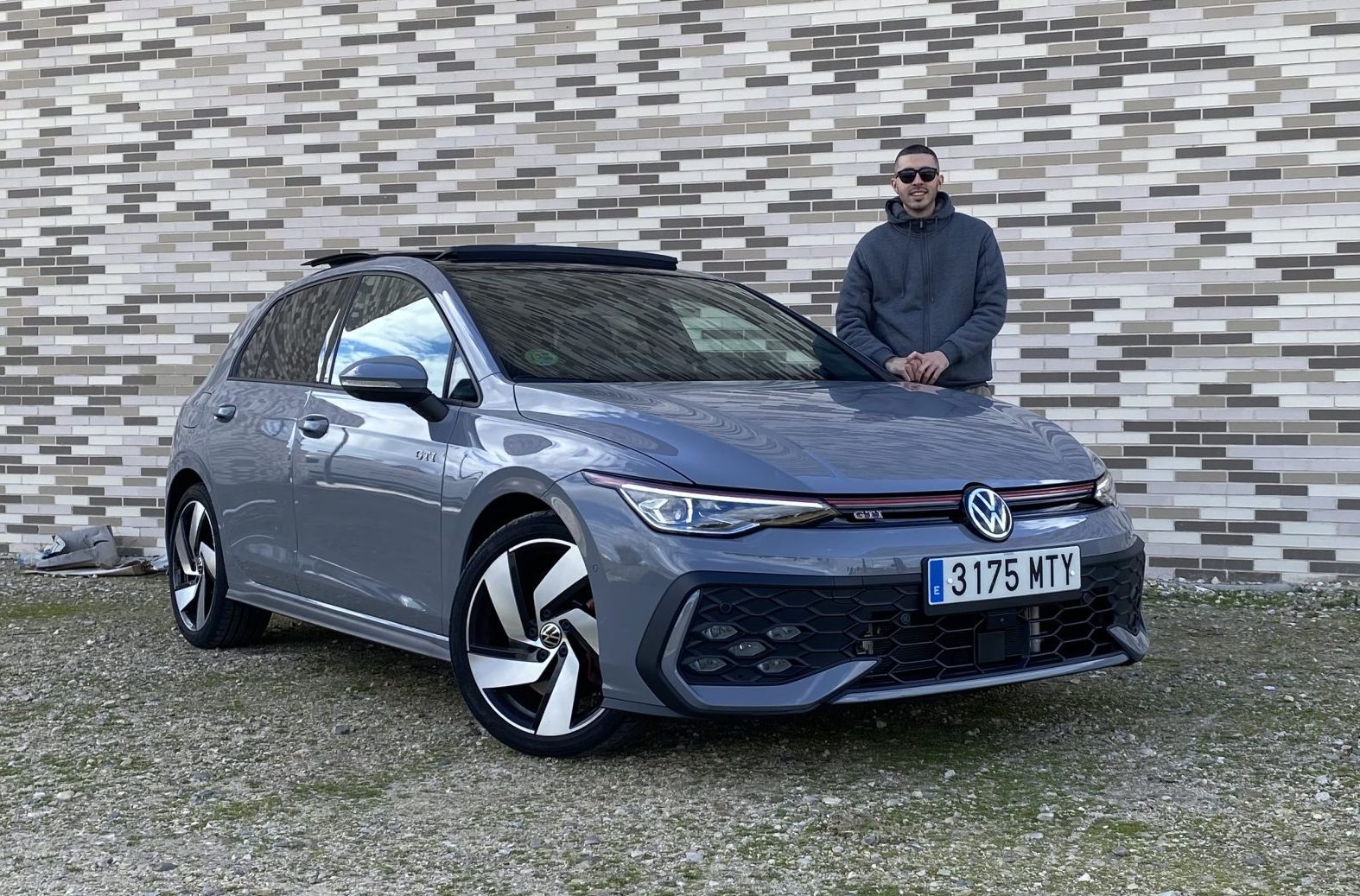
The Golf GTI is renewed in its 8.5 version with 265 horsepower and more technology. Is it still the king of compact sports cars?
Today we are celebrating the 50 years of the Volkswagen Golf, a model that needs no introduction, that has undergone many changes since its birth and that now arrives with a new engine version that makes it the fastest GTI in history, with more technology and a more ergonomic interior. A model that was born in 1975 and that has gone down in history on its own merits.
https://youtu.be/q_NmCQ-MInI
This mid-cycle update comes to return the GTI to its place among the best, with a renewed range of engines, an engine with 25 more horsepower, and a Clubsport version that places it at 300 CV. 37 million Volkswagen Golfs have been built worldwide, of which 770,000 are still on the road in Spain, figures that make it the model with the greatest presence in Spain. But first, let’s take a brief look at its history:
-
Golf GTI I (1976-1984) – The pioneer that started it all: compact, light and with 110 CV, it created the concept of the affordable sports car.
-
Golf GTI II (1984-1991) – The myth grows with more power, new versions such as the 16V with 139 CV and the radical G60 with 160 CV.
-
Golf GTI III (1991-1998) – Bigger and more comfortable, though less radical, it brought the 16V with 150 CV and the first diesel GTI.
-
Golf GTI IV (1998-2004) – The turbo era arrives with the iconic 1.8T, special editions such as the “25 years” with 180 CV and powerful diesel variants.
-
Golf GTI V (2004-2008) – Technological revolution with the 2.0 TFSI of 200 CV, DSG gearbox and editions such as the Edition 30 with 230 CV.
-
Golf GTI VI (2008-2013) – Faster and more efficient with 210 CV and better traction thanks to the XDS differential, while keeping its sporty essence.
-
Golf GTI VII (2013-2020) – Versatile and powerful with up to 230 CV in the Performance version and the option of manual or DSG gearbox.
-
Golf GTI VIII (2020-present) – The most advanced to date: 245 CV, cutting-edge technology and a Clubsport version of up to 300 CV. In 2024, it reaches 265 CV.
The Volkswagen Golf GTI 8.5 has the same dimensions as its predecessor, the 8. It measures 4.29 metres in length, 1.79 metres in width and 1.47 metres in height, with a wheelbase of 2.63 metres that makes it feel very planted and ensures good dynamics. All this with a kerb weight of 1,454 kg.
New design, Matrix LED headlights and illuminated logo
The Golf, apart from being an icon among motoring enthusiasts, has stood out in all its generations for being a very complete car, balanced yet capable of adding an extra sporty touch for those who want to go a step further. In its front design we don’t see many changes compared to the previous generation, but there are several details such as the GTI badges that remain intact over time and that will continue to provide its differentiation and extra sportiness compared to the other versions (as well as commanding respect as it passes).
Compared with the previous version, this 8.5 version has received design changes to the front headlights, which are Matrix LED, and to the bumpers, but the most eye-catching is found in the logo at the end of the bonnet, which now is backlit and gives it a design touch that I, personally, love. We also see the characteristic red mask that has been kept throughout its generations and that links the headlights together. These headlights now illuminate up to 550 metres compared with 220 on the previous version.
On the side, there isn’t much to highlight, just the alloy wheels, which come as standard at 17 inches, while the Clubsport starts with 18-inch wheels. For those seeking extra lightness, optional 19-inch wheels are offered, but on the GTI Clubsport, forged 19-inch wheels are available, weighing only 8 kg each, being 20% lighter than conventional ones.
Otherwise, there are no further design changes except that, at the rear, the GTI badges are now placed right below the logo.
Its boot has 375 litres, figures that are not bad for its segment since, for example, compared with the 381 litres of the Hyundai i30 N, they are very similar, and compared, for example, with the 279 litres of the Focus ST, it is considerably larger. Its segment average is 379 litres. There are also a series of hooks, coat hangers, a 12 V socket, a false floor and even a folding gap for carrying long objects.
Power increased by 20 CV
This GTI version features a four-cylinder 2.0 L engine that delivers 265 CV, 20 CV more than the previous version, rising to 300 CV in the Clubsport version, which is only sold with a 7-speed DSG dual-clutch automatic gearbox. This engine upgrade has also improved its acceleration figures: it is now 0.3 seconds faster in the 0-100 sprint (previously 6.2 and now 5.9). This extra 20 CV has been achieved by extending the maximum rev range, from 6,200 to 6,500 rpm.
An improved interior… with piano black
Its interior doesn’t show major changes either, but the few changes that can be seen have, I assure you, made it more sophisticated, with more technology and, most importantly, more ergonomic (less so because of the piano black finish found across the entire centre console). The finishes remain of good quality and well executed, but they don’t stand out as they should, given the sophistication of German manufacturers and its price. There is a kind of extended leather across the dashboard with some details that attempt to resemble carbon fibre.
The steering wheel is very comfortable and thick, a detail you will appreciate if you have large hands like me. It is a sporty three-spoke wheel, perforated in the middle. The steering is really firm and the driving position is everything one could ask for: low centre of gravity, comfort and driver-oriented technology. On top of all this, we have bucket-style sports seats, which hold very well on twisty roads, and which come as standard upholstered in tartan fabric, with Alcantara side bolsters and a “Scottish-style” fabric design with the characteristic checks. They are also optionally available in Vienna leather upholstery for 2,550 euros. Another interior option is the panoramic glass roof, an extra 1,145 €.
The multimedia screen is 12.9 inches, is very comfortable, is slightly oriented towards the driver and has several shortcuts for quite intuitive use that you will quickly get used to. We have wireless connectivity for our smartphones with Android Auto or Apple CarPlay. From here we can choose the driving mode—from four: Eco, Comfort, Sport and Individual; on the Clubsport there is one more, Special mode, tuned specifically for the Nürburgring circuit – deactivate whichever ADAS we want or even customise various settings.
The instrument cluster is the same as in the previous generation: a 10.2-inch digital display. It is very customisable and there are several display modes, but in the case of the GTI there is a special display mode showing rev-counter and speedometer dials. (Count the various display modes.) These are configurable from the buttons on the steering wheel which, another point in its favour, bring back physical buttons as opposed to the touch-sensitive ones of the previous version.
The fastest GTI in history
If we focus on its dynamics, I can already tell you that it works wonderfully and performs perfectly on twisty, sporty terrain. It has a DSG dual-clutch gearbox that works flawlessly and anticipates exactly what we want to do, but there are also paddle shifters behind the steering wheel if we want to take full control. It is also capable of extending the gears and shifting at just the right moment. Its torque is 370 Nm, which is not short in any driving mode.
Its acceleration, its 370 Nm of torque and its 265 CV allow you to overtake and merge very quickly and safely. All versions are limited to 250 km/h but, additionally, there is an optional package on the GTI Clubsport that removes that limit and allows the car to reach 267 km/h, called the Race Package. The engine sound is one I love, because it is deep and very natural even in ECO driving mode. But if that’s not enough for you, the Race package on the Clubsport adds a considerably louder Akrapovič exhaust.
The braking system has also improved and now features a front limited-slip differential. Both the GTI and the GTI Clubsport now come with this special front differential, which helps improve grip through corners. The system uses an electronically controlled clutch that adjusts its operation according to the selected driving mode. A differential that was previously present only on the GTI Clubsport, but not on the GTI, which used the brakes to prevent the wheels from spinning excessively.
Another detail I really liked is the suspension. It is already quite firm, as is the steering. It copes perfectly with any type of road, there is barely any understeer, and the rear end follows the front with vigour without protest. Moreover, we can add adaptive DCC suspension for an extra €880, which is a marvel. It lets us adjust the suspension across 15 different levels of firmness, and I assure you that at the firmest setting we feel like we’re on a board and the car feels very planted.
And now its consumption. Bear in mind that it is a sports car with 265 CV and a weight of around 1,400 kg. Even so, it allows fairly modest consumption on the road at legal motorway speeds: it uses about 7 L/100 km, but in town at lower speeds consumption rises to as much as 12 L/100 km. These are engines that consume less at higher speeds.
265, 300 or 333 CV?
The most basic Golf with 115 CV starts at €29,100, a good option with fairly modest consumption and more than sufficient performance. The price rises to €39,000 if we choose the R-Line trim with 150 CV. There are also plug-in hybrid versions, with 272 CV, incredible consumption and an electric-mode range of up to 131 km. This GTI version with the 2.0 TSI engine and 265 CV has a starting price of €50,000. The Clubsport with the same engine but 300 CV, has a price of €52,000, and finally the Golf R, with 333 CV, starts at €58,000.
Technical specifications of this car


 Kia offers an electric range of 10 models, 50 versions and 400 possible combinations
 The seven finalists for the 2027 European Car of the Year (COTY) are exclusively electric
 Peugeot E-208 GTi: a battery-powered toy that revives the spirit of the 1980s sports cars
Deja un comentario