The Mercedes-Benz GLE is revitalised through a restyle that modernises its look and technology
 David Lopez @espacionblanco
8 April 2026
4 min.
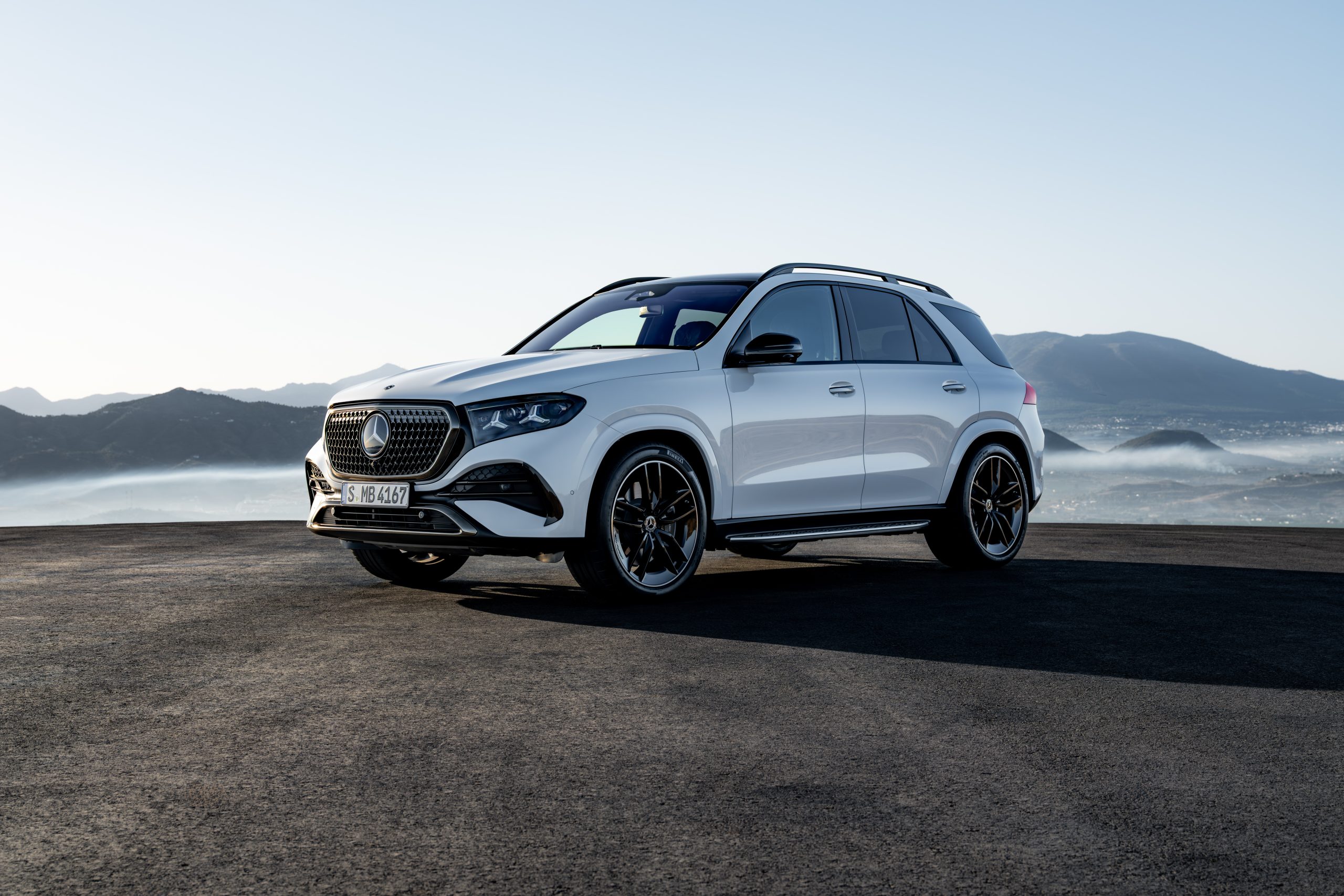
After a three-year cycle on the market, the Mercedes-GLE gets a restyle for both the conventional bodywork and the coupé, along with updated engines
With the M-Class, the Mercedes-Benz began its journey in the premium SUV segment way back in 1997, and it continues today, renamed GLE since 2015. A model that introduced a new generation in early 2023 now faces a restyle that updates its exterior look but especially its interior, where we find the most significant changes, both in design and technology.
Stylistically, the new Mercedes-Benz GLE comes with a new front end that sleeks its look, subtly changing the shape of the large front grille and, more noticeably, the side air intakes, which now have a more pronounced central join between them. Taking advantage of this change, Mercedes has also introduced a new design for the headlights, which include a new light signature through two stars arranged horizontally, accompanied by refined blue ambient lighting. It is worth noting that the new GLE is the first to offer digital light with micro-LED technology, which increases the high-resolution lighting field by around 40% while consuming roughly 50% less than its predecessor.
On the flanks of the new Mercedes-Benz GLE, the most significant changes focus on a new pattern for the side grilles, as well as a new design for the wing mirrors, which incorporate a new high-gloss black mirror base. At the rear, the changes aim to enhance its look through the light cluster, which now, as at the front, incorporates two three-dimensional stars framed in chrome, while both lights are joined by a black trim that also emphasises its width. This does not apply to the coupé version, which opts for a more sporty look. These changes also add two new colours to the palette and three new 20-inch wheel designs.
Looking inside, we see that the new Mercedes-Benz GLE has a modified upper dashboard due to the introduction of the MBUX Superscreen, which in its standard version consists of three 12.3-inch screens. This has meant that the previous square air vents are now oval in the centre and round at the ends. To this we must add new upholstery colours, available depending on the chosen finish, as well as new upholstery patterns, such as the 3D design with elegant moccasin stitching.
Apart from the new design, occupants of the new Mercedes-Benz GLE will benefit from this restyle with a wide range of technologies, such as the MBUX Augmented Reality for navigation, which overlays graphic navigation and traffic information onto live images. According to Mercedes, this will be especially useful in situations such as complex motorway exits or entering a city. They will also enjoy an interior whose sense of spaciousness is now enhanced thanks to the inclusion, as standard equipment, of a panoramic sunroof. And we must not forget a boot offering 630 litres of capacity (up to 825 litres with the rear seats adjusted), expandable to 2,055 litres by folding down the second-row seats in a 40:20:40 split.
Mechanically, the new Mercedes-Benz GLE also brings news in its engines, which, whether diesel or petrol, all feature mild-hybrid technology. On the petrol side, the most powerful option comes from the V8 engine of the GLE 580 4MATIC, with power increasing to 537 CV and maximum torque also rising to 750 Nm, in addition to modifications that prepare it for future emissions regulations. One step below is the six-cylinder petrol corresponding to the GLE 450 4MATIC, whose power remains the same but whose torque increases by 12% to reach 560 Nm. Finally, there is the plug-in hybrid GLE 450e 4MATIC, which builds on the previous six-cylinder, increasing its power by 74 CV over its predecessor and offering a fully electric range of 106 km according to WLTP.
On the diesel side, we have the GLE 350d 4MATIC and the GLE 450d 4MATIC, which for the first time use a six-cylinder diesel engine, and are also equipped with an electrically heated catalytic converter. This means the exhaust system reaches the optimal temperature range from the outset and ensures the temperature stays within the desired range throughout the driving cycle. To this we can add other improvements such as Nanoslide cylinder liners, a technology the brand uses in Formula 1, and high-tech steel pistons with vibrator cooling.

 Peugeot E-208 GTi: a battery-powered toy that revives the spirit of the 1980s sports cars
 New Lexus ES: luxury grows and goes electric
 First contact with the Dacia Sandero Hybrid 155: power and efficiency from €19,890
Deja un comentario