Uber fatal pedestrian crash: could a human driver have avoided it?
 Guillermo Lopez
22 March 2018
6 min.
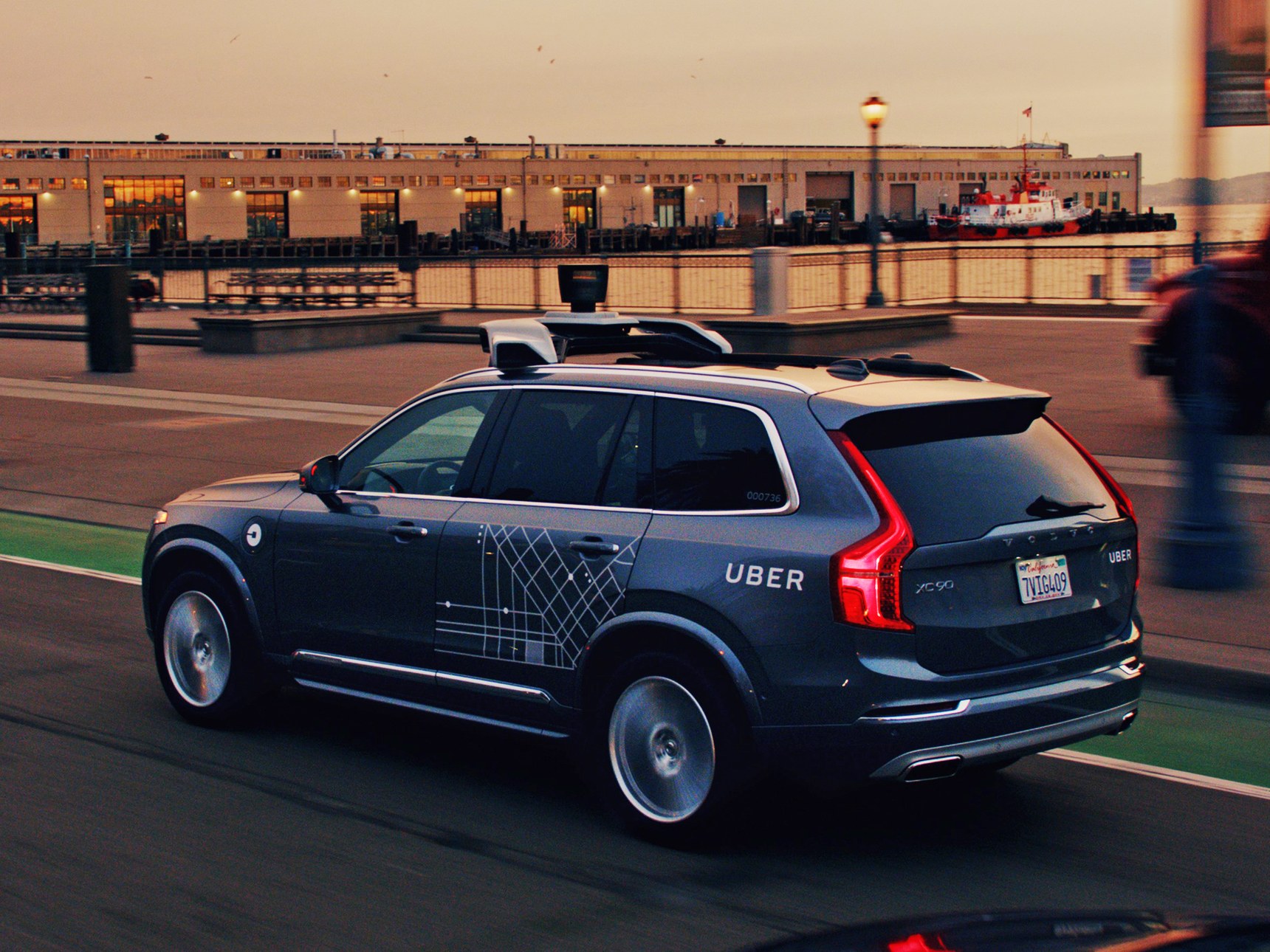
Autonomous driving has come under scrutiny after a woman was struck and killed by a self-driving car. Would a human driver have avoided the accident?
A few days ago an Uber self-driving car struck and killed a cyclist who was crossing a road while pushing her bicycle. The Uber car failed to detect the woman, a “pedestrian-cyclist”, on the roadway, and ran her over, causing her death. As an experimental vehicle under test, the self-driving car had a safety driver seated behind the wheel to “take over” in emergencies that might arise, as required by the regulations that allow these vehicles to drive and be tested on public roads open to traffic.
The accident has caused a major setback for the development of self-driving cars. Several manufacturers have announced the suspension of their public-road testing programs until the causes of the accident are better understood and steps can be taken to prevent a similar one from happening again.
In any case, many voices have spoken out against autonomous driving following the accident. Criticisms that point to the inability of self-driving vehicles to guarantee the safety of their passengers, pedestrians and other road users.
For many others, the fatal accident is nothing more than “the toll”, “another step” in the evolution and development of this technology, whose future adoption is already seen as inevitable.
Regarding the accident, several questions have arisen immediately: Could it have been avoided? Who was responsible? What did the driver on board do to prevent it?… and many others like them. The answer to most of them lies in the video that the Tempe Police, the city where the collision occurred, has made available on its website. It shows the footage recorded by the car’s cameras at the exact moment the fatal incident took place. On one hand, the front camera records the moments leading up to and the instant of the collision. On the other, the onboard camera inside the cabin records the driver’s activity and reactions at the time of the incident.
https://www.youtube.com/watch?v=pO9iRUx5wmM
From what is seen in the video, the only thing that can be asserted is that all parties involved are responsible for what happened that night. Yes, indeed, at night.
From what can be seen in the video, the cyclist is at fault because she crosses the road pushing her bicycle at night in an inappropriate place for doing so. She does it in a completely dark, unlit area, even though there are well-lit areas quite close to her position both before and after, but she chooses the worst spot to cross, where she can barely be seen from a distance. And she cannot be seen well because she is wearing a completely dark jacket and jeans.
On the other hand, she violates traffic rules, which require cyclists and pedestrians using the roadway to use reflective gear and light-colored clothing when travelling on roads, or to cross them as far as possible at designated places, as quickly as possible and in properly lit areas. Judging from the images, the cyclist or bicycle carrier (she is pushing the bike, not riding it) committed all of the irregularities described above.
The cyclist bears part of the blame, but that does not exempt Uber from its share. The vehicle’s systems failed. The radar should have detected the cyclist on the road, as she is a moving obstacle on the carriageway. It is no excuse to say that the cameras could not detect her because she was in the shaded part of the road. The collision occurs on a straight stretch. The vast majority of the detection devices of the self-driving vehicle (infrared, ultrasound, cameras, radar…) should have detected the cyclist, the moving obstacle on the road, with enough advance notice and either stopped the car or carried out an autonomous evasive maneuver.
However, the Uber car continues straight ahead without stopping. We do not know whether it finally reduced its speed in the presence of the cyclist, although this is not seen at any point in the attached video. When we look at the images of the driver, it can be seen that the car’s speed is not excessive —trees and street lamps “pass” the side windows at a normal and even slow pace— which is why the car should have activated its various braking systems with sufficient advance warning to stop and avoid the impact.
The driver’s figure also shows no sign of the car braking sharply, since the driver does not lurch forward at any point, although a reaction on his part can be seen at the moment of the collision. This would indicate that either the car’s detection elements failed, or the instructions given based on the information they captured were not appropriate. That is something the investigation will have to clarify.
And finally there is the driver of the car. His job is to monitor the road to prevent precisely this kind of situation, but he spends almost more time looking at the system screen than at the road ahead. Given how long the cyclist remains visible to the camera, we could say that any action by the driver would not have been the correct one, especially considering that his hands are not gripping the steering wheel while driving, which makes an instinctive reaction on his part to avoid the accident impossible. In fact, he does react, but the car keeps its linear direction at all times, which indicates that he did not perform any evasive maneuver and did not even attempt one.
In any case, would you have been able to avoid the collision? Should the car’s detection systems have prevented it? Who is responsible for the accident? Will it be possible to avoid this type of situation in the future? These are still some of the many questions that autonomous driving should be able to answer before its use becomes widespread.


 The seven finalists for the 2027 European Car of the Year (COTY) are exclusively electric
 Peugeot E-208 GTi: a battery-powered toy that revives the spirit of the 1980s sports cars
 New Lexus ES: luxury grows and goes electric
Deja un comentario