What was the "Procon-Ten" safety system of Audi, and how did it work?
 David Lopez @espacionblanco
9 July 2018
3 min.
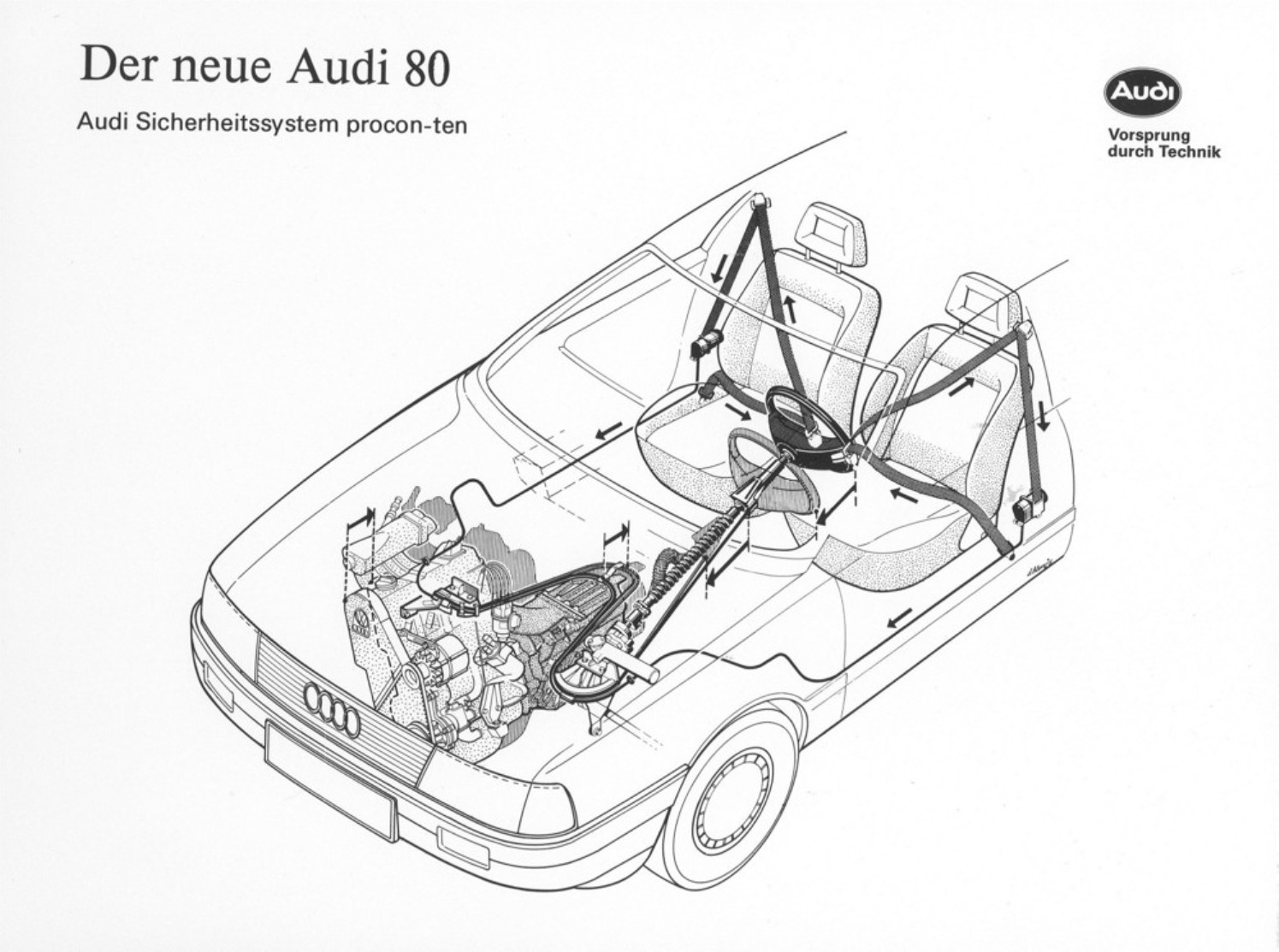
Despite being a leading brand in safety, Audi did not adopt the airbag as a standard system until 1994, as until then it relied on its Procon-Ten patent
Nowadays, when we decide to buy a new car, we hardly focus on the basic safety features it includes, mainly because we already take for granted that elements such as airbags or ABS come as standard on 99% of vehicles, if not 100%. What we now look at is whether they include, or can fit, some of the available driver assistance systems that also protect us and others, such as lane departure warning, blind spot monitoring…
But there was a time, not so long ago, when it was novel for brands and certain models to include something we now consider natural, such as airbags, ABS or even mechanical features like turbocharging or fuel injection. That is why in the 1980s and 1990s almost all vehicles displayed badges on their rear windows to showcase the technology they carried, with words such as Turbo, ABS, Injection, Quattro and… Procon-Ten.
Procon-Ten? That’s right, and although you may not recognise it, you have probably seen it many times (depending on your age too) on the rear windows of Audi’s 100 and 200 models, and later on the Audi 80 and 90. During the years these models were on sale, airbags were also being fitted to more and more vehicles, but Audi, despite being one of the main German and European manufacturers, did not do so until 1994, when it began to fit airbags as standard.
While the rest of the manufacturers and its main German competitors were fitting airbags, Audi sold these models with Procon-Ten technology, an ingenious and effective system that performed the same function as the airbag in a different way. As you know, in a frontal collision the engine generally moves towards the cabin, so Audi’s engineers thought this movement could be harnessed to install steel cables which, together with pulleys, pulled back the steering wheel and tensioned the seat belts, thus preventing injuries caused by the head striking the steering wheel.
The Procon-Ten system proved to be effective, even more than the engineers had anticipated at first, since Audi mounted its engines longitudinally and, moreover, very close to the front bumper. But after it was first fitted in 1986 to the Audi 100 and 200 with V8 engines, the Procon-Ten system was finally discontinued in 1994 when the airbag took over as its replacement, because it turned out to be an excessively heavy system, although to this day Audi still holds the trademark for Procon-Ten, so who knows whether we will see it on a Audi again in the future.
Below you can watch a video that begins with the commercial for the Procon-Ten system, followed by crash tests evaluating how it performed. The audio is in English, but you will have no trouble judging the Procon-Ten system for yourselves.
https://youtu.be/6JX_CFlFZ0w


 Peugeot E-208 GTi: a battery-powered toy that revives the spirit of the 1980s sports cars
 New Lexus ES: luxury grows and goes electric
 First contact with the Dacia Sandero Hybrid 155: power and efficiency from €19,890
Deja un comentario