Why does the Aston Martin Cygnet exist?
 Fernando Alvarez
24 May 2011
2 min.
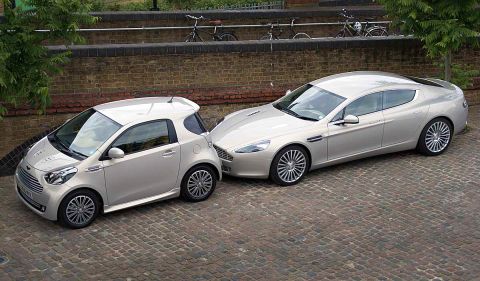
While reading a few things at random, I came across an article published in El Mundo about a first drive in London of the Aston Martin Cygnet. The article is completely undecided about whether the Cygnet impressed them or not. But there are some things about the Cygnet that don’t quite add up for me.
What is expected of Aston Martin is that, besides building sports cars, it can venture into other segments. The problem is that the Cygnet is neither a creation of Aston Martin, nor is it an affordable mini-car. At nearly 42,000 euros in Spain, once you add the automatic gearbox, the experience amounts to driving a Toyota iQ with a steering wheel bearing the Aston Martin logo.
And the truth is that it is exactly the same car, with a few electronic variations that don’t even serve to manage the engine, but rather Aston’s own navigation system, plus the grille.
Thankfully, Aston Martin has another goal in mind, and it seems to care little about the Cygnet. The raison d’être of the Cygnet has been to homologate a car with emissions that fall within the limits the EU will impose in 2012. Other manufacturers such as Ferrari or Porsche belong to automotive groups that can offset the high emissions of their sports cars with small models from sister brands. Aston Martin is not part of any automotive group, so it must create a model that helps balance the average emissions of its other sports cars (a V8 Vantage emits 328 g/km and the Cygnet 116 g/km).
Time will tell whether hastily copying a mass-produced Japanese model such as the iQ will dent the aristocratic Aston Martin, which still uses some artisanal production processes. Add to that the brand’s image and the prestige earned over the years.
Source and photo | El Mundo


 Peugeot E-208 GTi: a battery-powered toy that revives the spirit of the 1980s sports cars
 New Lexus ES: luxury grows and goes electric
 First contact with the Dacia Sandero Hybrid 155: power and efficiency from €19,890
Deja un comentario